Prisms: base area × height Plus
This application is part of Plus
Plus opens all applications: € 4,99 per month or € 19,90 per year. Log in to your account; no account yet? Make a free one first, then you can look at Plus.
Are you a teacher? Teacher login
Your own teacher subscription already includes every application, Plus included — there is nothing extra to buy.
What this application teaches
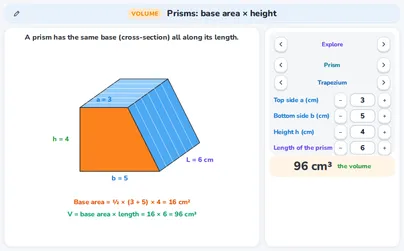
- I know a prism has the same cross-section (the base) all along its length.
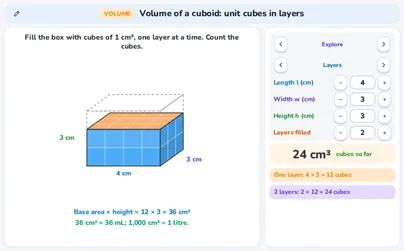
- I can find the base area of a triangle, a trapezium, an L-shape and a rectangle, and the volume V = base area × length.
- I can see the volume grow slice by slice: every slice has the same volume as the base area.
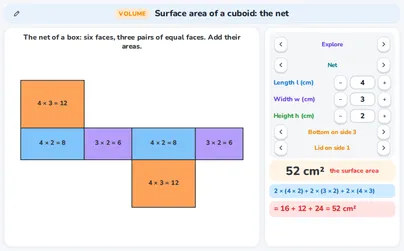
- I can use the net of a prism (two bases and one strip) to find the surface area: A = 2 × base area + perimeter × length.
- I can find the length, or a side of the base, from the volume.
- I write the unit: cm³ for volume and cm² for surface area.
Fits these school years
IB (MYP, Diploma): MYP 1, MYP 2, MYP 3, MYP 4, MYP 5
Cambridge International: Primary, stage 6, Lower Secondary, stage 7, Lower Secondary, stage 8, Lower Secondary, stage 9, IGCSE
Netherlands: Groep 8, Year 2, Vmbo bb (years 3-4), Vmbo kb (years 3-4), Vmbo gt (years 3-4), Vwo · Mathematics C, Year 3 (havo, vwo), Havo (all mathematics courses)
Türkiye (MEB): Year 7 (MEB), Year 8 (MEB), Year 10 (MEB)
England (GCSE, A Level): Year 6, Year 7, Year 8, Year 9, Year 10 (GCSE), Year 11 (GCSE)
USA (Common Core): Grade 6, Grade 7, Grade 8, Geometry