The Poisson distribution
There is no application for this outcome yet. It is taught as classroom work.
Syllabus: p. 37
The Poisson distribution
There is no application for this outcome yet. It is taught as classroom work.
Syllabus: p. 37
The Poisson distribution
There is no application for this outcome yet. It is taught as classroom work.
Syllabus: p. 37
The Poisson distribution
There is no application for this outcome yet. It is taught as classroom work.
Syllabus: p. 37
The Poisson distribution
There is no application for this outcome yet. It is taught as classroom work.
Syllabus: p. 37
The Poisson distribution
There is no application for this outcome yet. It is taught as classroom work.
Syllabus: p. 37
Linear combinations of random variables
The rest is completed as classroom work.
Syllabus: p. 37
Continuous random variables
There is no application for this outcome yet. It is taught as classroom work.
Syllabus: p. 38
Continuous random variables
There is no application for this outcome yet. It is taught as classroom work.
Syllabus: p. 38
Sampling and estimation
Syllabus: p. 38
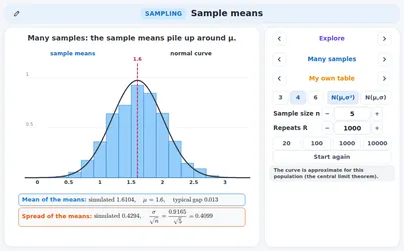
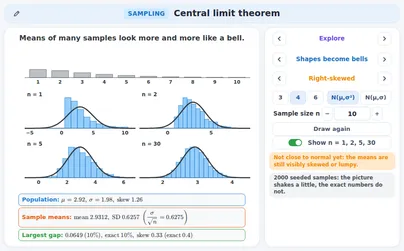
Sampling and estimation
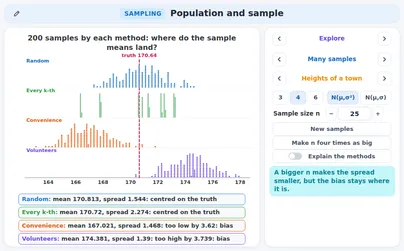 ExplorePopulation and sample: sample, population and biasOpen
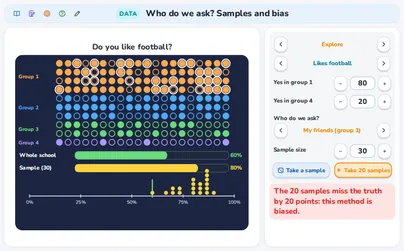 ExploreWho do we ask? Samples and biasAsk a school of 200 pupils with different plans, take samples and compare them with the whole school.Open
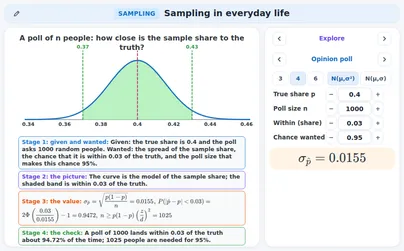 Everyday lifeSampling in everyday lifeFour workbenches with your own numbers: an opinion poll, bags of flour, journey times and a lab measurement.Open
Syllabus: p. 38
Sampling and estimation
Syllabus: p. 38
Sampling and estimation
Syllabus: p. 38
Sampling and estimation
Syllabus: p. 38
Sampling and estimation
Syllabus: p. 38
Sampling and estimation
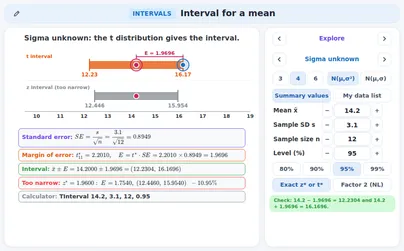 ExploreInterval for a mean: z, t and matched pairsOpen
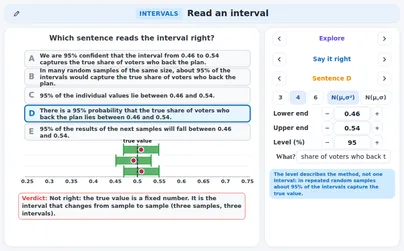 ExploreRead an interval: say it rightThree tabs about reading an interval: five sentences to choose from, claims against the interval, and two overlapping intervals.Open
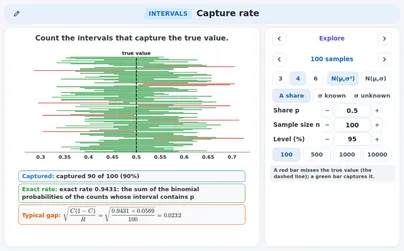 ExploreCapture rate: what 95% confident meansOpen
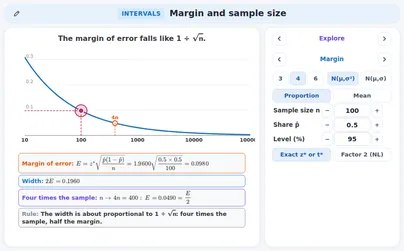 ExploreMargin and sample sizeOpen
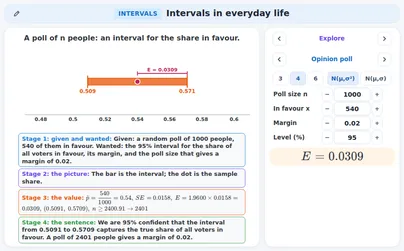 Everyday lifeIntervals in everyday lifeFour workbenches with your own numbers: an opinion poll, a lab measurement, a factory check and delivery times.Open
Syllabus: p. 38
Sampling and estimation
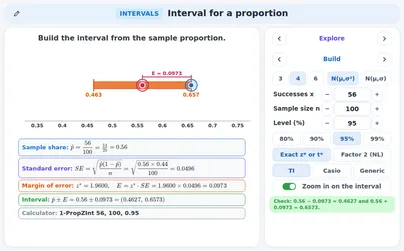 ExploreInterval for a proportion: margin of error and conditionsThree tabs about the interval for a proportion: build it from your own numbers, check its conditions and write the four-step answer.OpenExploreMargin and sample sizeOpenEveryday lifeIntervals in everyday lifeFour workbenches with your own numbers: an opinion poll, a lab measurement, a factory check and delivery times.OpenExploreCapture rate: what 95% confident meansOpen
Syllabus: p. 38
Hypothesis tests
Syllabus: p. 39
Hypothesis tests
Syllabus: p. 39
Hypothesis tests
Syllabus: p. 39
Hypothesis tests
Syllabus: p. 39
Hypothesis tests
Applications cover part of the scope of this outcome; the rest is completed as classroom work.
Syllabus: p. 39