
Applications outside the AA HL topics
These applications are tagged for AA HL, but not matched with any topic of the AA HL list (they may match a topic of the other level). You can still use them. They are grouped by group and subgroup.
Area under a curve5
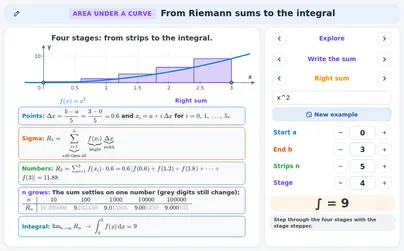 From Riemann sums to the integralFour stages take a Riemann sum from strips to the integral: the points, the sum in sigma notation, the sum with your own numbers and the limit written as an integral.Open
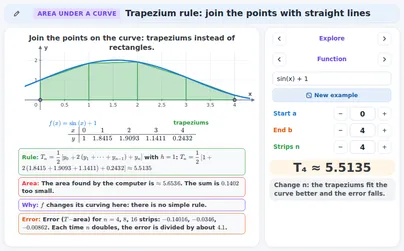 Trapezium rule: join the points with straight linesType a function and see the trapezia, the table of ordinates and the rule written with your numbers, with the exact area and the error.Open
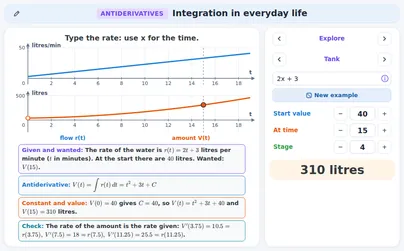
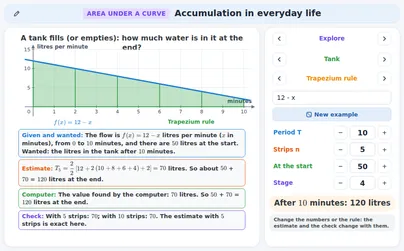 Accumulation in everyday lifeFive workbenches with a rate you type and your own numbers: a tank, electricity with a price, a journey, speed readings from a table and the visitors of a shop.Open
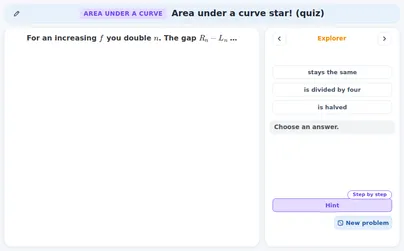 Area under a curve star! (quiz) QuizEndless practice with a score on the topic ‘Area under a curve’.Open
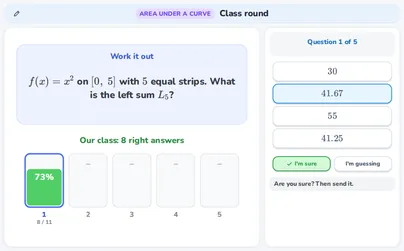 Class round: the whole class at once Class roundFive questions for the whole class at once: definitions, rules, true or myth, and sums.Open
Derivative toolkit and increment diagrams2
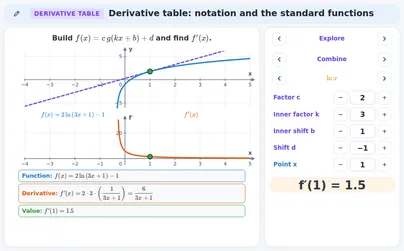 Derivative table: notation and the standard functionsThe derivative of the seven standard functions: notation, rule, graph and a check by a very small step.Open
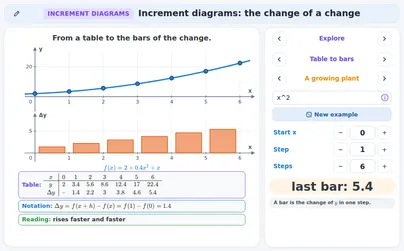 Increment diagrams: the change of a changeDraw the graph of y with a bar for the change in every step, for real situations and your own formula, and read how y changes.Open
Limits and continuity2
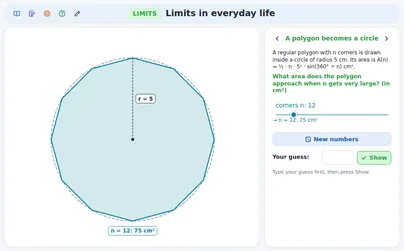
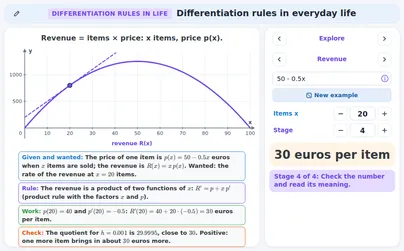
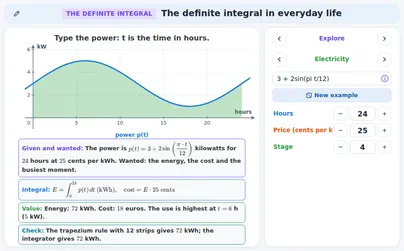
Special equations and inequalities, parameters and moving points6
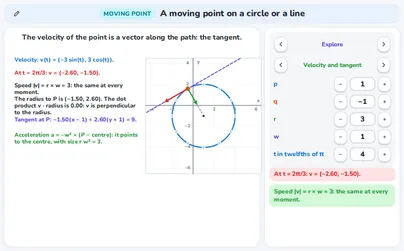 A moving point on a circle or a lineA point moving on a circle or a line given by x(t) and y(t): its position, the equation of the path, the velocity vector and the tangent line, and where a line path meets a circle.Open
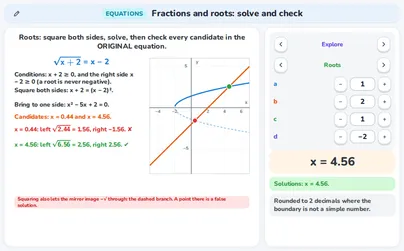 Fractions, roots and the checkLearn to solve equations with a fraction or a root and to check every candidate, in 3 forms with steppers and in your own equation.Open
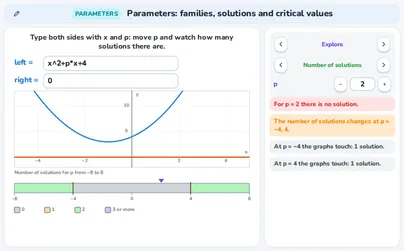 Parameters: families, solutions and critical valuesLearn to work with a parameter: a family of graphs, the number of solutions and the critical values, and the solution written as a formula in p.Open
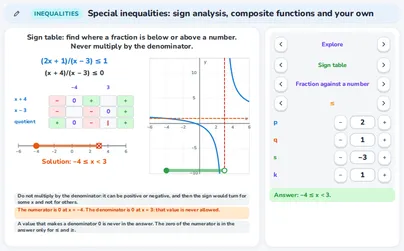 Special inequalities: sign analysis, composite functions and your ownLearn to solve inequalities with a fraction, with a composite function and of your own with a sign table and a number line.Open
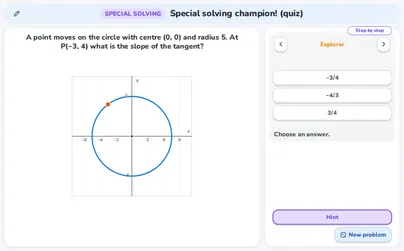 Special solving champion! (quiz) QuizEndless practice with a score on the topic ‘Special equations and inequalities, parameters and moving points’.Open
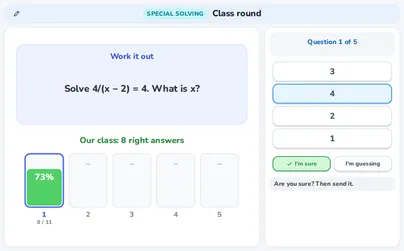 Class round: the whole class at once Class roundFive questions for the whole class at once: definitions, rules, true or myth, and sums.Open
Absolute value and piecewise5
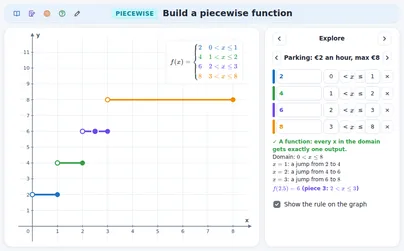 Build a piecewise functionPiecewise functions: build your own.Open
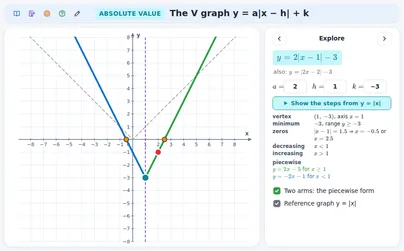 The V graph y = a|x − h| + kThe V graph y = a|x − h| + k starts from the reference graph y = |x|: multiply by a (steeper, flatter or upside down), move h to the right and k up.Open
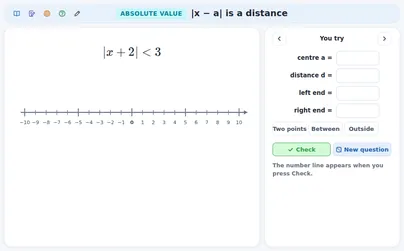 |x − a| is a distance|x − a| is a distance.Open
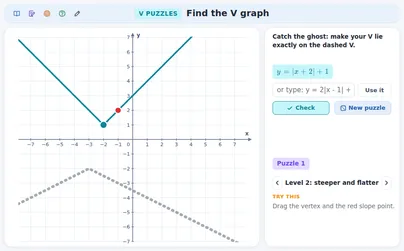 V puzzles: ghosts and descriptionsV puzzles: a game with two kinds of puzzle.Open
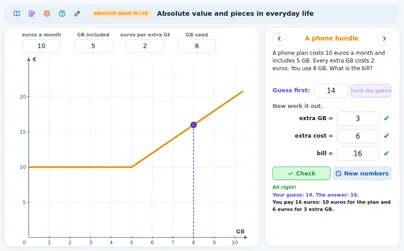 Absolute value and pieces in everyday lifeAbsolute value and pieces in everyday life: four situations with your own numbers: a tolerance (a bolt may be at most t mm off), a phone bundle (a price including some GB, then a price per extra GB), parking (a price per started hour with a maximum a day) and income tax in three brackets.Open
Exponential functions7
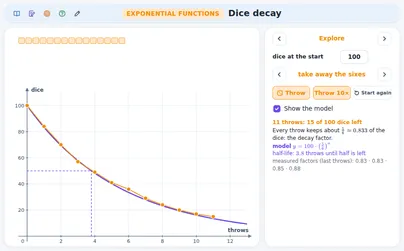 Dice decay: a real experimentA real experiment: throw N dice, take away the dice that show a six (or two or three faces) and throw the rest again.Open
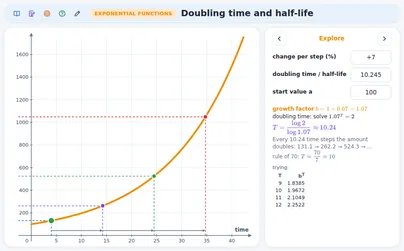 Doubling time and half-lifeDoubling time and half-life: type a percentage or the doubling time itself.Open
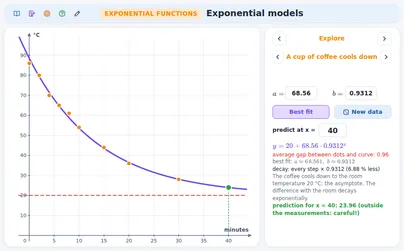 Exponential models: fit the dataExponential models: measurements of bacteria, a medicine in the blood or a cooling cup of coffee (or your own data).Open
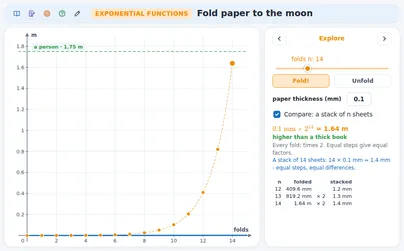 Fold paper to the moonFold a sheet of paper again and again: every fold doubles the thickness.Open
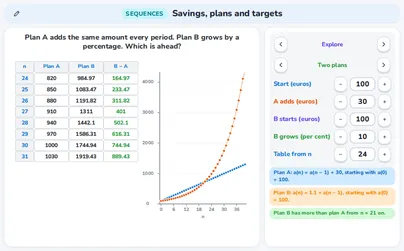
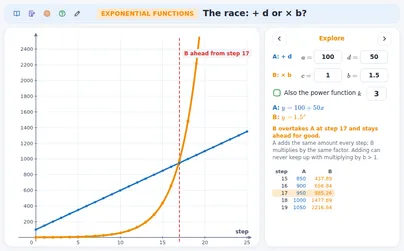 The race: linear against exponentialThe race: plan A adds d every step, plan B multiplies by b every step.Open
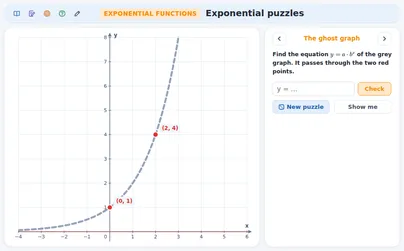 Exponential puzzlesExponential puzzles: a game with four puzzle types.Open
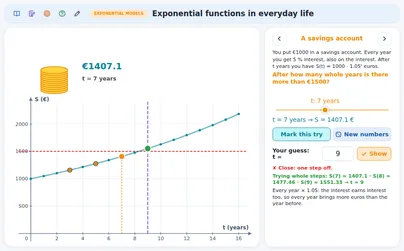 Exponential functions in everyday lifeExponential functions in everyday life: a savings account, a phone that loses value, a medicine in the blood and followers online.Open
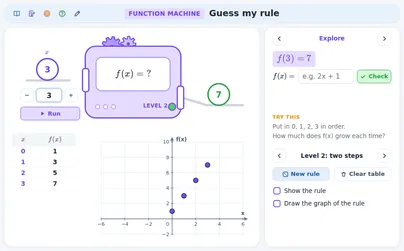
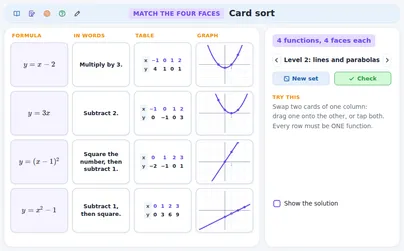
Linear functions4
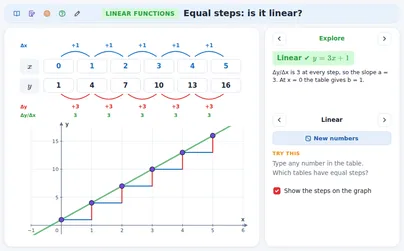 Equal steps: is the table linear?Equal steps: type a table and the application shows the steps Δx, Δy and Δy/Δx, and a staircase on the graph.Open
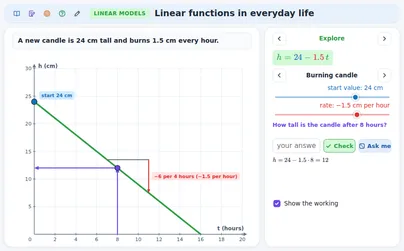 Linear functions in everyday lifeLinear models: a real situation as y = start value + rate × x.Open
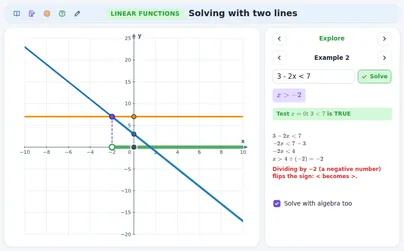 Solving equations and inequalities with linesSolving with two lines: type an equation or inequality (2x + 1 < x + 3).Open
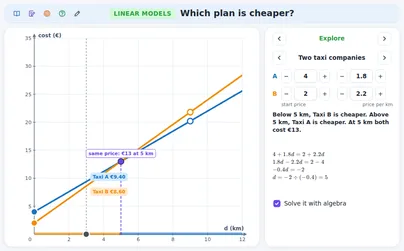 Which plan is cheaper?Which plan is cheaper?Open
Logarithms4
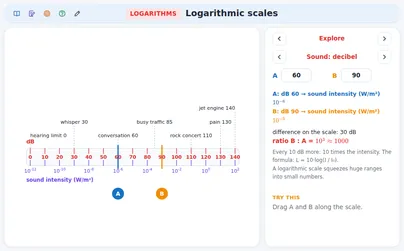 Logarithmic scales: pH, decibel, RichterOn a logarithmic scale the top line goes in equal steps and the real quantity underneath goes in powers of ten.Open
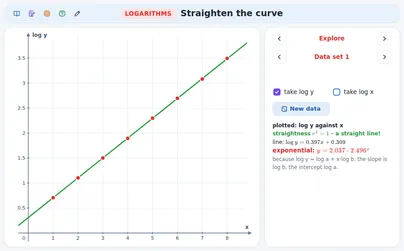 Straighten the curve with logarithmsMeasurements lie on a curve.Open
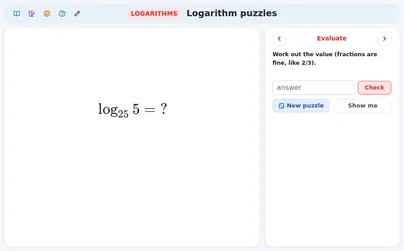 Logarithm puzzlesLogarithm puzzles: a game with four puzzle types.Open
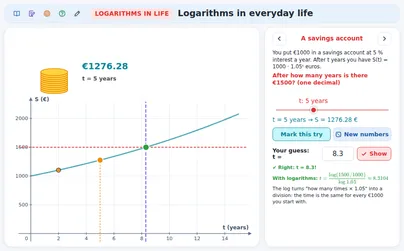 Logarithms in everyday lifeFour everyday situations where the question goes backwards: when is the money at the target, when is less than a target of medicine left, how many people make the noise, how many times must you dilute.Open
Polynomial functions2
Quadratic functions4
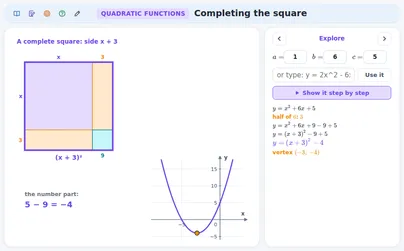 Completing the square with a picturex² + bx is a square and a strip; cut the strip in two halves and a corner (b ÷ 2)² is missing.Open
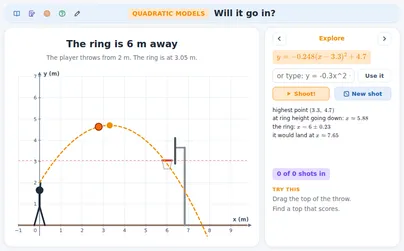 Will it go in? A basketball parabolaThe path of the ball is a parabola from the player's hands.Open
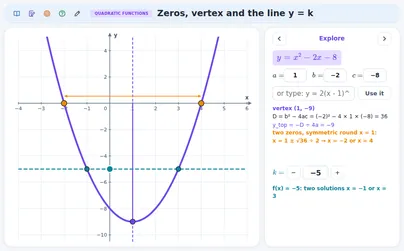 Zeros of a parabola: the graph viewThe zeros lie symmetric round the axis, the vertex is at height −D ÷ 4a, and the line y = k shows the solutions of f(x) = k.Open
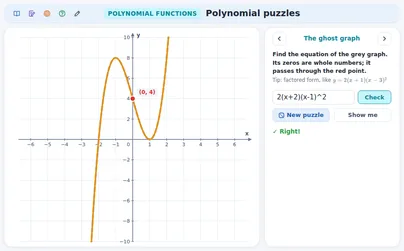
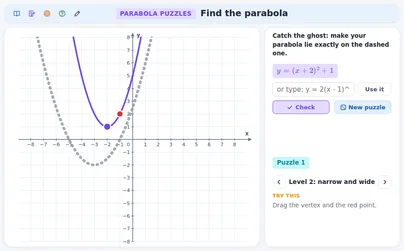 Parabola puzzles: ghosts and descriptionsA game: make your parabola lie on a dashed ghost, or build the parabola of a description (vertex and point, zeros and point, three points).Open
Square root and rational functions3
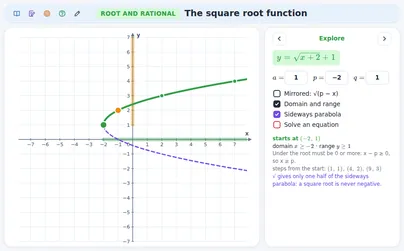 The square root function y = a√(x − p) + qThe square root function y = a√(x − p) + q: the graph starts at (p, q) and a square root is never negative.Open
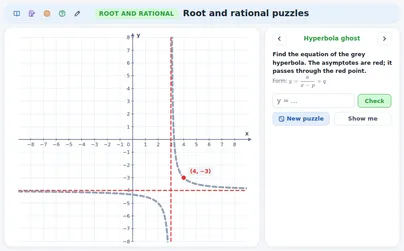 Root and rational puzzlesRoot and rational puzzles: a game with four puzzle types.Open
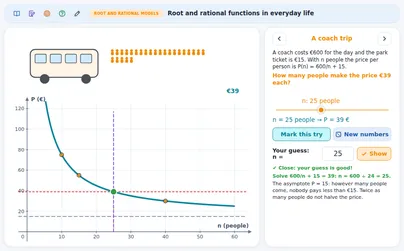 Root and rational functions in everyday lifeFour everyday scenes with a root or a fraction in the model (a shared coach trip, juice, a pendulum, the horizon) and what an asymptote means.Open
Transforming graphs3
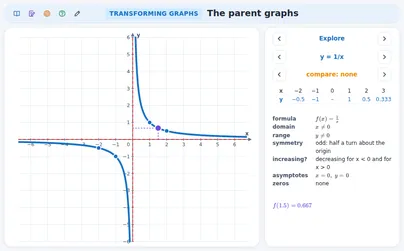 The parent graphsThe parent graphs y = x, x², x³, √x, 1/x, |x| and 2ˣ: the starting point of every transformation.Open
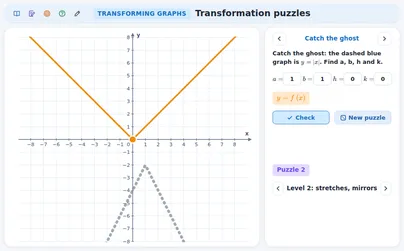 Transformation puzzlesTransformation puzzles: a game with three levels (moves; stretches and mirrors; everything).Open
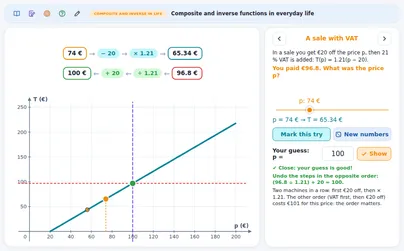
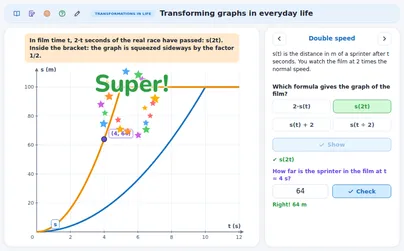 Transforming graphs in everyday lifeMove, stretch and mirror a graph in six everyday situations (a later bus, a booking fee, a film at double speed, a sale) and read values of the new graph.Open
Networks: parts, routes and weights3
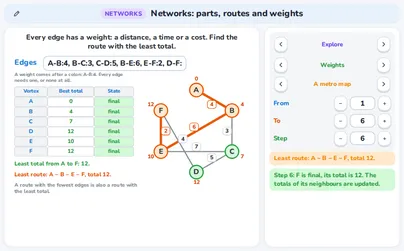 Networks: parts, routes and weightsLearn to read and use networks: vertices and edges, degrees and parts, routes and their weights, in your own network or in one of 4 situations.Open
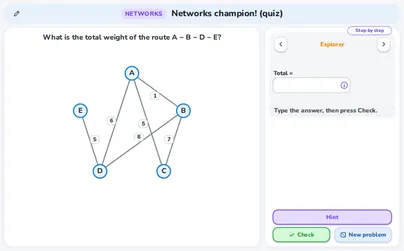 Networks champion! (quiz) QuizEndless practice with a score on the topic ‘Networks: parts, routes and weights’.Open
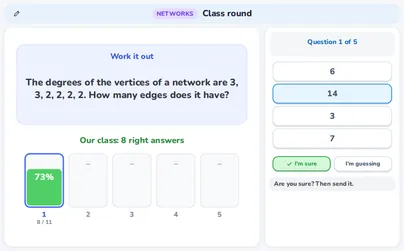 Class round: the whole class at once Class roundFive questions for the whole class at once: definitions, rules, true or myth, and sums.Open
Surds and standard form4
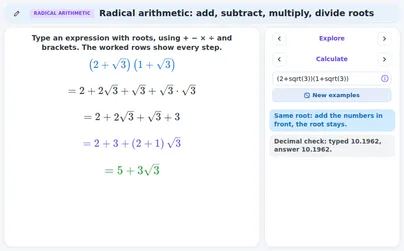 Radical arithmetic: add, subtract, multiply and divide rootsType any expression with roots and watch the working: roots simplified, brackets multiplied out, like roots collected.Open
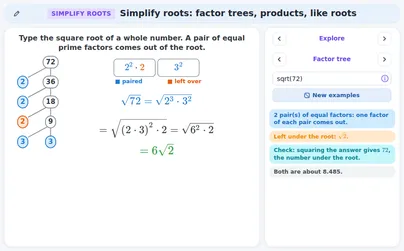 Simplify roots: factor trees, products and like rootsType a root and see its factor tree: the pairs of equal primes come out of the root, the primes left over stay inside.Open
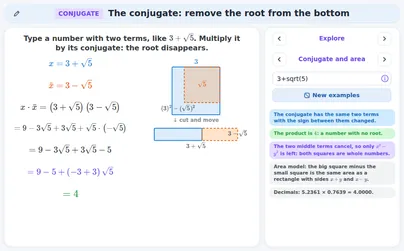 The conjugate: remove the root from the bottomType a number with a root and see its conjugate and the area picture: a big square minus a small square.Open
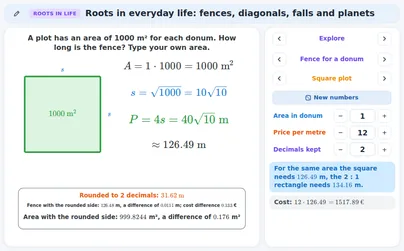 Roots in everyday life: fences, diagonals, falls and planetsFour real scenes with your own numbers.Open
Confidence intervals8
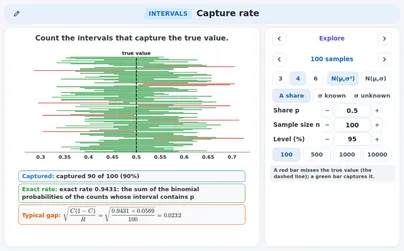 Capture rate: what 95% confident meansThree tabs about the capture rate: 100 or more seeded samples with the count and the exact rate, the picture of why the level works, and the intervals with z^* and s from small samples.Open
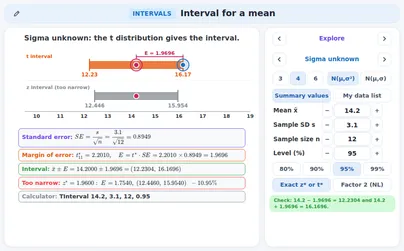 Interval for a mean: z, t and matched pairsFive tabs about the interval for a mean: with known, with unknown, the t distribution, matched pairs and the conditions.Open
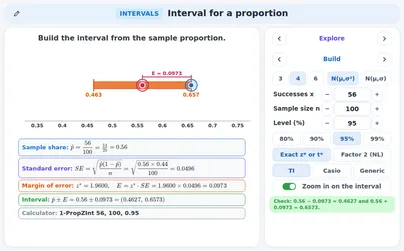 Interval for a proportion: margin of error and conditionsThree tabs about the interval for a proportion: build it from your own numbers, check its conditions and write the four-step answer.Open
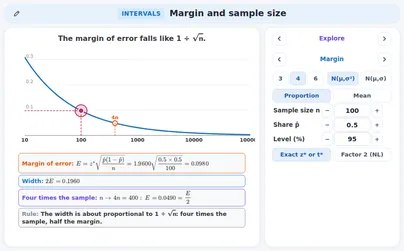 Margin and sample sizeFour tabs about margin and sample size: the margin against n, the sample size for a margin wanted, the trade-offs between level, margin and n, and a margin found by simulation.Open
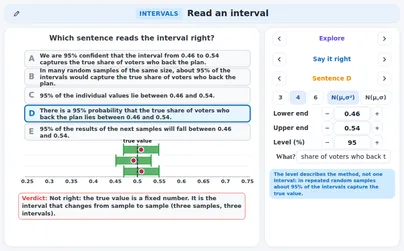 Read an interval: say it rightThree tabs about reading an interval: five sentences to choose from, claims against the interval, and two overlapping intervals.Open
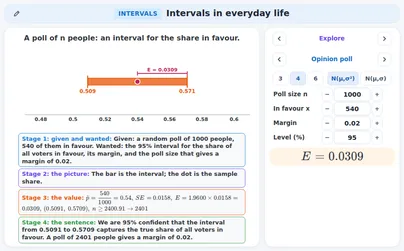 Intervals in everyday lifeFour workbenches with your own numbers: an opinion poll, a lab measurement, a factory check and delivery times.Open
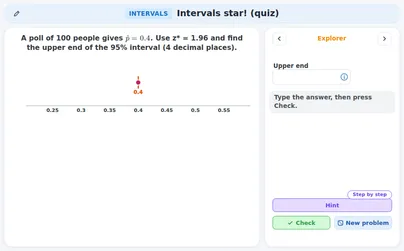 Intervals star! (quiz) QuizEndless practice with a score on the topic ‘Confidence intervals’.Open
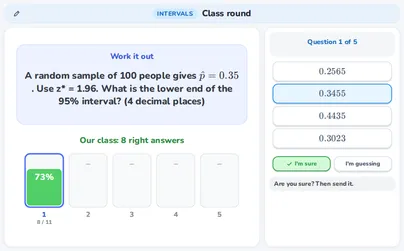 Class round: the whole class at once Class roundFive questions for the whole class at once: definitions, rules, true or myth, and sums.Open
Hypothesis tests8
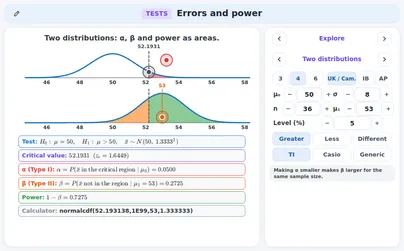 Errors and power: Type I and Type IIFour tabs about the two ways a test can be wrong: the decision table, two distributions with alpha, beta and power, the same idea with bars, and what changes the power.Open
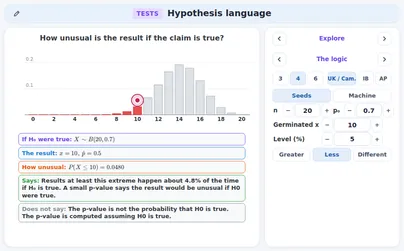 Hypothesis language: H0, H1, tails and levelsFour tabs about the language of testing: the logic of a test, hypotheses from a claim in words, tails and levels on one picture, and which test fits the question.Open
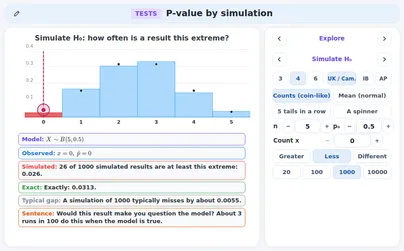 P-value by simulation and the correlation testThree tabs: simulate the null model and count the extreme results, judge eight sentences about the p-value, and test a correlation with a t test and by shuffling.Open
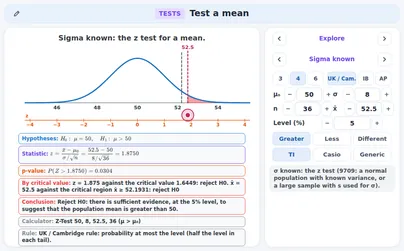 Test a mean: z, t and matched pairsFour tabs about the test for a mean: sigma known, sigma unknown, matched pairs and the conditions.Open
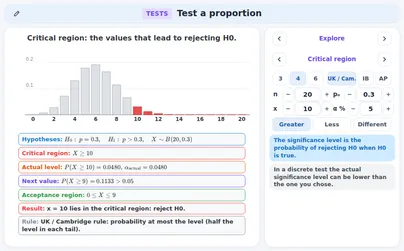 Test a proportion: exact, critical region and normalFour tabs about the test for a proportion: the exact binomial test, the critical region with its actual level, the normal approximation and the conditions.Open
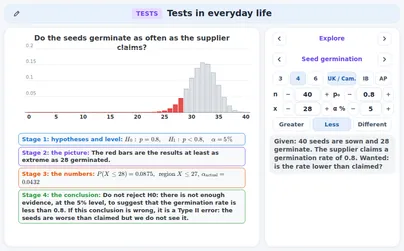 Tests in everyday lifeFour workbenches with your own numbers: seed germination, a bottling machine, delivery times and a fair spinner.Open
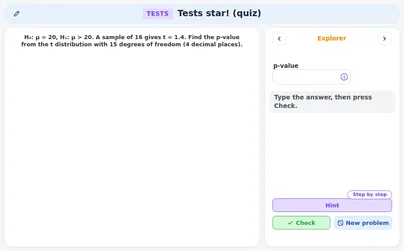 Tests star! (quiz) QuizEndless practice with a score on the topic ‘Hypothesis tests’.Open
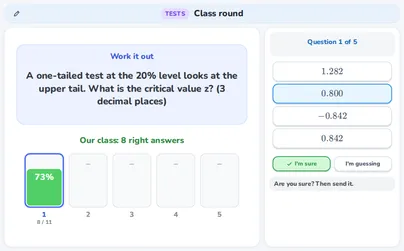 Class round: the whole class at once Class roundFive questions for the whole class at once: definitions, rules, true or myth, and sums.Open
Sampling distributions3
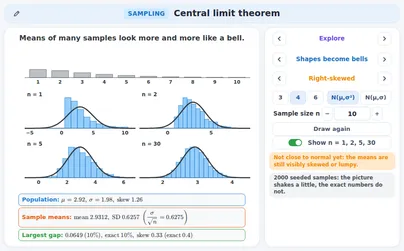 Central limit theoremThree tabs about the central limit theorem: shapes that turn into bells, a table that shows how large n must be, and sums next to means.Open
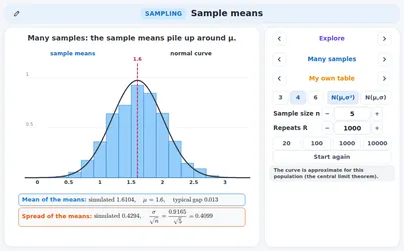 Sample means: the distribution of the sample meanFive tabs about the sample mean: one sample, many samples, the exact table with exact fractions, a probability for a normal population and the conditions.Open
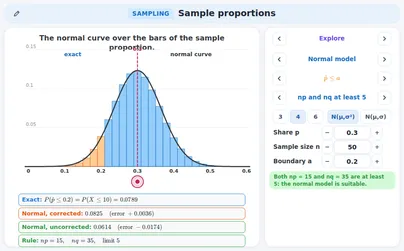 Sample proportions: the distribution of the sample shareFour tabs about the sample share: the exact bars of the sample proportion, the normal model next to them, the conditions and a sentence that states the probability correctly.Open
Spread and shape: quartiles, box plots, histograms, standard deviation2
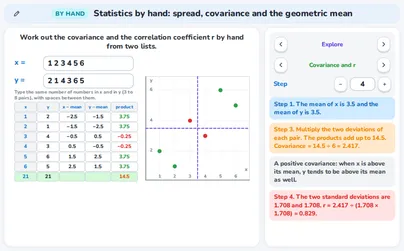
Statistics with a computer: big data sets5
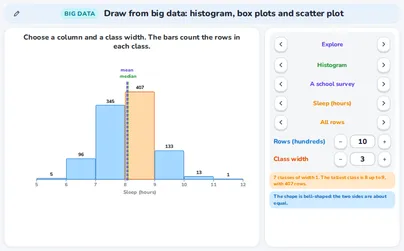 Draw from big data: histogram, box plots and scatter plotLearn to draw from big data: a histogram, box plots and a scatter plot of the columns you choose, with the numbers that go with them.Open
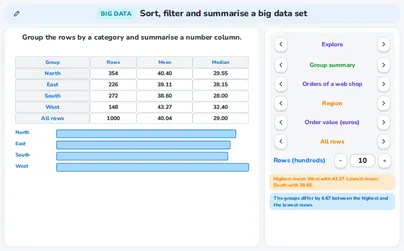 Sort, filter and summarise a big data setLearn to work with a big data set the way a computer does: sort it, filter it and summarise it by group, in 4 invented situations of 300 to 2 000 rows.Open
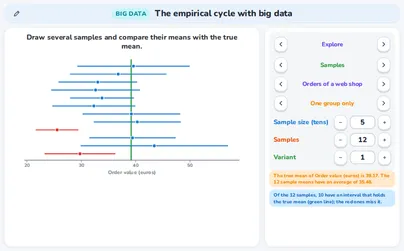 The empirical cycle with big dataLearn to investigate a question with a big data set and to judge whether a conclusion is justified.Open
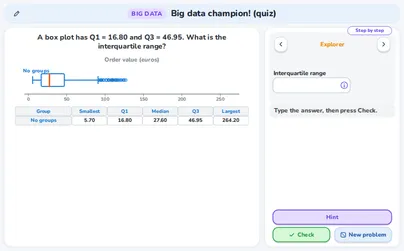 Big data champion! (quiz) QuizEndless practice with a score on the topic ‘Statistics with a computer: big data sets’.Open
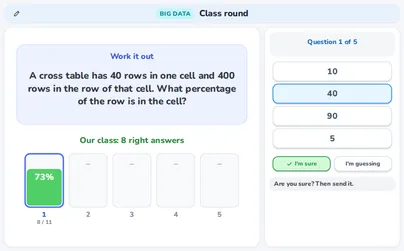 Class round: the whole class at once Class roundFive questions for the whole class at once: definitions, rules, true or myth, and sums.Open
Two variables: scatter plots, correlation and regression1
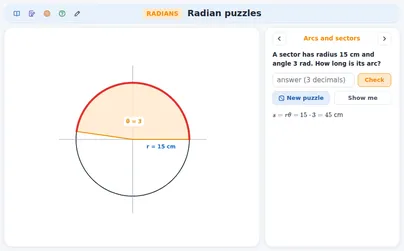
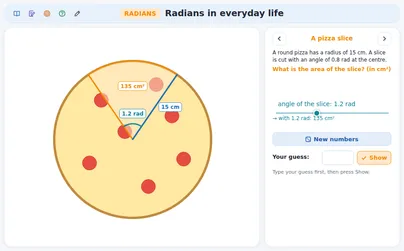
Reciprocal and inverse functions2
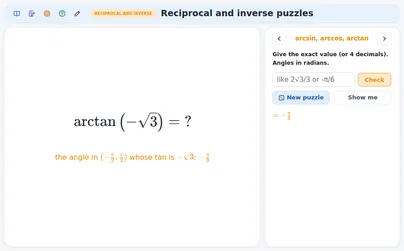
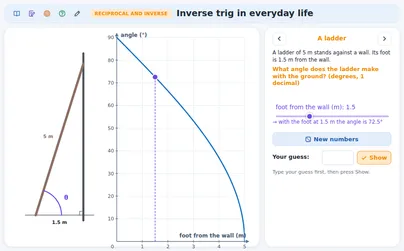
Right-angled triangles4
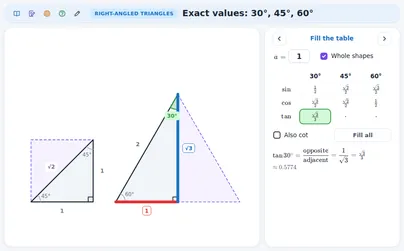 Exact values for 30°, 45° and 60°Half a square (a, a, a√2) and half an equilateral triangle (a, a√3, 2a) give exact values.Open
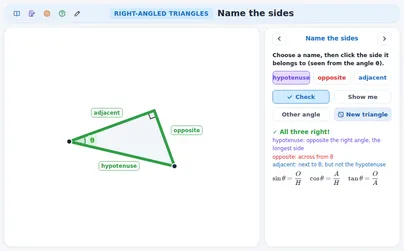 Name the sides: opposite, adjacent, hypotenuseA right triangle in any position with one acute angle θ marked.Open
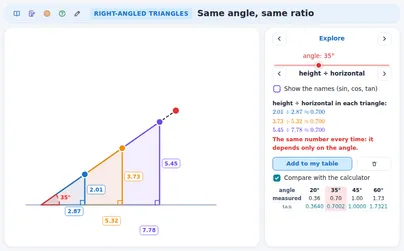 Same angle, same ratioThree ramps with the same angle but different sizes: height divided by horizontal distance always gives the same number, because the triangles are similar.Open
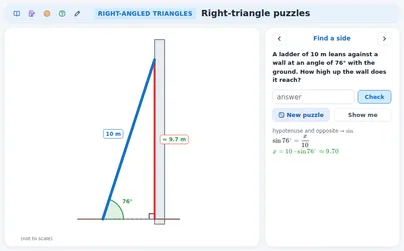 Right-triangle puzzlesPuzzles in context, new ones every time: a ladder against a wall, a ramp, a kite, the shadow of a pole, a plane, a steep road.Open
Trigonometric equations2
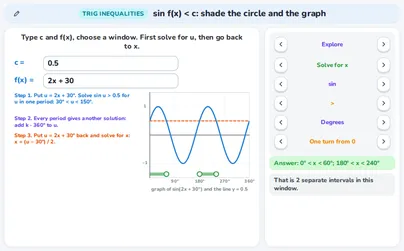 Trig inequalities: shade the circle and the graphType c and a sign: the arc and the part of the graph that satisfy it are coloured (tab Circle and graph).Open
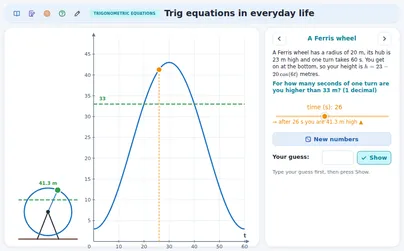 Trig equations in everyday lifeFour everyday scenes with a periodic model: a Ferris wheel, a ship in the harbour, long days and a warm day.Open
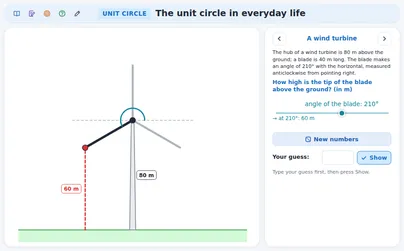
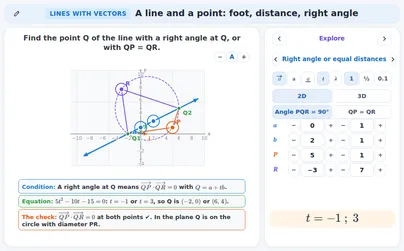
Position vectors and geometry3
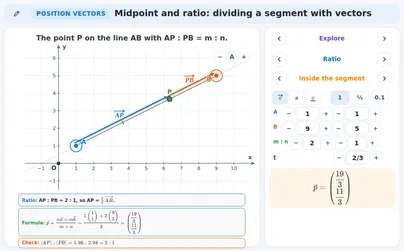 Midpoint and ratio: dividing a segment with vectorsFind the midpoint of two points, the point that divides a segment in the ratio m : n, and the centre of mass of weighted points.Open
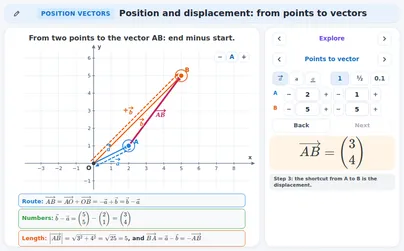 Position and displacement: from points to vectorsTwo points A and B and the origin O: see a = OA, b = OB and AB = b − a built step by step, then a moving point P = a + t v, and then the fourth vertex of a parallelogram.Open
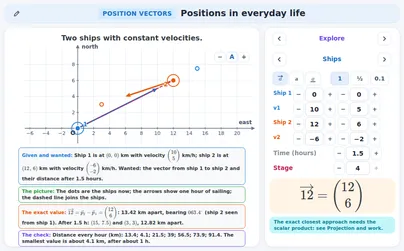 Positions in everyday lifeFour workbenches with your own numbers: a meeting point, the centre of a group, a relay tower on a drone loop and two ships with constant velocities.Open
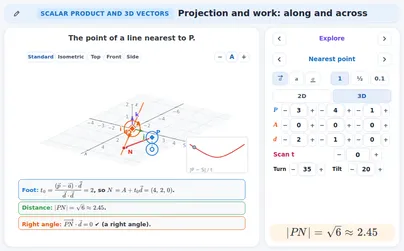
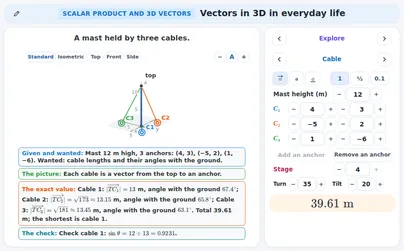
Vectors in 2D4
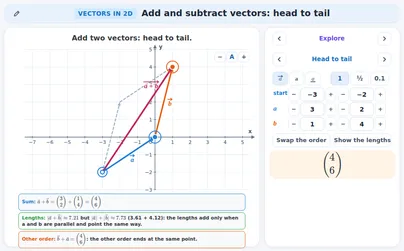 Add and subtract vectors: head to tailFour pictures of the same arithmetic: head to tail, the parallelogram, subtracting and a chain of vectors.Open
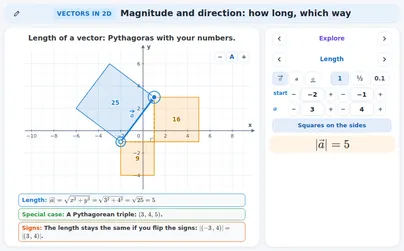 Magnitude and direction: how long, which wayFour tabs: the length of an arrow by Pythagoras, its direction as an angle or a bearing, the column from size and direction, and the sum of two vectors given by size and direction by two routes that must agree.Open
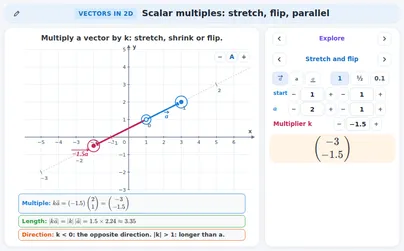 Scalar multiples: stretch, flip, parallelStretch, shrink and flip a vector with the number k, test for parallel vectors, steer s a + t b to a target and scale a vector to length 1.Open
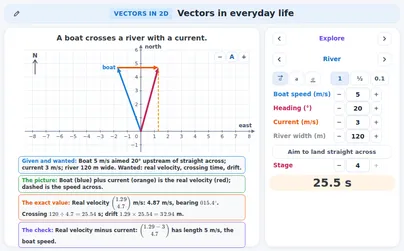 Vectors in everyday lifeFour workbenches with your own numbers and units: a walk, a boat in a river, an aircraft in a wind and a drone.Open