Number
1.11aSquare roots, positive and negative
1Pupils recognise that a positive number has a positive and a negative square root, write both, and use the radical sign correctly.1
2Pupils estimate the square roots, positive and negative, of numbers that are not perfect squares, by placing them between two integers, and check each estimate by squaring.3
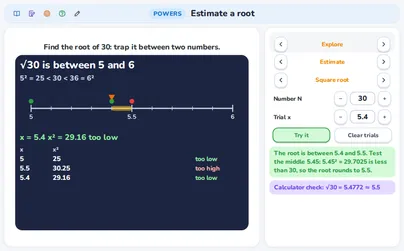 Estimate a rootTrap a root between two numbers with your own trials, or take the root of a product or a quotient.Open
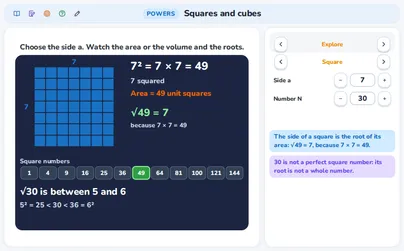 Squares and cubes: area and volumeChoose a side a and see the square drawn with unit squares or the cube drawn in layers, with its area or volume and the way back.Open
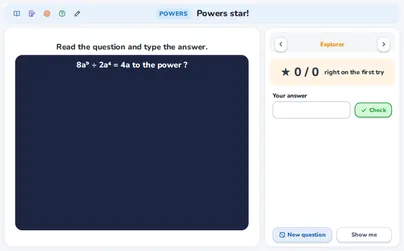 Powers star! (quiz) QuizEndless practice with a score on the topic ‘Powers and roots: squares, cubes and index laws’.Open
3Pupils explain squaring and taking a square root as inverse operations, and use this to solve simple equations such as x squared equals 49.6
- Estimate a rootTrap a root between two numbers with your own trials, or take the root of a product or a quotient.Open
- Squares and cubes: area and volumeChoose a side a and see the square drawn with unit squares or the cube drawn in layers, with its area or volume and the way back.Open
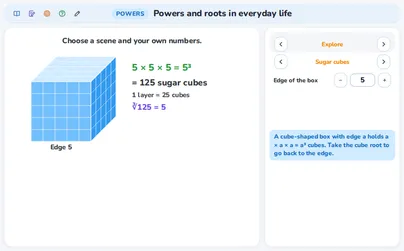 Powers and roots in everyday lifeChoose a scene and your own numbers: floor tiles, sugar cubes, pixels or a chain message.Open
- Powers star! (quiz) QuizEndless practice with a score on the topic ‘Powers and roots: squares, cubes and index laws’.Open
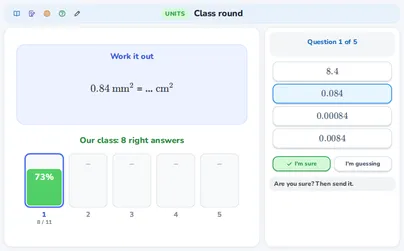
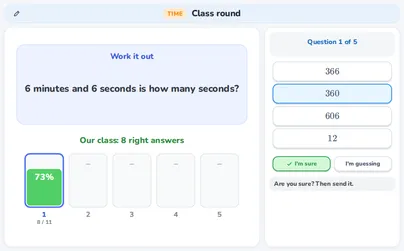
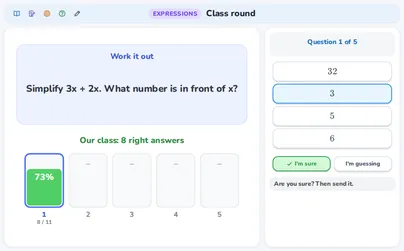
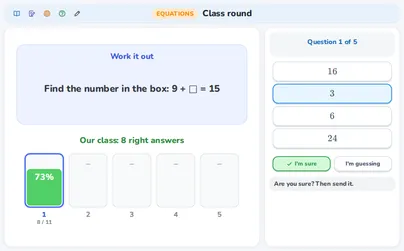
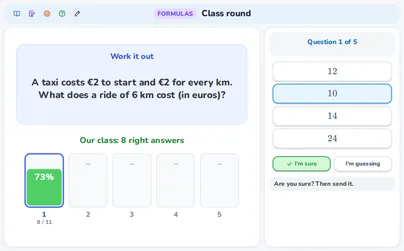
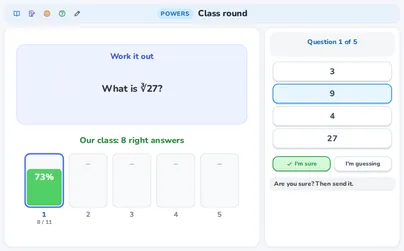 Class round: the whole class at once Class roundFive questions for the whole class at once: definitions, rules, true or myth, and sums.Open
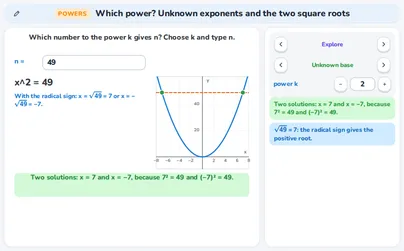 Which power? Unknown exponents and the two square rootsFind the exponent in b^x = n, or the number x with x^k = n.Open