
Part
- a[Understand and use the structure of mathematical proof, proceeding from given assumptions through a series of logical steps to a conclusion; use methods of proof, including proof by deduction, proof by exhaustion]
- b[Disproof by counter example]
Applications 10 applications
Explore
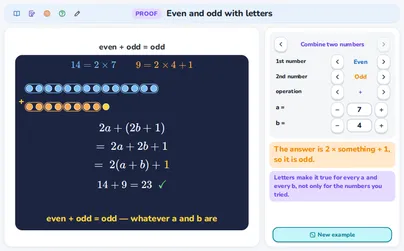 ExploreEven and odd with lettersFirst type a number and see it as pairs of dots: an even number is 2n, an odd number is 2n + 1.aOpen
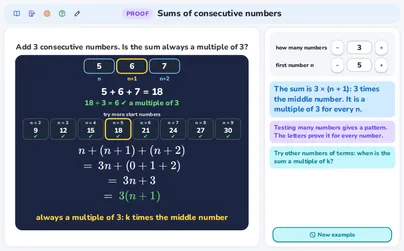 ExploreSums of consecutive numbersChoose how many consecutive numbers to add and the first number.aOpen
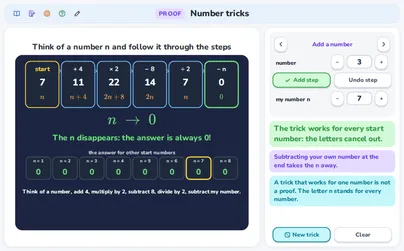 ExploreNumber tricksBuild a trick from up to 6 steps and a start number n.aOpen
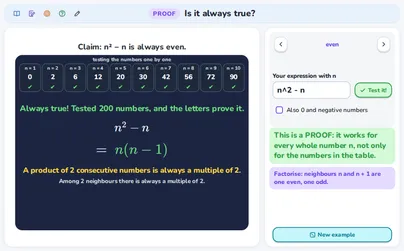 ExploreIs it always true?Type any expression with the letter n and choose a claim: always even, odd, a multiple of d, a prime number, a square number or bigger than n.a · bOpen
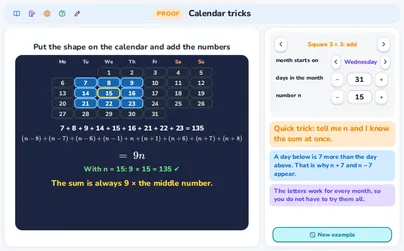 ExploreCalendar tricksPut a shape on a month calendar: a row, a column, a cross or a square.aOpen
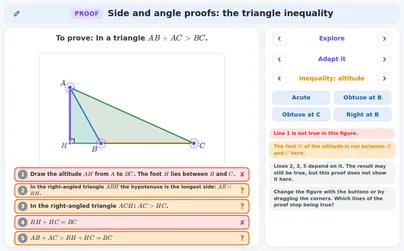 ExploreSide and angle proofs: the larger side, the triangle inequalityOpen
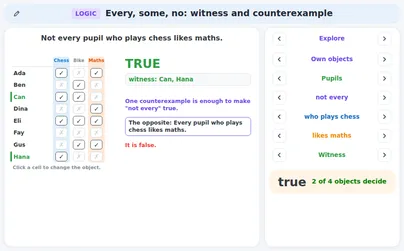 ExploreEvery, some, no: witness and counterexampleBuild a statement “every / some / no / not every object (that has A) has B” on your own set.bOpen
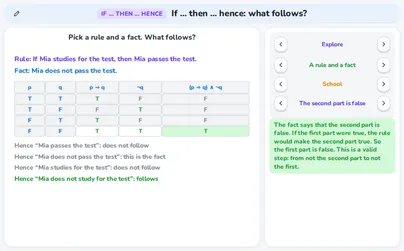 ExploreIf … then … hence: what follows?aOpen
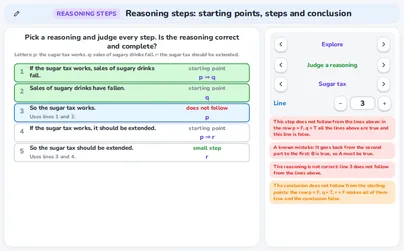 ExploreReasoning steps: starting points, steps and conclusionLearn to take a reasoning apart: every line gets its role, every step its kind, and the whole reasoning a verdict.Open
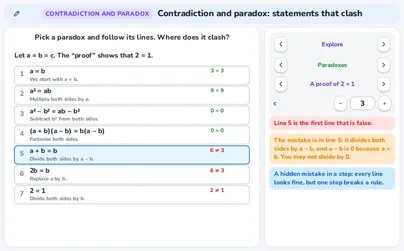 ExploreContradiction and paradox: statements that clashOpen
Supporting applications 4 applications
The rest is completed as classroom work.
DfE content: p. 7