İnteraktif Dersler

Money: coins, notes, rounding and exchange

Lecture notes

Definition

The money of the euro: coins and notes

The euro has coins and notes. There are 8 coins: 1, 2, 5, 10, 20 and 50 cents and 1 and 2 euros. There are 6 notes: 5, 10, 20, 50, 100 and 200 euros. A note of 500 euros exists too, but it is no longer printed. It is still money. One euro is 100 cents.
1c2c5c10c20c50c12
Example
A 2 euro coin is worth 200 cents.A 5 euro note is worth 500 cents.50 cents + 50 cents = €1.
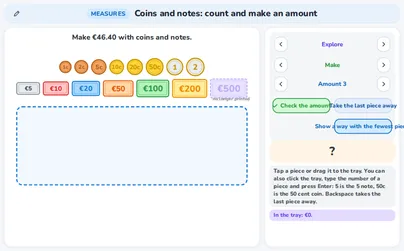
€5€10€20€50€100€200
Rule

Count a pile: sort, count, add

Do not count the pieces one by one. Put the pieces of the same value in one group. Count each group, work out what it is worth (the number × the value) and add the groups.
250c50c50c3×50c20c20c2×20c5c5c5c5c4×5c= 4.10
Example
Tip

Add the big pieces first and look for friendly pairs

Start with the biggest pieces, then the smaller ones. Look for pairs that make a round amount: 50 cents and 50 cents make a euro, cents make 50 cents, five coins of 20 cents make a euro.
50c50c2×50c20c20c2×20c10c= 1.50
Example
Rule

Make an amount with the fewest pieces

To make an amount with the fewest pieces, take the biggest piece that still fits. Then look at what is left and again take the biggest piece that fits. Go on until nothing is left.
€20€10€5120c20c2×20c5c= 36.45
Example
€36.45: take €20 (left €16.45), €10 (left €6.45), €5 (left €1.45), €1 (left €0.45),€0.20 (left €0.25), €0.20 (left €0.05), €0.05 (left 0).That is 7 pieces.
Watch out!

More pieces is not more money

A big pile of coins can be worth less than one note. Do not look at how many pieces there are, but at what each piece is worth.
€10= 1011111117×1= 7
Example
1 note of €10 is worth €10.7 coins of €1 are worth .€7 is less than €10: the pile with the most pieces has less money.
Rule

Change: count up from the price

The change is what you get back: the money you pay minus the price. Count up from the price to the money you pay, with the nearest round amounts. What you add on the way is the change. Then make it with the fewest pieces.
2150c10c5c= 3.65
Example
Price €6.35, you pay €10.Check → . Fewest pieces → , that is 5 pieces.
Tip

A collection tin: make bags of ten

A tin is full of small coins. Sort them by value. Put ten coins of the same value in a bag: ten coins of 20 cents are worth 2 euros. Count the full bags, then the loose coins.
20c20c20c20c20c20c20c20c20c20c10×20c20c20c20c20c20c20c20c20c20c20c10×20c20c20c20c20c20c20c20c20c20c20c10×20c20c20c20c20c20c20c20c7×20c= 7.40
Example
3 bags → 7 loose coins → Check: 37 coins → .
Definition

Euros and cents

An amount can be written in euros (3.50) or in cents (350). One euro is 100 cents, so 350 cents is 3 euros and 50 cents. The application also reads 350c as the same amount. Work in cents when you count many small coins.
Example
350 cents = ., so 350 cents = €3.50.3 coins of 50 cents → cents = €1.50.1 250 cents = .
Definition

Other money: pound, dollar and lira

Other countries have other money, with other pieces. In the application: the pound (coins of 1, 2, 5, 10, 20 and 50 pence and 1 and 2 pounds, notes of 5, 10, 20 and 50), the dollar (coins of 1, 5, 10 and 25 cents, notes of 1 to 100) and the lira (coins of 1, 5, 10, 25 and 50 kuruş and 1 lira, notes of 5 to 200). Every one has 100 small units in a big unit. You count and make amounts in the same way.
25¢25¢25¢3×25¢10¢5¢= 0.90
Example
Pounds: 50p + 20p + 20p = 90p, that is 3 pieces.Dollars: 25¢ + 25¢ + 25¢ + 10¢ + 5¢ = 90¢, that is 5 pieces.
50p20p20p2×20p= 0.90
Special case

The biggest piece first: not for every set of coins

Taking the biggest piece first gives the fewest pieces for all the sets of the application. It is not true for every possible set of coins. Imagine coins of 1, 3 and 4: the biggest piece first is not always the best.
Example
Amount 6 with coins of 1, 3 and 4.Biggest first → , that is 3 coins.Better → , that is 2 coins.
Definition

Why shops round to 5 cents

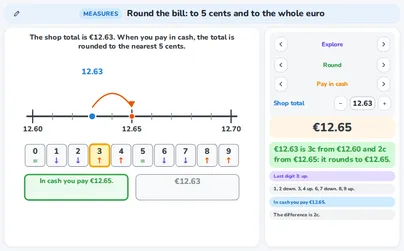
In the Netherlands the coins of 1 and 2 cents are hardly used any more. When you pay in cash, the shop rounds the total to the nearest 5 cents. When you pay by card, you pay the exact total, to the cent.
Example
The total is €12.63.In cash you pay €12.65.By card you pay €12.63.
Rule

The rule for 5 cents: look at the last digit

Look at the last digit of the cents. 1, 2: down. 3, 4: up. 6, 7: down. 8, 9: up. A total that ends in 0 or 5 stays the same. Down means to the multiple of 5 below, up to the multiple of 5 above.
12.6012.6512.7012.62512.67512.63
Example
€12.61 → €12.60 €12.62 → €12.60€12.63 → €12.65 €12.64 → €12.65€12.66 → €12.65 €12.67 → €12.65€12.68 → €12.70 €12.69 → €12.70
Rule

Rounding to the nearest multiple of 5

Rounding to 5 cents means: choose the multiple of 5 cents that is nearest. Find the two multiples on each side of the total and see which one is closer.
12.6012.6512.703212.63
Example
€12.63 lies between €12.60 and €12.65.€0.02 is smaller than €0.03: €12.63 rounds to €12.65.
Special case

No halfway for 5 cents, but there is one for the whole euro

A price is a whole number of cents. The middle of 12.60 and 12.65 is 12.625, which is not a whole number of cents: it never occurs, so rounding to 5 cents never has a tie. For the whole euro it is different: 50 cents is exactly halfway, and then we round up.
12.6012.6512.625
Example
is not a price.€12.50 is halfway between €12 and €13 → and .So €12.50 rounds up to €13.
121312.5012.50
Rule

Round to the whole euro: 50 cents or more goes up

To round to the whole euro look at the cents. 50 cents or more: up to the next euro. Less than 50 cents: down, the euros stay the same.
121312.5012.63
Example
€12.63 has 63 cents: up, to €13.€12.49 has 49 cents: down, to €12.€12.50 has 50 cents: up, to €13.
121312.5012.49
Rule

The shop rounds the total, not every price

A shop adds all the prices first and rounds once, the total. If every price was rounded, the small errors would add up and the bill could be further from the real amount.
Example
Prices .Rounding the total: €9.32 → €9.30 (error €0.02).Rounding every price → (error €0.03).
Tip

Rounding to 5 cents changes the bill by at most 2 cents

A total is at most 2 cents away from the multiple of 5 it rounds to. So you never pay more than 2 cents extra and never save more than 2 cents. The last digit tells how much it moves: 1 → −1, 2 → −2, 3 → +2, 4 → +1, 6 → −1, 7 → −2, 8 → +2, 9 → +1.
Example
€12.62 → €12.60: 2 cents less.€12.63 → €12.65: 2 cents more.€12.64 → €12.65: 1 cent more.The biggest move is 2 cents.
Rule

Which totals round to the same multiple?

Every multiple of 5 cents is the result for 5 different totals: itself, 2 cents below and 2 cents above, and the ones in between. The lowest is 2 cents below and the highest is 2 cents above.
12.6012.6512.7012.6312.67
Example
The totals that round to €12.65: €12.63, €12.64, €12.65, €12.66, €12.67.Lowest → .Highest → .There are 5 totals.
Tip

Estimate a total with round prices

To estimate a bill, round every price to the nearest 50 cents or to the nearest euro, then add. An estimate is not the exact total: it only has to be close. Rounding to 50 cents is closer than rounding to the euro.
Example
Prices €1.95, €3.49, €0.89, €2.20, €0.79; exact total €9.32.To the euro → (error €0.32).To 50 cents → (error €0.18).
Watch out!

Common mistake: 6 and 7 go down, not up

Many pupils round up every digit from 5 on, as with tens. With 5 cents it is different: the multiples of 5 are 5 cents apart, so 6 and 7 are close to 5, and 8 and 9 are close to 10. Do not use 5 as the middle: look at which multiple of 5 is nearer.
12.6012.6512.702312.67
Example
€12.67 is 2 cents above €12.65 and 3 cents below €12.70. and .So €12.67 rounds down to €12.65, not up to €12.70.
Definition

The exchange rate: money for 1 euro

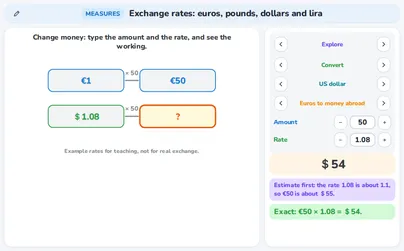
An exchange rate says how much money of another country you get for 1 euro. In the application the example rates are 1 euro = 1.08 dollars, 1 euro = 0.85 pounds and 1 euro = 38 lira. They are examples to practise with, not the real rates of today.
€$11.08×1.08
Example
1 euro = 1.08 dollars.10 euros = dollars.
Rule

From euros to other money: multiply by the rate

To change euros into money abroad, multiply the number of euros by the rate. A ratio table helps: what you do to the 1 euro, you do to the amount you have.
€$11.081010.805054×1.08
Example
1 euro → 1.08 dollars.50 euros → dollars.Table: ×50 on both rows, and .
Rule

Back to euros: divide by the rate

To change money abroad back into euros, divide by the rate. Going back is the opposite of going there, so multiplying becomes dividing. Check the answer: multiply it by the rate and you must get the money abroad again.
€$11.08?54÷1.08
Example
54 dollars → euros.Check → .58.32 would be the answer if you multiplied → , which is too much.
Tip

Estimate first with a rate of one digit

Before you calculate, round the rate to one digit and estimate. The estimate is close when it is within 10% of the exact answer. It also catches a slip: a result far from the estimate means that you multiplied when you had to divide, or the other way round.
€TL13825950×38
Example
The rate , so 50 euros ≈ dollars.Exact: 54 dollars, so the estimate is 1.9% more: close.Lira: the rate 38 ≈ 40, so 25 euros ≈ lira.Exact → lira, 5.3% less: close.
Rule

Which is cheaper? Change both to the same money

To compare a price in dollars with a price in euros, change both to the same money, best to euros. Then the smaller amount is the cheaper one.
Example
Offer A costs 79 dollars. Offer B costs €70.A in euros → .€70 is less than €73.15: B is cheaper, by about €3.15.Check in dollars → dollars, less than 79.
Definition

A bureau de change: two rates and a commission

A bureau de change pays less than it asks. It gives you less money abroad for 1 euro than the middle rate (you buy), and it asks more money abroad for 1 euro when you give it back (you sell). The difference is the commission: what the exchange costs you.
Example
Middle rate 1.08. The bureau gives 1.04 dollars for 1 euro and asks 1.12 dollars for 1 euro back.€100 → dollars.Back → .You lose (about 7%).
Tip

From one foreign money to another: go through the euro

You do not need a rate between two foreign moneys. Change the first money to euros (divide), then the euros to the second money (multiply).
Example
54 dollars to lira, with 1 euro = 1.08 dollars = 38 lira. euros. lira.
Rule

Find the rate from two amounts

If you know an amount in euros and the same amount in other money, the rate is the other money divided by the euros. It tells how much you get for 1 euro.
€$1?5054×?
Example
50 euros is worth 54 dollars..So 1 euro = 1.08 dollars.Check → .
Watch out!

Rates change: the euro can get stronger or weaker

Real rates change every day, so the rates of the application are only examples. If you get more money abroad for 1 euro than before, the euro has become stronger. If you get less, it has become weaker. A bigger rate does not mean a weaker euro.
Example
First 1 euro = 1.08 dollars: €100 is 108 dollars.Later 1 euro = 1.12 dollars: €100 is 112 dollars.112 is more than 108: the euro is stronger.
Tip

A holiday budget: change every price to euros

On holiday the prices are in the money of that country. Change every price to euros (divide by the rate), add them and take the total from your budget. What is left is the money you can still spend.
Example
Budget €40. A T-shirt costs 570 lira, a museum ticket 380 lira and an ice cream 95 lira (1 euro = 38 lira)., , ..Left → .
Definition

A tientje and a ton

In Dutch, a tientje is 10 euros (a note of 10) and a ton is 100 000 euros. A ton is also 1 000 kilograms, but when it is about money it is 100 000 euros. Knowing such words helps when you read prices in the Netherlands.
11 000 00010100 000
Example
3 tientjes = ., so 7 tientjes.2 ton = .
Rule

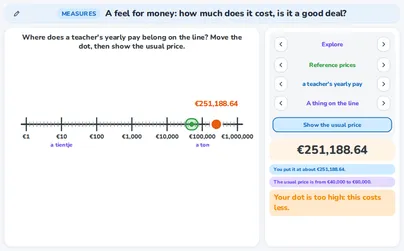
Reference prices: know what things usually cost

A reference price is what a thing usually costs. If you know a few, you can judge other prices. Most things have a usual range, not one price. The prices in the application are examples from the Netherlands.
110010 0001 000 0002.2250400 000
Example
A loaf of bread: usually €1.50 to €3 (orange).A second-hand bike: usually €150 to €400 (blue).A house: usually €250 000 to €500 000 (green).A bike for €40 is far below the usual range: ask why.
Rule

On the price line every step is ten times as much

The line from 1 euro to 1 million euros is not even. Every step to the right is ten times as much as the step before: 1, 10, 100, 1 000, 10 000, 100 000, 1 000 000. From 1 to 1 000 000 there are 6 steps. That is why cheap and expensive things fit on one line.
110010 0001 000 000101 000100 000
Example
, , .From €10 to €1 000 is 2 steps → .From €1 to €1 000 000 is 6 steps.
Rule

Is it possible? Compare with what you know

Use a reference price to test a question. To see how far off an idea is, divide the usual price by the money you have.
110010 0001 000 0001 000400 000
Example
Can you buy a house for €1 000?A house costs about €400 000..No: €1 000 is 400 times too little.
Rule

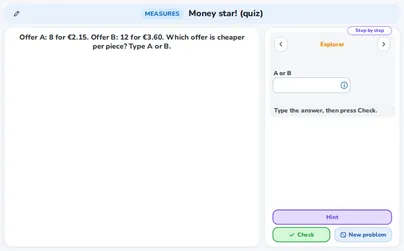
The better deal: compare the price per piece

Two bags have different sizes and different prices. To compare, work out the price of one piece in each bag: divide the price by the number of pieces. The smaller price per piece is the better deal, if the pieces are the same.
Example
6 rolls cost €2.40 and 10 rolls cost €3.50.€2.40 ÷ 6 = €0.40 per roll.€3.50 ÷ 10 = €0.35 per roll.The bag of 10 is cheaper per roll, by €0.05.
Rule

A percentage discount or a voucher?

A discount of 20% is 20 out of every 100 euros of the price. Work out the amount in euros first: 20% of a price is the price × . Then compare the euros you save. A percentage saves more on an expensive thing, a voucher can be better on a cheap thing.
Example
A thing of €85 with 20% off → . A voucher gives €15.€17 is more than €15: the discount saves €2 more.A thing of €40 with 20% off → , less than €15: the voucher is better.
Rule

Per month and per year

A year has 12 months. A price per month times 12 is the price per year. A price per year divided by 12 is the price per month. A small price every month adds up to a big price in a year.
Example
A subscription costs €3.99 a month.A year → .A thing of €84 a year is a month.
Rule

Saving up: how many weeks?

To find how many weeks you need to save for a thing, divide the price by what you save in a week. If there is a remainder you still need one more week, so round up to a whole week.
Example
A game costs €45. You save €4 a week., so more than 11 weeks.After 11 weeks → , not enough.After 12 weeks → , enough. You need 12 weeks.
Definition

VAT and interest: a percentage of an amount

VAT is a tax that a shop adds to the price, a percentage of the price without VAT. Interest is money that a bank adds to your savings, a percentage of what you saved. For both you work out a percentage of an amount. In the application the bank adds, for example, 2% a year.
Example
VAT of 21% on €50 → . With VAT → .Interest of 2% on €250 in a year → . Then there is .
Watch out!

The cheapest is not always the best deal

A low price is not always a good deal. Ask: what do I get? How long does it last? Is it the same thing? A bike for €350 is cheaper than a new bike of €480, but it is old. Think about the number and the reason.
Example
→ the old bike saves €130.Water at the station costs €4.50, in the supermarket €0.60. → the supermarket gives 7.5 bottles for the price of 1 at the station.

Exercises

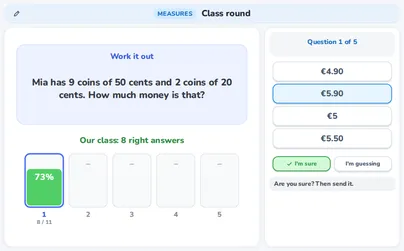
A pile holds 3 coins of 50 cents, 2 coins of 20 cents and one coin of 2 euros. How much money is that? Easy
Show solution
.
.
.
250c50c50c3×50c20c20c2×20c= 3.90
€3.90
Check → cents = €3.90.
What is the fewest number of coins that make €0.90? Easy
Show solution
Take the biggest piece that fits: €0.50. Left: €0.40.
Take the biggest piece that fits in €0.40: €0.20. Left: €0.20.
Take €0.20 again. Nothing is left.
50c20c20c2×20c= 0.90
3 coins →
Check → . Another way, , needs 4 coins: more.
A shop total is €12.67. What do you pay in cash? Easy
Show solution
The last digit of the cents is 7: that is 6 or 7, so it goes down.
€12.67 is 2 cents above €12.65 and 3 cents below €12.70.
€12.65 is nearer, so you pay €12.65.
€12.65
Check → and . The smaller distance wins.
Round €8.50 and €8.49 to the whole euro. Easy
Show solution
€8.50 has 50 cents: 50 cents or more goes up, so €8.50 → €9.
€8.49 has 49 cents: less than 50, so it goes down: €8.49 → €8.
€8.50 → €9 and €8.49 → €8
Check → and → €8.50 is exactly halfway, so it goes up.
1 euro = 1.08 dollars. How many dollars do you get for 50 euros? Easy
Show solution
Euros to dollars: multiply by the rate.
.
€$11.0850?×1.08
54 dollars
Check → .
A tientje is 10 euros and a ton is 100 000 euros. How many tientjes make €70? How much money is 2 ton? Easy
Show solution
Count the tens in 70 → .
2 ton = .
7 tientjes; 2 ton is €200 000
Check → .
A thing costs €6.35. You pay with a note of €10. What is the change, and how many pieces are the fewest? Medium
Show solution
Count up → ; ; ; .
The change is .
The fewest pieces → , that is 5 pieces.
2150c10c5c= 3.65
€3.65 change, in 5 pieces
Check → .
What are the fewest pieces (coins and notes) that make €36.45? Medium
Show solution
Biggest piece first: €20. Left: €16.45.
Then €10 (left €6.45), €5 (left €1.45), €1 (left €0.45).
Then €0.20 (left €0.25), €0.20 (left €0.05) and €0.05 (left 0).
€20€10€5120c20c2×20c5c= 36.45
7 pieces →
Check → .
A receipt shows €1.95, €3.49, €0.89, €2.20 and €0.79. What do you pay in cash? What if every price had been rounded first? Medium
Show solution
Add the prices → .
Round the total once: the last digit is 2, so down: €9.30.
Rounding every price to 5 cents → .
In cash €9.30. Rounding every price gives €9.35: €0.05 more, so the shop rounds the total.
Check → .
1 euro = 1.08 dollars. A jacket costs 81 dollars. How many euros is that? Medium
Show solution
Dollars to euros: divide by the rate.
.
€$11.08?81÷1.08
€75
Check → .
1 euro = 1.08 dollars. Shoes cost 64 dollars in one shop and €60 in another. Which is cheaper, and by how much? Medium
Show solution
Change 64 dollars to euros → .
€59.26 is less than €60, so the shoes at 64 dollars are cheaper.
The difference → .
The shoes at 64 dollars are cheaper, by about €0.74
Check in dollars → , which is more than 64.
A game costs €45. You save €4 a week. How many weeks do you need? Medium
Show solution
→ more than 11 weeks.
After 11 weeks you have → not enough.
A part of a week still needs a whole week: 12 weeks.
12 weeks
Check → , which is more than 45.
Which totals round to €3.40 in cash? Give the lowest, the highest and how many there are. Hard
Show solution
€3.40 itself stays. Two cents below, €3.38, ends in 8: up to €3.40.
Two cents above, €3.42, ends in 2: down to €3.40. €3.37 would go down to €3.35 and €3.43 up to €3.45.
So the totals are €3.38, €3.39, €3.40, €3.41 and €3.42.
3.303.353.403.453.383.42
Lowest €3.38, highest €3.42, 5 totals
Check → and .
A bureau gives 1.04 dollars for 1 euro and asks 1.12 dollars for 1 euro when you give them back. You change €100 into dollars and then all the dollars back into euros. How much do you lose? Hard
Show solution
To dollars → dollars.
Back to euros: divide by 1.12 → .
What you lose → .
€7.14 (the commission of the bureau)
Check → .
1 euro = 38 lira = 1.08 dollars. How many dollars is 380 lira? Hard
Show solution
Lira to euros: divide by 38 → .
Euros to dollars: multiply by 1.08 → .
€TL13810380÷38€$11.081010.80×1.08
10.80 dollars
Check → and .
60 euros buy 51 pounds. What is the rate: 1 euro = how many pounds? Hard
Show solution
The rate is what you get for 1 euro: divide the pounds by the euros.
.
€£1?6051×?
1 euro = 0.85 pounds
Check → .
A jacket costs €85. Shop A takes 20% off. Shop B gives a voucher of €15. Which saves more? And if the jacket costs €40? Hard
Show solution
20% of €85 → . €17 is more than €15: shop A saves €2 more.
For €40 → . €8 is less than €15.
Now the voucher saves more.
For €85 the discount saves €2 more; for €40 the voucher saves €7 more
Check → and .
You have a budget of €60 on holiday. A T-shirt costs 570 lira, a museum ticket 380 lira and an ice cream 95 lira (1 euro = 38 lira). How much is left? Hard
Show solution
Change every price to euros → , , .
Add them → .
Subtract from the budget → .
€32.50
Check → and .
Are you a teacher?

Start live lessons with these applications for your whole class. Free to try for one month.

Try it free

Fits these school years

IB (MYP, Diploma): PYP, MYP 1, MYP 2, MYP 3

Cambridge International: Primary, stage 4, Primary, stage 5, Primary, stage 6, Lower Secondary, stage 7, Lower Secondary, stage 8

Netherlands: Groep 5, Groep 6, Groep 7, Groep 8, Year 1

Türkiye (MEB): Year 3 (MEB), Year 4 (MEB), Year 5 (MEB), Year 6 (MEB)

England (GCSE, A Level): Year 4, Year 5, Year 6, Year 7, Year 8

USA (Common Core): Grade 3, Grade 4, Grade 5, Grade 6, Grade 7

What the applications of this topic teach 4 applications

Coins and notes: count and make an amount

  • Counting a pile of coins and notes by grouping equal values
  • Making an amount with the fewest pieces
  • Working out the change by counting up from the price

Round the bill: to 5 cents and to the whole euro

  • Rounding a shop total to 5 cents
  • Knowing that the middle of two 5-cent multiples is never a price
  • Saying why the shop rounds the total once, not every price
  • Estimating a total by rounding every price

Exchange rates: euros, pounds, dollars and lira

  • Changing euros into other money with the rate, and back
  • Estimating first with the rate in one digit
  • Saying which offer is cheaper by changing both to euros
  • Planning a holiday budget in euros with prices in lira

A feel for money: how much does it cost, is it a good deal?

  • Knowing what common money amounts and everyday costs are
  • Placing a price on the line from 1 euro to 1 million euros
  • Thinking about a money question with a number and a reason
  • Seeing that paying later and borrowing cost money