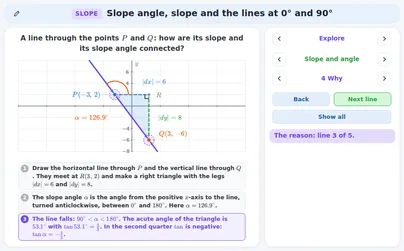
The slope angle α of a line is the angle from the positive x-axis to the line, measured anticlockwise. It is at least 0∘ and less than 180∘. A line that rises has 0∘<α<90∘, a line that falls has 90∘<α<180∘.
Example
The line in the figure rises to the right and makes 40∘ with the x-axis: α=40∘. A line that falls to the right and makes 50∘ with the x-axis has α=180∘−50∘=130∘.
Definition
The slope of a line
The slope m of the line through P(x1,y1) and Q(x2,y2) is the rise divided by the run: m=dxdy=x2−x1y2−y1, with x2=x1. It is the same for every pair of points of the line.
Example
P(1,−2), Q(5,1): dx=5−1=4 and dy=1−(−2)=3, so m=43.
Rule
The slope is the tangent of the slope angle
In the right triangle with the run ∣dx∣ and the rise ∣dy∣ as legs, the tangent of the angle at P is opposite over adjacent. So for a line that rises tanα=dxdy=m. This holds for every line that is not vertical: m=tanα.
Example
The legs are 4 and 3: tanα=43=0.75, so α≈36.9∘.
Rule
From the slope to the angle
To find α from m use the inverse tangent. If m>0: α=tan−1m. If m<0: α=180∘−tan−1∣m∣. Check with a sketch: a line that falls has an angle above 90∘.
Example
m=−1: tan−11=45∘, so α=180∘−45∘=135∘. For m=21: α=tan−10.5≈26.6∘.
Rule
Why the slope is positive or negative
The tangent changes sign with the quarter of the slope angle. For 0∘<α<90∘ (first quarter) tanα>0: m>0 and the line rises. For 90∘<α<180∘ (second quarter) tanα<0: m<0 and the line falls.
Example
tan30∘≈0.58>0: the line rises. tan150∘=−tan30∘≈−0.58<0: the line falls.
Definition
Horizontal lines
A horizontal line has α=0∘ and the slope m=tan0∘=0, because the rise is 0. All its points have the same y, so its equation is y=k.
Example
The horizontal line through (4,2) is y=2: slope 0, slope angle 0∘.
Definition
Vertical lines
A vertical line has α=90∘. Its run is 0, so dxdy has no value, and neither has tan90∘: a vertical line has no slope. All its points have the same x, so its equation is x=k.
Example
The vertical line through (−3,1) is x=−3: slope angle 90∘, no slope, and it cannot be written as y=mx+n.
Rule
How steep is a line?
The bigger ∣m∣, the steeper the line and the nearer α is to 90∘. For ∣m∣<1 the line is gentle, ∣m∣=1 gives 45∘ (or 135∘), and for ∣m∣>1 the line is steep.
Example
The slopes 21, 1 and 3 give the angles 26.6∘, 45∘ and 71.6∘ (rounded): the bigger the slope, the steeper the line.
Definition
The equation of a line
The equation of a line links the x and the y of its points: a point is on the line exactly when its coordinates make the equation true. Put the coordinates in and see whether both sides are equal.
Example
For y=2x−1: the point (4,7) is on the line because 2⋅4−1=7. The point (3,4) is not, because 2⋅3−1=5=4.
Rule
Point-slope form
A line through P(x1,y1) with the slope m has the equation y−y1=m(x−x1). A point (x,y) is on the line when x−x1y−y1=m.
Example
P(3,2), m=2: y−2=2(x−3).
Rule
Slope-intercept form
Solved for y the equation reads y=mx+n. The number m is the slope and n is the y-intercept: the line crosses the y-axis at (0,n). From a point and the slope: n=y1−mx1.
Example
From y−2=2(x−3): y=2x−6+2=2x−4, so m=2 and n=−4.
Rule
A line through two points
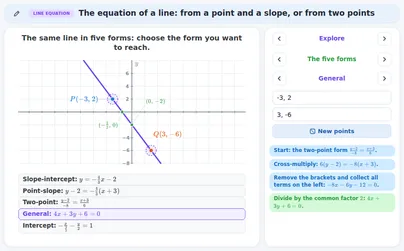
First the slope m=x2−x1y2−y1, then the point-slope form with one of the points. Together this is the two-point form y2−y1y−y1=x2−x1x−x1. If x1=x2 the line is vertical: x=x1.
Example
P(−1,5), Q(3,−3): m=3−(−1)−3−5=−2, so y−5=−2(x+1), that is y=−2x+3.
Rule
A line from a point and the slope angle
First the slope m=tanα, then the point-slope form. If α=90∘ there is no slope and the line is x=x1. If α=0∘ the line is y=y1.
Example
P(1,2) and α=135∘: m=tan135∘=−1, so y−2=−(x−1), that is y=−x+3.
Rule
General form
The general form is Ax+By+C=0 with whole numbers A, B, C without a common factor (A and B not both 0). Every line has one, a vertical line too. The slope is m=−BA when B=0.
Example
y=−32x+2: multiply by 3 and collect the terms: 2x+3y−6=0. The slope is −32.
Rule
Intercept form
If a line crosses the axes at (a,0) and (0,b) with a=0 and b=0, its equation is ax+by=1. A line through the origin or parallel to an axis has no intercept form.
Example
2x+3y=6: divide by 6: 3x+2y=1. The line crosses the axes at (3,0) and (0,2).
Rule
The five forms of one line
One line has five forms: y=mx+n, point-slope, two-point, general and intercept form. Choose the one the problem needs: a point and the slope: point-slope; two points: two-point; the axes: intercept form; comparing lines: y=mx+n or the general form.
Example
The line through P(0,2) and Q(3,0): y=−32x+2; y−2=−32(x−0); 0−2y−2=3−0x−0; 2x+3y−6=0; 3x+2y=1.
Definition
Parallel lines
Two lines are parallel when they have the same slope angle, so the same slope: m1=m2, and different y-intercepts. Two vertical lines are parallel too. With equal intercepts as well the lines are the same line.
Example
y=21x+1 and y=21x−2 have m1=m2=21 and the intercepts 1 and −2: they are parallel.
Rule
Crossing lines and their meeting point
Lines with different slope angles cross in exactly one point. Find it by solving the two equations together: the point whose coordinates make both equations true.
Example
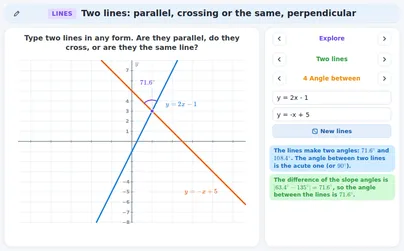
y=2x−1 and y=−x+5: 2x−1=−x+5 gives x=2 and y=3. The meeting point is (2,3); check: 2⋅2−1=3 and −2+5=3.
Definition
Perpendicular lines
Two lines are perpendicular when they meet at a right angle. If neither is parallel to an axis, their slopes satisfy m1⋅m2=−1, so m2=−m11: turn the fraction upside down and change the sign. The slope angles differ by 90∘.
Example
m1=2: m2=−21, and 2⋅(−21)=−1. For m1=−43 the perpendicular slope is 34.
Rule
Why the slopes multiply to −1
Take a line with the run a and the rise b, so m1=ab. Turn this step by 90∘ anticlockwise: the run becomes −b and the rise a, so the perpendicular line has m2=−ba=−ba. Then m1⋅m2=ab⋅(−ba)=−1.
Example
Run 3 and rise 2: m1=32. Turned: run −2 and rise 3, so m2=−23=−23, and 32⋅(−23)=−1.
Rule
The angle between two lines
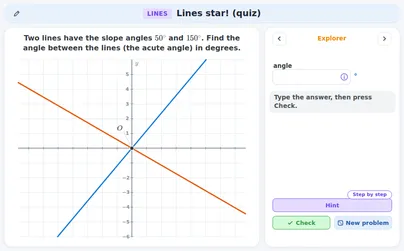
The angle between two lines is the acute one (or 90∘). Take the difference of the slope angles d=∣α1−α2∣. If d≤90∘ the angle is d, otherwise it is 180∘−d. Parallel lines make 0∘.
Example
α1=30∘, α2=150∘: d=120∘>90∘, so the angle between the lines is 180∘−120∘=60∘.
Rule
A steady change in real life
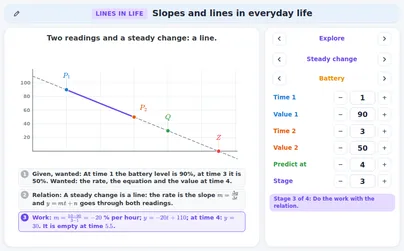
A steady change is a line v=mt+n: the slope m is the change per unit of time (a speed, a rate) and n is the starting value at t=0. A negative slope means a decrease.
Example
A phone battery shows 100 percent at the start and 40 percent after 3 hours: m=3−040−100=−20 per hour, so v=−20t+100. It is empty at t=5.
Rule
Gradient: the slope as a percent
Roads and ramps give the steepness as a percent: the gradient is 100⋅runrise=100m, the slope times 100. A sign with 8% means 8 m of rise for every 100 m of ground (not of road). A ramp “1:n” rises 1 for every n of run, so m=n1. A minus sign means downhill.
Example
A road rises 6 m over 75 m of ground: m=756=0.08, so the gradient is 8%. The ramp rule 1:12 is m=121≈0.083, about 8.3%.
Rule
Roof, ramp, road: slope, angle and length
The run is the horizontal distance and the rise the vertical one. The slope is m=runrise, the slope angle α=tan−1m, and the length along the slope is run2+rise2. The rafter of a roof is that length: longer than the run, shorter than run plus rise.
Example
A roof has run 4 m and rise 3 m: m=43=0.75, α=tan−10.75≈37∘ and the rafter is 42+32=5 m.
Rule
Two readings give the rate and the equation
A steady change is a line y=mt+n. From two readings (t1,y1) and (t2,y2) the rate is m=t2−t1y2−y1, then n=y1−mt1. Now any value can be predicted: put the time in. A positive m is growth, a negative m is decline.
Example
After 2 weeks you have 50 euro, after 6 weeks 130 euro: m=6−2130−50=20 euro per week, n=50−20⋅2=10, so y=20t+10. After 10 weeks: 20⋅10+10=210 euro.
Rule
When is it empty?
When the rate is negative the value falls to zero. Solve mt+n=0: t=−mn. The point (t,0) is where the line crosses the time axis; the model is only meaningful until then.
Example
A tank holds 80 litres at minute 2 and 40 litres at minute 6: m=6−240−80=−10 litres per minute, n=80+10⋅2=100, y=−10t+100. Empty when −10t+100=0, at minute 10.
Rule
Two streets: meeting point and angle
For two streets y=m1x+n1 and y=m2x+n2: equal slopes mean parallel (or the same street), different slopes cross. They cross where m1x+n1=m2x+n2. They are perpendicular when m1m2=−1; otherwise the angle comes from the slope angles.
Example
y=21x+1 and y=−2x+6: 21x+1=−2x+6 gives 25x=5, so x=2 and y=2. Since 21⋅(−2)=−1, the streets cross at a right angle at P(2,2).
Tip
Sketch first, then check with a second point
Sketch the points and the line. The sign of m must match the picture: rising m>0, falling m<0, horizontal m=0. Then put a second point in your equation: if it fails, look for the slip.
Example
For the line through P(2,1) and Q(4,5) you find y=2x−3. Check with Q: 2⋅4−3=5, and with P: 2⋅2−3=1.
Tip
Key angles and exact slopes
The line at 45∘ has the slope 1 and at 135∘ the slope −1. At 0∘ the slope is 0 and at 90∘ there is none. Keep m as an exact fraction in the equation and round only the angle.
Example
m=32 stays 32 in the equation; the angle is tan−132≈33.7∘.
Tip
Four stages for a real-life problem
Work in four stages: what is given and what is wanted, which relation connects them, the work, and a check against a sketch or by putting the answer back. Draw the run and the rise first: it shows whether the answer can be right.
Example
Ramp: given: rise 0.5 m and slope 1:12; wanted: the ground; relation: run =12⋅ rise; work: 12⋅0.5=6 m; check: 0.5÷6=121.
Watch out!
Rise and run swapped
A common mistake is m=dydx. The slope is the rise over the run, the tangent of the angle, not the run over the rise.
Example
(0,0) and (2,6): m=26=3, not 31.
Watch out!
Mixed order and sign slips
Take both differences in the same order. x2−x1y2−y1 and x1−x2y1−y2 are equal, but mixing the orders flips the sign. Write negative numbers in brackets.
Example
P(−3,4), Q(2,−1): dy=−1−4=−5 and dx=2−(−3)=5, so m=−1. Mixing the orders gives −5−5=1, which is wrong: the line falls.
Watch out!
The slope angle of a falling line
For a falling line the calculator gives a negative angle, or you stop at the acute angle of the triangle. The slope angle is between 90∘ and 180∘: add 180∘ to the negative angle.
Example
m=−21: tan−1(−0.5)≈−26.6∘, so α=180∘−26.6∘=153.4∘.
Watch out!
The perpendicular slope needs two changes
Only changing the sign (−m) or only turning the fraction over (m1) is not enough. Do both: −m1.
Example
For m=3 the slopes −3 and 31 are wrong; −31 is right, because 3⋅(−31)=−1.
Rule
The perpendicular through a point: set up its equation
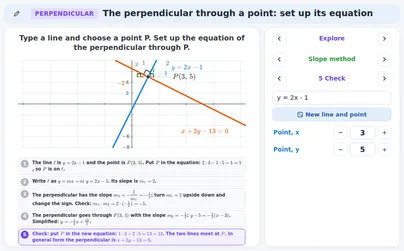
Two stages set up the perpendicular through a point P: find the slope m1 of the line, turn it into m2 = -1/m1 (upside down, sign changed), then write the line through P with y - y1 = m2(x - x1). A horizontal line and a vertical line are perpendicular to each other, with no slope to turn over. Check by multiplying the two slopes: the product must be -1.
Example
Line y = 2x - 1, point P(3, 5) (P is on the line: 2 x 3 - 1 = 5). Slope m1 = 2, so m2 = -1/2. The perpendicular: y - 5 = -1/2(x - 3), that is y = -1/2 x + 13/2. Check: m1 x m2 = 2 x (-1/2) = -1.
Watch out!
Equal slopes: parallel or the same line
Lines with equal slopes are parallel only when their y-intercepts differ. Equal slopes and one common point mean the same line. Compare the intercepts, or put a point of one line in the other.
Example
y=x+1 and 2y=2x+2 both have the slope 1 and the intercept 1: they are the same line, not parallel lines.
Watch out!
Percent, 1 : n and degrees are different numbers
Gradient 100m, ratio 1:n with n=m1 and angle tan−1m describe one steepness in three ways. A gradient of 100% is 45∘ (rise equals run), not 90∘. And the percent compares the rise with the ground distance, not with the length of the road.
Example
m=41: the gradient is 100⋅41=25 percent, the ratio is 1:4 and the angle is about 14∘.
Watch out!
Change divided by change, not a value divided by time
The rate is m=ΔtΔy, the change per unit of time. Dividing a reading by its time (y2÷t2) only works when the line goes through the origin.
Example
Battery: 90 percent at 1 h and 50 percent at 3 h: m=3−150−90=−20 per hour, not 350.
Special case
Special cases
A horizontal line has m=0 and a vertical line has no slope. A horizontal and a vertical line are perpendicular although m1⋅m2 does not exist: the rule needs two slopes. A line through the origin has n=0.
Example
y=3 and x=−2 are perpendicular: the slope angles are 0∘ and 90∘. The line y=2x goes through the origin (n=0) and has no intercept form.
Special case
Streets along the axes
A vertical street x=a has no slope and a horizontal street y=b has slope 0. They are perpendicular, although the rule m1m2=−1 cannot be used (a vertical line has no slope). They cross at (a,b). Two vertical streets are parallel.
Example
x=3 and y=1 cross at (3,1) at a right angle. The streets x=3 and x=5 are parallel and never meet.
Exercises
Find the slope of the line through A(−2,1) and B(4,4). Easy
Show solution
dx=4−(−2)=6 and dy=4−1=3.
m=dxdy=63=21.
Answer → m=21
Check: the line rises to the right, so m>0, and the rise is smaller than the run, so m<1.
Find the slope angle of the line with slope 1 and of the line with slope −1. Easy
Show solution
m=1>0: α=tan−11=45∘.
m=−1<0: the line falls, so α=180∘−tan−11=180∘−45∘=135∘.
Answer → 45∘ and 135∘
Check: 1⋅(−1)=−1, so the lines are perpendicular, and 135∘−45∘=90∘.
A line has the slope angle 30∘. Find its slope to 2 decimal places. Does the line rise or fall? Easy
Show solution
m=tan30∘.
m≈0.58.
0∘<30∘<90∘ and m>0: the line rises.
Answer → m≈0.58, the line rises
Check: tan45∘=1 and 30∘<45∘, so m must be below 1.
Write the equation of the line through P(2,−1) with slope 3. Easy
Show solution
Point-slope form: y−y1=m(x−x1).
y−(−1)=3(x−2), so y+1=3(x−2).
y=3x−6−1=3x−7.
Answer → y=3x−7
Check: x=2 gives y=3⋅2−7=−1.
A road rises 6 m over 75 m of ground. What is its gradient in percent? Easy
Show solution
m=756=0.08.
Gradient =100⋅0.08=8 percent.
Answer → 8%
Check: 8% is 8 m per 100 m, and 8⋅0.75=6 m per 75 m.
A ramp may have a slope of at most 1:12. It must rise 0.5 m. How much ground does it need at least? Easy
Show solution
A slope of 1:12 means rise =12run.
run=12⋅0.5=6 m.
Answer → at least 6 m
Check: 0.5÷6=121.
Find the equation of the line through P(−1,5) and Q(3,−3) and write it in general form. Medium
Show solution
m=3−(−1)−3−5=4−8=−2.
y−5=−2(x+1), so y=−2x+3.
General form: 2x+y−3=0.
Answer → y=−2x+3, that is 2x+y−3=0
Check with Q: −2⋅3+3=−3.
A line goes through P(1,2) with slope angle 135∘. Find its equation. Medium
Show solution
m=tan135∘=−1 (the line falls).
y−2=−1(x−1).
y=−x+1+2=−x+3.
Answer → y=−x+3
Check: x=1 gives y=2, and the slope −1 belongs to 135∘.
Are the lines 2x+y=5 and 4x+2y=7 parallel, crossing or the same? Medium
Show solution
Solve for y: y=−2x+5 and y=−2x+27.
m1=m2=−2: the lines are parallel or the same.
The intercepts 5 and 27 differ, so the lines are parallel and different.
Answer → parallel, different lines
Check with a point: (0,5) is on the first line, but 4⋅0+2⋅5=10=7, so it is not on the second.
Find where the lines y=2x−1 and x+y=5 meet. Medium
Show solution
The slopes are 2 and −1: different, so the lines cross in one point.
Put y=2x−1 in x+y=5: x+2x−1=5, so 3x=6 and x=2.
y=2⋅2−1=3.
Answer → the meeting point (2,3)
Check: 2+3=5 and 2⋅2−1=3.
Find the line through P(4,0) that is perpendicular to y=2x−3. Medium
Show solution
The given line has the slope 2, so the perpendicular slope is m=−21.
Point-slope form: y−0=−21(x−4).
y=−21x+2.
Answer → y=−21x+2
Check: 2⋅(−21)=−1, and x=4 gives y=−2+2=0.
Write 3x−4y=12 in intercept form and find where the line crosses the axes. Medium
Show solution
Divide by 12: 123x−124y=1, so 4x+−3y=1.
So a=4 and b=−3.
The line crosses the axes at (4,0) and (0,−3).
Answer → 4x+−3y=1; (4,0) and (0,−3)
Check: 3⋅4=12 and −4⋅(−3)=12.
A roof has run 8 m and rise 6 m. Find its slope, its slope angle to the nearest degree and the length of a rafter. Medium
Show solution
m=86=43.
α=tan−10.75≈37∘.
Rafter =82+62=100=10 m.
Answer → m=43, α≈37∘, rafter 10 m
Check: the rafter 10 is more than the run 8 and less than 8+6=14.
After 1 week you have 45 euro saved, after 4 weeks 75 euro, and you save the same amount every week. Write y=mt+n and find the savings after 10 weeks. Medium
Show solution
m=4−175−45=330=10 euro per week.
n=45−10⋅1=35, so y=10t+35.
After 10 weeks: y=10⋅10+35=135 euro.
Answer → y=10t+35; 135 euro
Check: t=4 gives 10⋅4+35=75.
Two streets follow y=2x+1 and y=−x+7 (1 square = 10 m). Where do they meet, and what is the acute angle between them to 1 decimal place? Medium
Show solution
2x+1=−x+7, so 3x=6, x=2 and y=2⋅2+1=5.
The slope angles: tan−12≈63.4∘ and 180∘−tan−11=135∘.
The angle between: 135∘−63.4∘=71.6∘.
Answer → they meet at (2,5); the angle is about 71.6∘
Check: (2,5) in y=−x+7 gives −2+7=5.
Find the angle between the lines y=x and y=3x+2 to 1 decimal place. Hard
Show solution
The slope angles are α1=tan−11=45∘ and α2=tan−13≈71.6∘.
The difference is d=71.6∘−45∘=26.6∘.
d≤90∘, so the angle between the lines is 26.6∘.
Answer → 26.6∘
Check: both lines rise and the second is only a bit steeper, so the angle between them is small, below 45∘.
The line 3x+ky=6 is perpendicular to y=2x+1. Find k. For which k is it parallel to y=2x+1? Hard
Show solution
Solve for y: y=−k3x+k6, so the slope is m=−k3.
Perpendicular: −k3⋅2=−1, so 6=k.
Parallel: −k3=2, so k=−23.
Answer → k=6 (perpendicular) and k=−23 (parallel)
Check with k=6: the slope is −63=−21 and 2⋅(−21)=−1.
Show that the triangle A(0,0), B(4,2), C(−1,2) has a right angle at A and find the slope angles of AB and AC. Hard
Show solution
The slope of AB is 42=21 and the slope of AC is −12=−2.
The product is 21⋅(−2)=−1, so AB⊥AC: a right angle at A.
αAB=tan−121≈26.6∘ and αAC=180∘−63.4∘=116.6∘: they differ by 90∘.
Answer → right angle at A; 26.6∘ and 116.6∘
Check: AB2+AC2=20+5=25=BC2.
A phone battery shows 85 percent after 1 hour and 55 percent after 4 hours, and loses charge steadily. Write v=mt+n and find when the battery is empty. Hard
Show solution
m=4−155−85=3−30=−10 percent per hour.
n=85−(−10)⋅1=95, so v=−10t+95.
Empty: 0=−10t+95, so t=9.5 hours.
Answer → v=−10t+95; empty after 9.5 hours
Check: t=4 gives −10⋅4+95=55.
Is the point C(5,7) on the line through A(−1,−2) and B(3,4)? Hard
Show solution
m=3−(−1)4−(−2)=46=23.
Point-slope form with A: y+2=23(x+1).
Put x=5: y+2=23⋅6=9, so y=7. The point (5,7) is on the line.
Answer → yes, C is on the line
Check with the slope of AC: 5−(−1)7−(−2)=69=23, the same slope.
A tank holds 90 litres at minute 3 and 60 litres at minute 5 and loses water steadily. Write y=mt+n and find the minute when it is empty. Hard
Show solution
m=5−360−90=2−30=−15 litres per minute.
n=90−(−15)⋅3=135, so y=−15t+135.
Empty: −15t+135=0, so t=9.
Answer → y=−15t+135; empty at minute 9
Check: t=5 gives −15⋅5+135=60.
A road sign shows −10%. After 300 m of ground, how many metres has the road dropped, and what is the angle below the horizontal to 1 decimal place? Give the slope angle α too. Hard
Show solution
m=−0.10, so the drop is 0.10⋅300=30 m.
Below the horizontal: tan−10.1≈5.7∘.
The line falls, so α=180∘−5.7∘=174.3∘.
Answer → 30 m; 5.7∘ below the horizontal; α≈174.3∘
Check: tan5.7∘≈0.1, a gentle slope, far from 45∘.
Interactive applications for this topic
Free applications open with a free student account. Teachers can use all applications in a live lesson.