İnteraktif Dersler

Special equations and inequalities, parameters and moving points

Lecture notes

Definition

An equation with x in a denominator

When x stands in a denominator, first write down the values of x that make a denominator 0: they are not allowed. Then multiply both sides by the denominator, solve the equation and check every candidate. A candidate that makes a denominator 0 is a false solution. In Fractions you choose one of three forms and see the steps and both sides as graphs.
Example
Solve . Not allowed → . Multiply both sides by x − 1 → , so and . Check → and is allowed. Another equation, , gives the candidate . But makes the denominator 0: it is a false solution and the equation has no solution.
Watch out!

A root equation: check the candidates

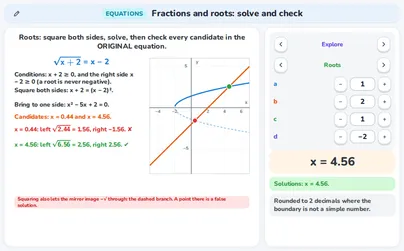
Squaring both sides of a root equation can add a candidate that is not a solution. A root is never negative, so the right side must be at least 0 as well. Put every candidate in the ORIGINAL equation, not in the squared one. In the graph the squared equation also holds on the dashed mirror branch −√: a point there is a false solution. In Roots you choose √(a x + b) = c x + d and see every candidate checked.
Example
Solve . Square → , so and → candidates and . Check → left , right 3: equal. Check → left , right −1: not equal, a false solution on the dashed branch. The solution is .
−2−112345−3−2−112345xy(3, 3)(−1, −1)solutionfalse solution
Rule

An inequality with a fraction: the sign table

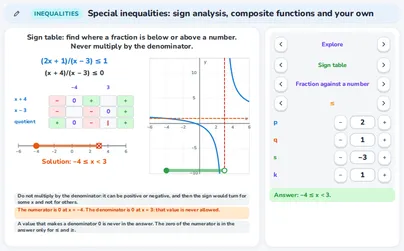
Bring everything to one side and make ONE fraction. Find the zero of the numerator and the zero of the denominator, put them in a sign table and write the sign of the numerator, of the denominator and of the fraction on every part. Read the answer from the signs of the fraction. The zero of the numerator belongs to the answer only for ≤ and ≥; the zero of the denominator never does. In Sign table you see the table, the number line and the graph.
Example
Solve . One side → . Zeros → (numerator) and (denominator). The fraction is + for , − for and + for . We need ≤ 0, so . At the fraction is 0, so 4 is in the answer; at the fraction has no value.
x−34numerator−−+0denominator−++fraction+−+0x−34
Rule

A composite function: u first, then x

A composite function such as √(5 − 2x) is a chain: first , then the outer function √u. Solve the inequality for u first and go back to x afterwards. √u, 2^u and log₂ u grow with u, so the sign stays. 1/u falls on each side of 0, so the sign turns and the two sides of 0 are done apart. Check the domain: √u needs u ≥ 0, log₂ u needs u > 0 and 1/u needs u ≠ 0. If a in u = a x + b is negative, the ends turn round when you go back to x. In Composite function you choose one of six outer functions.
Example
Solve . Domain → . Square → . So is between 0 and 9. Back to x → gives and gives . Because is negative the ends turn round → .
u = 5 − 2x09x−22.5
Watch out!

Never multiply by the denominator

If you multiply both sides of by x − 2, you forget that x − 2 can be negative. For the sign stays, for it turns. A pupil who multiplies anyway finds only and loses all . Bring everything to one side and use the sign table. And in the answer the zero of the denominator is never included, also not with ≤ or ≥: the formula has no value there.
Example
becomes with the zeros and . The fraction is − for , + for and − for . Answer → or . Check → gives , which is below 2. gives , which is not below 2. gives , below 2.
x22.5numerator++−0denominator−++fraction−+−0x22.5
Tip

Your own equation or inequality

In Own equation and Own inequality you type f(x) and g(x) yourself. The application looks for solutions and boundary points between −50 and 50 (a note on the screen says so) and checks each one in the formula. A boundary that is not a simple number is rounded to 2 decimals: write “about”. A formula that has no value somewhere (a root of a negative number, a division by 0) is not an error: the screen says where. A search can miss a solution outside the range, so look at the graph too. A graphing calculator does the same with its intersection function.
Example
has three solutions → , and . Check → , and . For both sides are about 0.59.
Definition

A parameter: a family of graphs

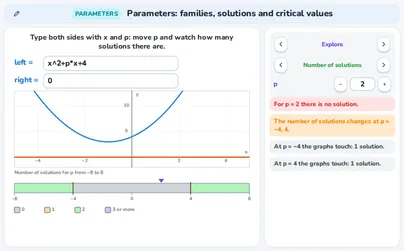
A formula with a letter p next to x, like , is a whole set of formulas: every value of p gives another graph. The letter p is a parameter. Look for what all the graphs have in common. Here every graph passes through (0, 4), because the term with p disappears at . In Family of graphs you type y = f(x, p) and move p; the graphs of the other whole values of p stay pale.
Example
. At the value is 4 for every p, so every graph passes through (0, 4). For p = 4 the formula is → the graph touches the x-axis at .
−4−2246−2246810xyp = 4(0, 4)
Rule

The number of solutions and the critical values

The number of solutions of an equation with a parameter can change with p. A value of p where it changes is a critical value. For look at the discriminant → D > 0 gives two solutions, D = 0 gives one and D < 0 gives none. D = 0 at p = −4 and at p = 4: these are the critical values. In Number of solutions a bar shows the number of solutions for p from −8 to 8 and marks the critical values.
Example
p = 5: D = , two solutions → and . p = 4: D = , one solution → . p = 3: D = , no solution. Check → .
Rule

Solve for x: the solution as a formula in p

To solve an equation with a parameter, treat p like a number: bring the terms with x together and write x as a formula in p. Then look at the values of p for which this does not work, such as a division by 0. For such a p the equation has either no solution or every x as a solution. Writing the solution as a formula in p is what the exams ask. In Solve for x you choose one of four templates and see x against p.
Example
Solve . Bring the x terms together → . For p ≠ 3 → . For p = 5 this gives , for p = 0 it gives . Check p = 5 → . For p = 3 the left side has no x and the numbers differ (0 and 6): no solution.
Definition

A point on a circle: a parametric description

A point that moves on a circle with centre (p, q) and radius r can be described by x(t) = p + r cos(w t) and y(t) = q + r sin(w t). The time t is the parameter. The number w says how fast the point turns; one round takes 2π ÷ w. If you leave out t (cos² + sin² = 1) you get the equation of the path: (x − p)² + (y − q)² = r². In Circle path you set p, q, r, w and the time.
Example
, → centre (2, 1), radius 3, one round takes π. At t = 0 the point is at (5, 1). At t = π/4 the angle 2t is π/2 and the point is at (2, 4). The path is . Check the point → .
−2−1123456−3−2−112345xyP
Rule

Velocity, speed and the tangent

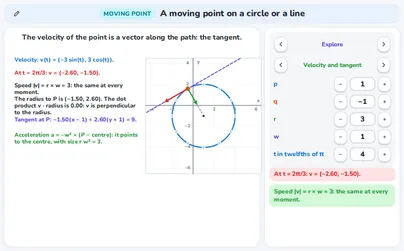
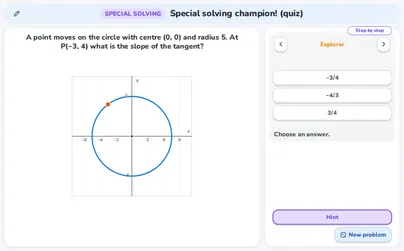
The velocity of a moving point is the vector v(t) = (x′(t), y′(t)). It lies along the path, so it points in the direction of the tangent. On a circle x′(t) = −r w sin(w t) and y′(t) = r w cos(w t). The speed |v| = r × w is the same at every moment and v is perpendicular to the radius: their dot product is 0. The acceleration points to the centre and has size r w². The tangent line goes through P in the direction of v. In Velocity and tangent you see all this at a moment that you choose.
Example
On the path of the last card at t = π/4: v = (−6, 0) and the speed is . The radius to P is (0, 3) and → v is perpendicular to the radius. The tangent through P = (2, 4) with direction (−6, 0) is horizontal → . The acceleration is (0, −12), of size , towards the centre.
−2−1123456−3−2−112345xytangentvelocityP
Rule

A line that meets a circle: when is the point inside?

A point that starts at (x₀, y₀) with velocity (vx, vy) is at (x₀ + vx t, y₀ + vy t) at time t. It is on the circle when → a quadratic equation in t. D > 0: the point enters and leaves at two moments; D = 0: it just touches; D < 0: it never reaches the circle. The moment of closest approach to the origin is t = −(x₀ vx + y₀ vy) ÷ (vx² + vy²). In A line meets a circle you set the start, the velocity and R.
Example
A point starts at (−5, 3) with velocity (2, 0): its place is . On the circle → , so or → t = 4.5 (it leaves, at (4, 3)) and t = 0.5 (it enters, at (−4, 3)). Closest approach: t = , at (0, 3), distance 3.
Tip

Typing formulas and keeping them private

In the own tabs you type formulas with x (and p or t where the tab says so): + − × ÷ ^, brackets, and sqrt, abs, ln, exp and log2. You may write or , and a comma or a point for a decimal. A formula that cannot be read gets a message that tells what to change. Everything you type or choose stays in your browser: nothing is stored and nothing is sent anywhere. Every stepper, choice and button also works by keyboard.
Example
Type for , for and for . The formula has no value at → the screen says so instead of showing an error.

Exercises

Solve and check the answer. Easy
Show solution
Not allowed → , so .
Multiply both sides by and expand the bracket → , so and .
Check → is allowed and .
A candidate is only a solution when the original equation holds and no denominator is 0.
Solve . Easy
Show solution
Zeros → (numerator) and (denominator).
Signs of the fraction: + for , − for and + for .
x−13numerator−−+0denominator−++fraction+−+0x−13
We need > 0: the two outer parts.
or
The inequality is strict, so is not in the answer; never is, because the fraction has no value there.
Solve for x. What is x for p = 2? Which value of p is not allowed? Easy
Show solution
Multiply both sides by p (p ≠ 0) → .
So .
For p = 2 → . Check → .
The value p = 0 is not allowed: the fraction has no value.
x = 4p − 3; for p = 2, ; p = 0 is not allowed
Writing x as a formula in p gives the solution for every allowed value of p at once.
Solve and check the candidates in the original equation. Medium
Show solution
Square both sides → , so and . Candidates → and .
Check → left , right → equal, a solution.
Check → left , right → not equal, a false solution.
The right side must be at least 0: that rules out at once.
Solve . Medium
Show solution
Bring everything to one side → .
Zeros → (numerator) and (denominator).
Signs of the fraction: + for , − for and + for .
x−31numerator−++0denominator−−+fraction+−+0x−31
We need ≥ 0 → (the zero of the numerator is in) or ( has no value).
or
Multiplying by x − 1 would have lost the part .
A point moves with and . Find its place at t = π/6, its speed there and the equation of its path. Medium
Show solution
The centre is (1, −2), r = 2 and w = 3. At t = π/6 the angle 3t is π/2, so P = (1, 0).
The velocity is v(t) = (−6 sin 3t, 6 cos 3t). At t = π/6: v = (−6, 0) and the speed is .
−2−11234−5−4−3−2−112xytangentvelocityP
The path is . Check P → .
P = (1, 0), speed 6, path
The radius to P is (0, 2) and → v is perpendicular to the radius, so the tangent at P is the line .
For which positive value of p does have exactly one solution? What is that solution? Hard
Show solution
One solution means , so .
So p = 6 or p = −6; the positive one is p = 6.
Then , so . Check → .
The critical values are p = −6 and p = 6. For p = 7: D = , so two solutions.
p = 6, with
For |p| > 6 there are two solutions and for |p| < 6 there is none.
Solve . How many whole numbers are in the answer? Hard
Show solution
Domain → , so .
log₂ u grows with u, so the sign stays → . With → .
So 0 < u ≤ 8. Back to x → , so and .
u = 2x − 308x1.55.5
The whole numbers with are 2, 3, 4 and 5: 4 numbers.
; four whole numbers
The domain gives the open end; ≤ gives the closed end.
A point starts at (−8, −3) with velocity (2, 1). When is it inside the circle , and how close does it get to the origin? Hard
Show solution
The place is , so .
On the circle → , so with D = .
t = and t = → the point is inside for 1.6 < t < 6.
Closest approach: t = . Then and the distance is .
inside for 1.6 < t < 6; least distance about 0.89, at t = 3.8
The moment of closest approach lies in the middle of the entering and leaving moments → .
Are you a teacher?

Start live lessons with these applications for your whole class. Free to try for one month.

Try it free

Fits these school years

IB (MYP, Diploma): MYP 4, MYP 5, Diploma, year 1, Diploma, year 2

Cambridge International: IGCSE, AS Level, A Level

Netherlands: Year 3 (havo, vwo), Havo · Mathematics B, Vwo · Mathematics B

Türkiye (MEB): Year 9 (MEB), Year 10 (MEB), Year 11 (MEB), Year 12 (MEB)

England (GCSE, A Level): Year 10 (GCSE), Year 11 (GCSE), Year 12 (A Level), Year 13 (A Level)

USA (Common Core): Algebra 1, Algebra 2, Precalculus

What the applications of this topic teach 4 applications

Fractions, roots and the check

  • Solving an equation with x in a denominator and checking
  • Solving a root equation and naming the false solution
  • Typing an own equation f(x) = g(x) and reading its solutions

Special inequalities: sign analysis, composite functions and your own

  • Solving an inequality with a fraction using a sign table
  • Solving an inequality with a composite function: first u, then x
  • Knowing that a zero of the denominator is never in the answer

Parameters: families, solutions and critical values

  • Seeing a formula with a parameter as a family and finding the shared point
  • Finding how many solutions there are for a value of p
  • Writing the solution as a formula in p and naming the exceptions

A moving point on a circle or a line

  • Describing a point moving on a circle with x(t) and y(t)
  • Finding velocity, speed and tangent line at a moment
  • Finding when a point on a line is inside a circle