
Kinds of data: categorical, discrete, continuous Plus
This application is part of Plus
Plus opens all applications: € 4,99 per month or € 19,90 per year. Log in to your account; no account yet? Make a free one first, then you can look at Plus.
Are you a teacher? Teacher login
Your own teacher subscription already includes every application, Plus included — there is nothing extra to buy.
What this application teaches
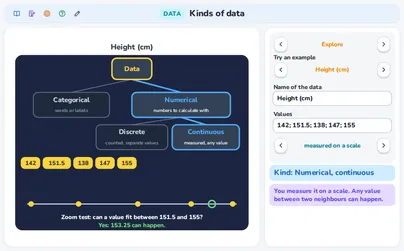
- I can tell categorical data (words or labels) from numerical data, and I know categories can have an order (small, medium, large).
- I know that numbers used only as names (shirt number, bus line) are categorical: I cannot calculate with them.
- I can tell discrete data (counted, separate values) from continuous data (measured, any value) and I know a measured value is rounded: 152 cm stands for 151.5 ≤ h < 152.5.
Fits these school years
IB (MYP, Diploma): PYP, MYP 1, MYP 2, MYP 3, MYP 4, MYP 5, Diploma, year 1, Diploma, year 2
Cambridge International: Primary, stage 4, Primary, stage 5, Primary, stage 6, Lower Secondary, stage 7, Lower Secondary, stage 8, Lower Secondary, stage 9, IGCSE
Netherlands: Groep 6, Groep 7, Groep 8, Year 2, Year 3 (havo, vwo), Havo · Mathematics A, Vwo · Mathematics A, Vwo · Mathematics C, Groep 5, Vmbo bb (years 3-4), Vmbo kb (years 3-4), Vmbo gt (years 3-4)
Türkiye (MEB): Year 5 (MEB), Year 6 (MEB), Year 7 (MEB), Year 8 (MEB), Year 9 (MEB), Year 10 (MEB), Year 12 (MEB)
England (GCSE, A Level): Year 4, Year 5, Year 6, Year 7, Year 8, Year 9, Year 10 (GCSE), Year 11 (GCSE), Year 12 (A Level), Year 13 (A Level)
USA (Common Core): Grade 5, Grade 6, Grade 3, Grade 4, Grade 7, Grade 8, Algebra 1, Algebra 2
Similar applications
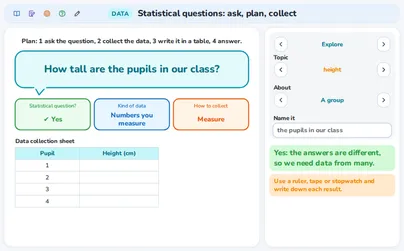 DemoStatistical questions: ask, plan, collect
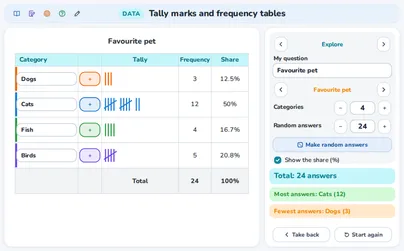 PlusTally marks and frequency tables
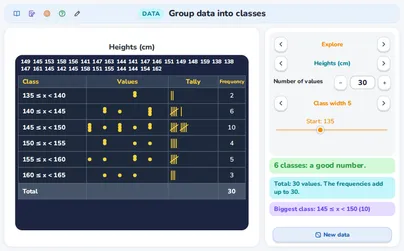 PlusGroup data into classes
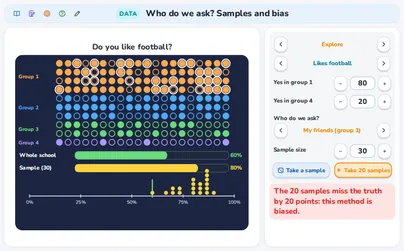 PlusWho do we ask? Samples and bias
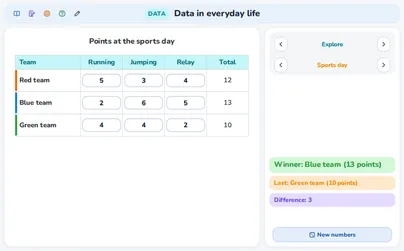 PlusData in everyday life
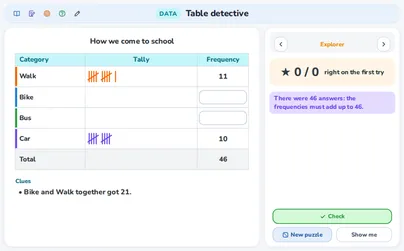 PlusTable detective
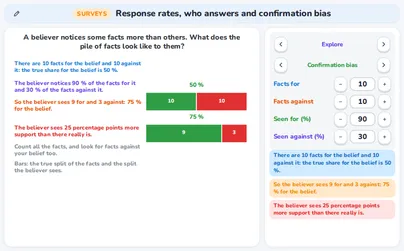 PlusResponse rates, who answers and confirmation bias
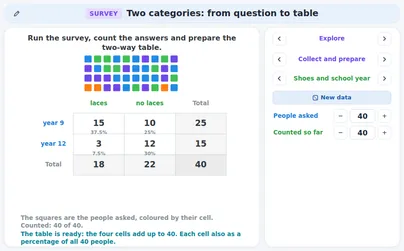 PlusTwo categories: from question to table
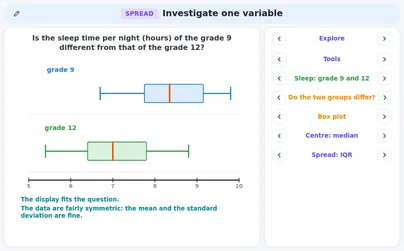 PlusInvestigate one variable
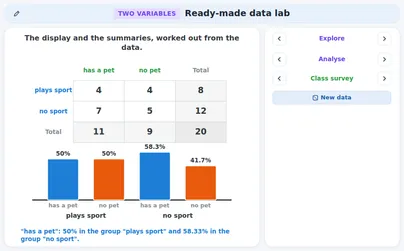 PlusReady-made data lab
Read the lecture notes: Data: collect, tally, group and sample