
Class round, primary school edition: the whole class at once Plus
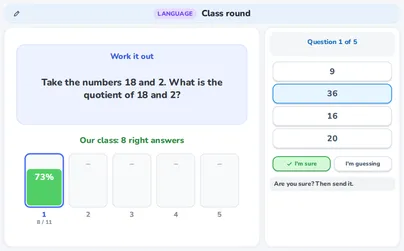
This application is part of Plus
Plus opens all applications: € 4,99 per month or € 19,90 per year. Log in to your account; no account yet? Make a free one first, then you can look at Plus.
Are you a teacher? Teacher login
Your own teacher subscription already includes every application, Plus included — there is nothing extra to buy.
What this application teaches
- I know what the words numerator, parallel, mean and prime number mean.
- I know that so and therefore join a reason to its result, that a chain of equal signs must stay equal and that a good answer is a sentence with the number and the unit.
- I can tell what is true and what is a myth: the sum of 12 and 4, the chain 3 + 4 = 7 + 2 = 9, a billion and the word “because”.
- I know the words and rules of this topic.
Fits these school years
IB (MYP, Diploma): MYP 1, MYP 2, MYP 3
Cambridge International: Lower Secondary, stage 7, Lower Secondary, stage 8, Lower Secondary, stage 9, Primary, stage 6
Netherlands: Year 1, Year 2, Year 3 (havo, vwo), Vmbo bb (years 3-4), Vmbo kb (years 3-4), Vmbo gt (years 3-4), Groep 7, Groep 8
Türkiye (MEB): Year 5 (MEB), Year 6 (MEB), Year 7 (MEB), Year 8 (MEB)
England (GCSE, A Level): Year 7, Year 8, Year 9, Year 6
USA (Common Core): Grade 6, Grade 7, Grade 8, Grade 5
Similar applications
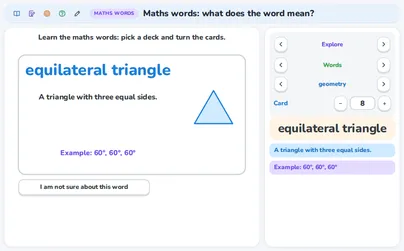 FreeMaths words: what does the word mean?
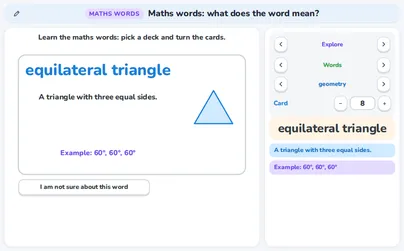 PlusMaths words, primary school edition: what does the word mean?
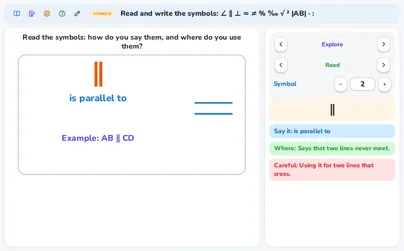 PlusRead and write the symbols: ∠ ∥ ⊥ ≈ ≠ % ‰ √ ² |AB| · :
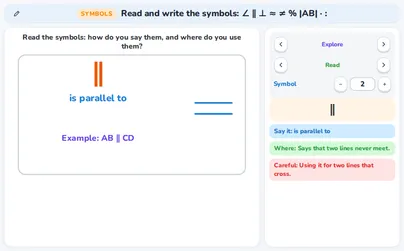 PlusRead and write the symbols, primary school edition: ∠ ∥ ⊥ ≈ ≠ % |AB| · :
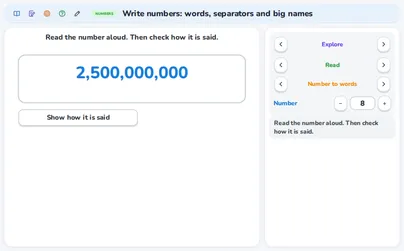 PlusWrite numbers: words, separators and big names
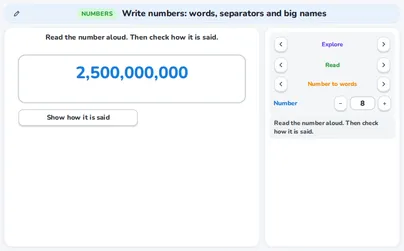 PlusWrite numbers, primary school edition: words, separators and big names
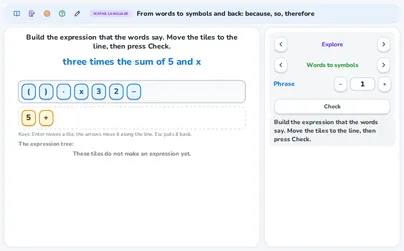 PlusFrom words to symbols and back: because, so, therefore
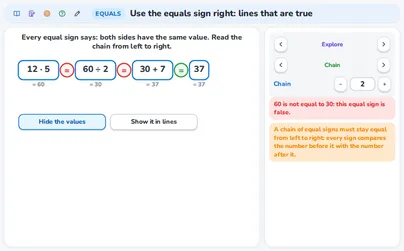 PlusUse the equals sign right: lines that are true
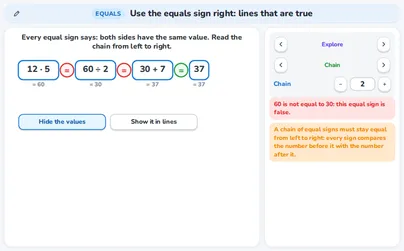 PlusUse the equals sign right, primary school edition: lines that are true
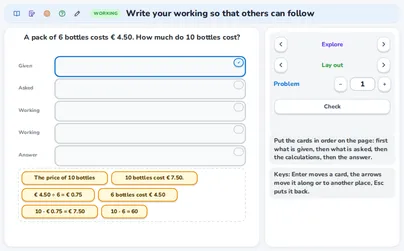 PlusWrite your working so that others can follow
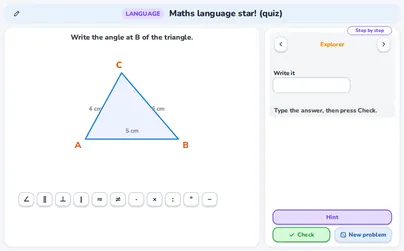 PlusMaths language star! (quiz), primary school edition
Read the lecture notes: Maths language: words, symbols and working