Back to the lecture notes: Estimating and number structures 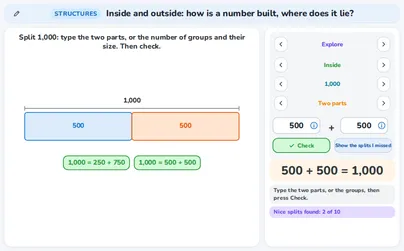
Inside and outside: how is a number built, where does it lie? Plus
This application is part of Plus
Plus opens all applications: € 4,99 per month or € 19,90 per year. Log in to your account; no account yet? Make a free one first, then you can look at Plus.
Are you a teacher? Teacher login
Your own teacher subscription already includes every application, Plus included — there is nothing extra to buy.
What this application teaches
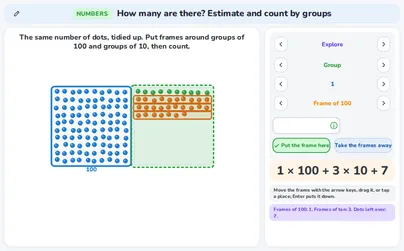
- I can split a number such as 1 000 into two parts or into equal groups: 1 000 = 500 + 500 = 4 × 250, and I can find all the nice splits.
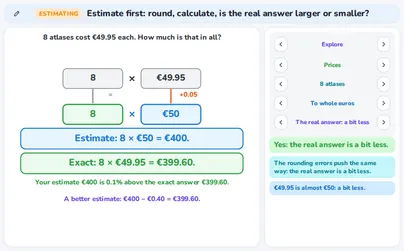
- I can say where a number lies between round numbers: 998 lies close to 1 000, 489 is closer to 500 than to 400 and 450 is exactly halfway.
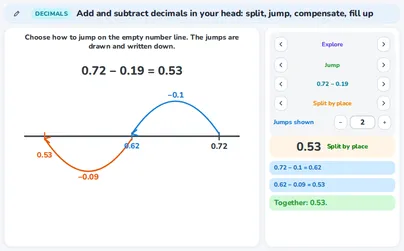
- I can do the same with decimals: 1 = 0.75 + 0.25, 2 = 10 × 0.2, 0.98 lies close to 1 and 1.2 is halfway between 1.1 and 1.3.
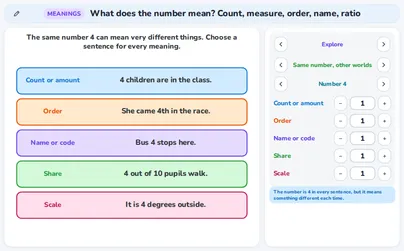
- I can see that different structures can make the same number: 2 × 500 = 4 × 250.
Fits these school years
IB (MYP, Diploma): PYP, MYP 1, MYP 2, MYP 3
Cambridge International: Primary, stage 4, Primary, stage 5, Primary, stage 6
Netherlands: Groep 5, Groep 6, Groep 7, Year 1, Groep 8
Türkiye (MEB): Year 3 (MEB), Year 4 (MEB), Year 5 (MEB), Year 6 (MEB)
England (GCSE, A Level): Year 4, Year 5, Year 6
USA (Common Core): Grade 3, Grade 4, Grade 5