The rate triangle: speed, density, price, flow
This is a demo, open for everybody. A free account opens 140+ applications; Plus opens all of them.
Make a free account Log inWhat this application teaches
- I can work out a rate: total ÷ amount.
- I can work out the total: rate × amount.
- I can work out the amount: total ÷ rate.
- I can compare two places by the people in every km², not by the total: Riverton has more people in all than Marketville, but fewer in every km².
- I can compare two things by the grams in every cm³ and say which one is denser.
How to use it
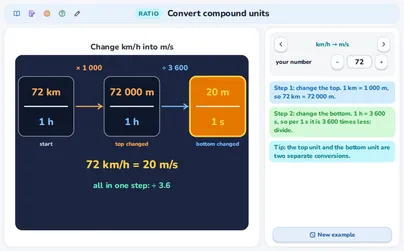
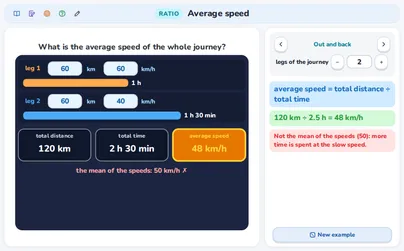
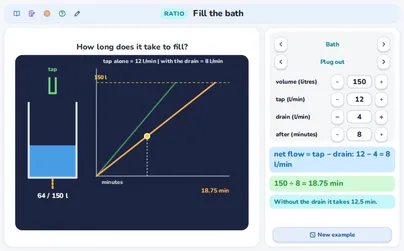
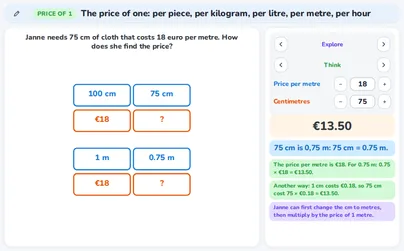
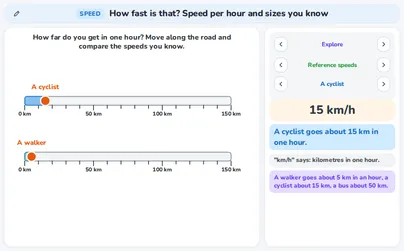
Aim: Choose a situation (speed, density, pressure, price per unit, flow, population density) and type two of the three numbers. The three boxes make the triangle: the top number, the rate and the bottom number. The third number is worked out for you, with the formula and a ratio table that shows what the rate means: 75 km/h is 75 km in 1 hour, so 150 km in 2 hours. A switch Compare puts two places or two things side by side.
- Choose a situation and what you want to find: the rate, the top number or the bottom number.
- Type the two known numbers in the boxes of the column.
- Look at the triangle: the gold box is the answer. The gold line shows the formula.
- Read the ratio table: the rate is the amount for 1. The arrow shows the multiplier.
- New example gives new numbers.
- At the bottom of the right-hand column the switch has two names: Rate triangle and Compare. Choose Compare, then Two places or Two things. For each of the two items choose one with the arrows.
- Two places: 8 invented towns (Riverton, Oakdale, Hillcrest, Lakeside, Marketville, Stonebridge, Eastport, Pinewood) and My town; for My town set People (500 to 1 000 000, in steps of 500) and Area (km²) (1 to 500). Say which place is more crowded by pressing its name, or The same. Then both densities appear, as numbers (people ÷ area) and as bars, and a gold tag marks the more crowded place.
- Watch the trap: Riverton has more people in all (52 000 against 36 000) but fewer in every km² (2 600 against 4 000), so Marketville is more crowded. The page warns you whenever the bigger total is not the denser one.
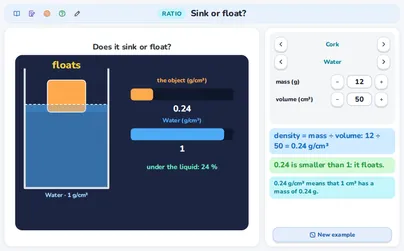
- Two things: 6 things (a block of wood, a block of iron, a block of aluminium, a bottle of water, a block of ice and a bottle of cooking oil), compared by the grams in every cm³. A bottle of water has more mass than a block of aluminium (500 g against 270 g) but less in every cm³ (1 g against 2.7 g), so the aluminium is denser.
- Nothing you type or choose in this application is sent anywhere. The keyboard works too: Tab moves from control to control, Enter (or the space bar) presses a button, the up and down arrow keys change the number in a box and Esc closes a help window.
Tip for teachers: Ask: “Which number is the total, and for how much is the rate?” The rate is always for 1. Ask first: “Which place has more people in all? Which has more in every km²?” The towns are invented.
Fits these school years
IB (MYP, Diploma): MYP 1, MYP 2, MYP 3, MYP 4, MYP 5, PYP
Cambridge International: Lower Secondary, stage 8, Lower Secondary, stage 9, IGCSE, Primary, stage 4, Primary, stage 5, Primary, stage 6
Netherlands: Groep 8, Year 1, Year 2, Year 3 (havo, vwo), Vmbo bb (years 3-4), Vmbo kb (years 3-4), Vmbo gt (years 3-4), Havo · Mathematics A, Vwo · Mathematics A, Vwo · Mathematics C, Groep 5, Groep 6, Groep 7
Türkiye (MEB): Year 7 (MEB), Year 8 (MEB), Year 4 (MEB), Year 5 (MEB), Year 6 (MEB)
England (GCSE, A Level): Year 8, Year 9, Year 10 (GCSE), Year 4, Year 5, Year 6
USA (Common Core): Grade 7, Grade 8, Grade 4, Grade 5, Grade 6