Secant to tangent: the slope at a point
This is a demo, open for everybody. A free account opens 140+ applications; Plus opens all of them.
Make a free account Log inWhat this application teaches
- I can find the slope of the secant (the difference quotient) between two points of a graph I typed (MEB 12.4.5).
- I can slide Q towards A and see the secant become the tangent, from the right and from the left.
- I can read f′(a) as the limit of the quotient, the slope of the tangent and the instantaneous rate of change.
- I can guess the rule for f′ of xⁿ, √(x) and 1/x from tables and test my guess at six points.
How to use it
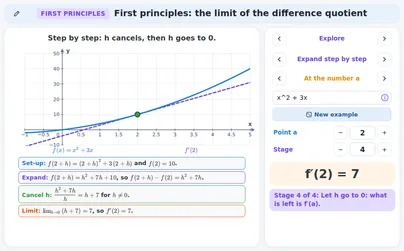
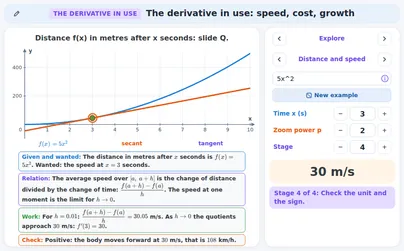
Aim: Type a function and a point, drag the second point Q towards A and watch the secant turn into the tangent while the table of quotients settles on a number. Then guess the derivative of a function yourself and let the tool test your guess.
- In Explore choose Secant to tangent. Type your own function in the field (for example x^2, sqrt(x) or 1/x; a point or a comma for decimals). A red message tells you what could not be read. New example gives a new function and a new point.
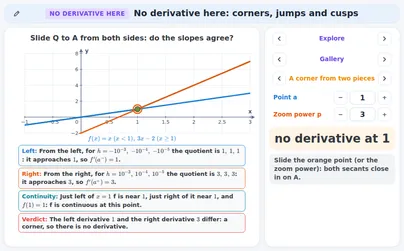
- Set Point a. Drag the orange point Q along the graph (the arrow keys also move it), or change Zoom power p so that h=10^(-p). Choose From the right (h > 0) or From the left (h < 0).
- Read the rows Secant, Table, Limit and Meaning: the slope of the secant with your numbers, the table of quotients for h=±1 down to ±0.0001, the limit from both sides and f′(a) as the slope of the tangent.
- Choose Guess f′ from tables. Type f and your own guess g(x) for f′: the tool finds f′ as a limit at six points and marks each guess in Check; Limits shows the numbers.
- In Guess first choose the answer before you look at the picture; then Next one gives another question.
- In Practice choose a level (Starter, Explorer or Champion), type or choose the answer and press Check. Stuck? Press Hint; Next step shows the solution one step at a time and Show answer gives the answer. Step by step switches the help.
Tip for teachers: Ask: “Why can we not just put h=0?” and “What happens at a point where f has no value on one side?” Try √(x) at a=0 and 1/x near 0. A guess that fits at five points can still fail at the sixth: one counter-example is enough. Next: “Derivative table”.
Fits these school years
IB (MYP, Diploma): Diploma, year 1, Diploma, year 2
Cambridge International: IGCSE, AS Level
Netherlands: Havo · Mathematics A, Havo · Mathematics B, Vwo · Mathematics A, Vwo · Mathematics B
Türkiye (MEB): Year 12 (MEB)
England (GCSE, A Level): Year 12 (A Level), Year 13 (A Level)
USA (Common Core): Calculus