İnteraktif Dersler
Lecture notes Exercises

The derivative as a limit

Lecture notes

Definition

The average rate of change and the secant

The average rate of change of from to is the change in divided by the change in : . On the graph it is the slope of the secant through the points at and : rise over run. A positive value means rises on average, a negative value that it falls.
xyΔxΔyAB
Example
from to : . The secant through and has slope .
xy212AB
Definition

The difference quotient

Write the second point as . The slope of the secant through and is the difference quotient with . The number may be negative: then lies to the left of .
1234246810xyhΔyAQ
Example
, and : . For : .
Rule

From secants to the tangent

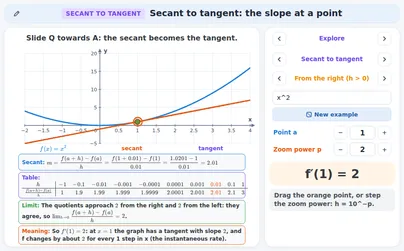
Let slide along the graph towards , so . The secants settle on one line, the tangent at , and their slopes (the difference quotients) settle on a number: the slope of the tangent. Check both sides: and must give the same number.
1234246810xyA
Example
at : gives , gives , gives and gives . The quotients approach from both sides, so the tangent has slope .
Definition

The derivative at a point

The derivative of at is the limit of the difference quotient: , when this limit is a number. Then is differentiable at . The second form puts .
Example
at : , which approaches . So .
Definition

The tangent line

If exists, the tangent at has slope and equation . A positive means the graph rises at , a negative one that it falls, and a horizontal tangent.
xy1mA
Example
at : and , so .
xy14A
Definition

The instantaneous rate of change

The instantaneous rate of change at one moment is the derivative: the limit of the average rate over as . For a distance it is the speed at , written . Its unit is the unit of per unit of .
123420406080tsA
Example
metres after seconds, at : the quotient is , which approaches . The speed after seconds is m/s.
Rule

The derivative of x to the power n

For with a positive whole number, . Proof from the definition: (the dots hold the terms with and higher powers), so : every term after the first keeps a factor .
−1123−4481216xyA
Example
: the quotient is , and it approaches . At the slope is .
Rule

The derivative of 1/x

For with , . Proof: use a common denominator, . The slope is negative everywhere: the graph falls.
12345123xyA
Example
At : and , so the tangent is .
Rule

The derivative of the square root

For with , . Proof: multiply top and bottom by the conjugate : .
24681234xyA
Example
At : and , so the tangent is .
Definition

The left and the right derivative

The left derivative is ( to the left of ) and the right derivative is ( to the right). exists exactly when both exist and are equal.
xyA21
Example
for and for , at : left and right . Since there is no derivative at : a corner.
Special case

A smooth join of two pieces

A function in two pieces is differentiable at the join when the pieces meet (the same value at , so is continuous) and have the same slope there (equal left and right derivatives). Two conditions give two equations.
−1123−2246xyA
Example
for and for . Same value: . Same slope: , the slope of at . So and : the line is the tangent of the parabola at .
Special case

A corner: the absolute value

is continuous at but has a corner there: is for and for . The left and right derivatives are and ; they differ, so does not exist. At every other point has a derivative, or .
−3−2−1123−1123xy−11
Example
: . : . A smaller changes nothing: there is no limit.
Special case

A vertical tangent: the cube root

is continuous at , but grows without end on both sides. The tangent is the vertical line , and a vertical line has no slope, so does not exist.
−3−2−1123−2−112xy
Example
: . : . The quotients keep growing.
Special case

A cusp

is continuous at , but is large and positive for and large and negative for . Both sides are infinite with opposite signs: a cusp. The graph points straight up at , and again there is no derivative.
−3−2−1123−1123xy
Example
: . : . : . : . The quotients leave every number, with opposite signs.
Special case

A jump or a hole

If is not continuous at (a jump, a hole, or no value at all), it has no derivative there: does not shrink to , so dividing by gives a quotient that grows without end.
−3−2−1123−112xy
Example
for and for , at : from the left , which is for and for .
Rule

Differentiable means continuous, not the other way round

If exists then is continuous at : is the quotient times , so it approaches . The other way round is false: , and are continuous at without a derivative. A corner is not a jump.
xyxy
Example
at : . For this is , for it is : it shrinks to .
Special case

Five ways to lose the derivative

Five ways to have no derivative at a point: a corner (the left and right slopes differ), a jump, a vertical tangent (the slope grows without end), a cusp (infinite, opposite signs) and a hole. Ask: is continuous at ? Do the quotients settle on a number from both sides?
xyxyxyxyxy
Example
is continuous everywhere. At the left derivative is and the right derivative is : a corner. At every other point the derivative is or .
Rule

The cost of the next item

In economics the derivative of the cost is the marginal cost: the rate at which the cost grows at items, in euros per item. It is close to the cost of the next item, , because is small compared with .
255075100200400600xCA
Example
euros at items: and , so the next item costs . The derivative is , so euros per item.
Rule

Read the sign and the unit

The sign of says what does: positive means increasing, negative decreasing, zero a flat moment. The unit of is the unit of per unit of : metres per second, euros per item, mg/L per hour. Always say it in words.
12344812162024tyA
Example
A ball thrown up: metres after seconds. . At the speed is m/s (up), at it is (the top) and at it is m/s (down).
Watch out!

Do not put h = 0 at the start

Putting straight into the difference quotient gives , which has no meaning. First expand and cancel the factor (allowed, because on the way), and only then let .
Example
at is . Expanding gives , and now gives .
Watch out!

Look at both sides

One side is not enough. The quotient from the right may settle on a number while the one from the left settles on another number, or on none. The average of the two is not the derivative. exists only when both one-sided limits exist and are equal.
−3−2−1123−1123xy
Example
at : right , left , and their average is wrong: there is no derivative. And at has values only for : grows without end from the right.
Tip

Newton, Leibniz and the notation

Newton and Leibniz both found the derivative in the 17th century, independently. Leibniz wrote for the limit of , a tiny change of over a tiny change of ; the prime came later. In physics is the speed. Discuss in class: why was the idea of a limit needed?
Example
: . So , which is at .
Tip

Where to look next

To see a limit up close open “Zoom in on a limit” and “Limits in everyday life” (limit-zoom, limits-in-life). The average rate is in “Average rate of change” and “The rate triangle” (rate-of-change, rate-triangle), and the V graph is in “The V graph” (absolute-v-graph). The next topic, the rules of differentiation, builds on the definition of this topic.
Example
Between and the distance grows by metres: an average speed of m/s. The speed at itself is m/s: shrink the stretch and the average comes closer.
Tip

The classic picture

For the classic picture of a secant turning into a tangent for open derivative-of-x-squared.
Example
The classic picture shows one function; the tools of this subgroup let you type your own function and drag the second point.

Exercises

Find the average rate of change of from to . Easy
xy315AB
Show solution
Work out the two values: and .
The change in is and the change in is .
The average rate of change is .
Check: it is the slope of the secant through and : up for to the right.
For the line find the difference quotient at with . What do you notice? Easy
Show solution
and .
.
A line has the same slope everywhere, so every gives .
, the slope of the line, for every
So for every : the tangent of a line is the line itself.
and . Work out the difference quotient for and for . What number do they approach? Easy
Show solution
: .
: .
The numbers and come down towards (for you get ).
and ; they approach
The limit is , the slope of the tangent at .
Find for from the definition: simplify the quotient and let . Easy
Show solution
.
Expand: .
Let : .
Check with the pattern: the slope of at is , and .
The slope of at is . Write the equation of the tangent at . Easy
Show solution
The point is .
The slope is .
.
Check: at the line gives , so it passes through .
Find for from the definition. Medium
Show solution
.
, so the numerator is .
Cancel : . Let : .
Check with the rule : .
Find for from the definition (use a common denominator). Medium
Show solution
.
Common denominator: .
Divide by : . Let : .
Check with : . The sign is negative: the graph falls.
Find for from the definition (use the conjugate). Medium
Show solution
.
Multiply top and bottom by : the top becomes .
Cancel : . Let : .
Check with : .
A cyclist is metres from the start after seconds. Find the speed at from the definition. Medium
Show solution
Given: . Wanted: the speed at , in m/s.
.
. The unit is metres per second.
m/s
Check: the average speed over the first seconds is m/s, and a cyclist who keeps speeding up has a higher speed at the end of it.
The cost of items is euros. Find the cost rate at from the definition and compare it with the cost of the next item. Medium
Show solution
and .
euros per item.
The next item: , so .
euros per item; the next item costs
The two numbers are close: for the quotient is .
for and for . Is differentiable at ? Find the left and the right derivative. Medium
Show solution
Continuity: and , so the pieces meet.
Left: . Right: .
: the left and right derivatives differ.
The left derivative is , the right derivative is : not differentiable at (a corner)
Continuous does not mean differentiable: the graph has no gap, but it bends at .
for and for . Find and so that is differentiable at . Medium
Show solution
Same value at : .
Same slope at : .
Then , so .
and
Check: the line is the tangent of at : .
Find for from the definition, and then . Hard
Show solution
Expand: .
.
Let : , and .
and
It fits the pattern with ; the coefficients come from Pascal’s triangle.
At which points does the graph of have a tangent with slope ? Use . Hard
Show solution
Solve , so .
or .
The points are and .
At and at
Both branches of the hyperbola fall, so both slopes are negative; by symmetry the two points are mirror images in the origin.
For each of , , and say whether the derivative at exists, and why. Hard
Show solution
: the quotient is from both sides, so .
: the quotient is from the right and from the left: a corner. : the quotient grows without end on both sides: a vertical tangent.
: the quotient is large positive from the right and large negative from the left: a cusp.
Only has a derivative at ; the other three are continuous at but have none
Four graphs, all without a gap at : continuity alone does not give a derivative.
Is differentiable at ? Look at the quotient from both sides. Hard
Show solution
and .
.
from the right and from the left, so .
Yes,
The absolute value in the formula does not guarantee a corner: here it multiplies by and smooths it out.
for and for . For which is continuous at ? Is then differentiable at ? Hard
Show solution
Continuity: , so and .
Left derivative: .
Right derivative: the slope of is . Both are .
, and then is differentiable at with
Here the slope condition holds by itself once the pieces meet; with other numbers it would be a second equation.
A ball is thrown up: metres after seconds. Find from the definition, the moment of the top and the speed at . Hard
Show solution
, so .
The top is where the speed is : , so seconds.
At : , so the speed is m/s: the ball is falling.
; the top at s; at the speed is m/s
Check: the top is at height m, and the minus sign means moving down.
Are you a teacher?

Start live lessons with these applications for your whole class. Free to try for one month.

Try it free

Fits these school years

IB (MYP, Diploma): Diploma, year 1, Diploma, year 2

Cambridge International: IGCSE, AS Level

Netherlands: Havo · Mathematics A, Havo · Mathematics B, Vwo · Mathematics A, Vwo · Mathematics B

Türkiye (MEB): Year 12 (MEB)

England (GCSE, A Level): Year 12 (A Level), Year 13 (A Level)

USA (Common Core): Calculus

What the applications of this topic teach 4 applications

Secant to tangent: the slope at a point

  • Finding the slope of the secant between two points of a graph
  • Sliding Q towards A and seeing the secant become the tangent
  • Reading f′(a) as the limit of the quotient and the instantaneous rate
  • Guessing the rule for f′ of xⁿ, √x and 1/x from tables

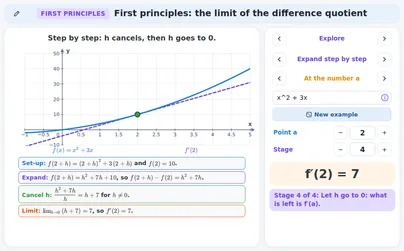
First principles: the limit of the difference quotient

  • Expanding the difference quotient for a polynomial and letting h → 0
  • Doing the same at any x
  • Proving the derivative of xⁿ, 1/x and √x from the limit
  • Saying why h may be cancelled but h = 0 cannot be put in first

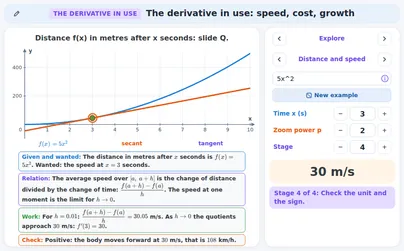
The derivative in use: speed, cost, growth

  • Working out the speed at one moment from a distance formula
  • Working out the cost rate at x items and comparing with the next item
  • Working out the rate of change of a drug concentration

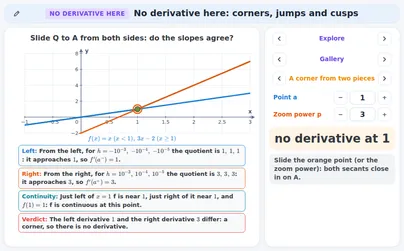
No derivative here: corners, jumps and cusps

  • Deciding from left and right quotients whether a derivative exists
  • Naming the cases: corner, jump, hole, vertical tangent, cusp
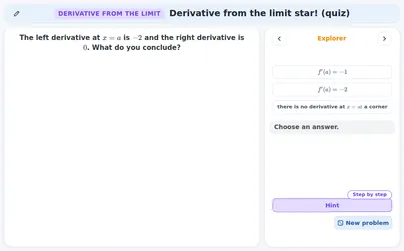
  • Saying why differentiable means continuous but not the reverse