İnteraktif Dersler

Rules of differentiation

Lecture notes

Definition

Known: a constant and a power

From the definition: the derivative of a constant is , and . Every rule below uses these and the limit of the difference quotient as .
Example
, so at the slope is . A constant such as gives .
Rule

The constant multiple

. Proof: the quotient of is times the quotient of , and the limit of times a quotient is times its limit. The graph of is the graph of stretched times, and so is every slope.
12369xy
Example
: , and at the slope is .
Rule

The sum rule

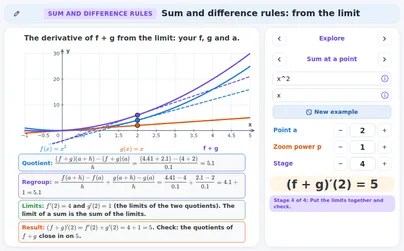
. Proof at a point: . Each quotient has a limit, and the limit of a sum is the sum of the limits.
123481216xyA
Example
, , : and , so . Check with : , close to .
Rule

The difference rule

. The proof is the same with a minus sign: the limit of a difference is the difference of the limits. Keep the order: , not .
123−2246810xyA
Example
, , : . With the quotient is .
Rule

Term by term

The constant multiple, the sum and the difference together let you differentiate a polynomial term by term: . A number on its own has derivative .
Example
: . At : , a horizontal tangent.
Rule

The product rule

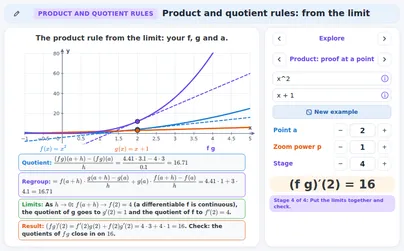
: the derivative of the first times the second, plus the first times the derivative of the second. Think of a rectangle with sides and : a small step makes the sides longer by and , and the area grows by two strips and a tiny corner that vanishes in the limit.
xyf·gΔf·gf·ΔgΔfΔg
Example
, , : . Check: and .
Watch out!

The derivative of a product is not the product of the derivatives

is not : the product rule has two terms. A quick test: gives with , but .
12381624xyA
Example
, , : the wrong rule gives , the true slope of is .
Rule

The quotient rule

For : . The top is the derivative of the top times the bottom, minus the top times the derivative of the bottom; the bottom of the answer is the bottom squared.
123451234xyA
Example
, , : . Check: has derivative .
Watch out!

Mistakes with the quotient rule

The derivative of a quotient is not . Keep the order in the top (; the other order gives the wrong sign) and do not forget that the bottom of the answer is .
Example
, , : is wrong, and has the wrong sign. The true slope is .
Definition

A composite function: two machines

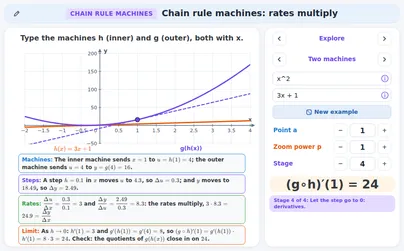
A composite function is two machines in a row: the inner machine sends to and the outer machine sends to . Here the composite always has exactly two functions.
x=1h=3x+1u=4g=u²y=16
Example
and give . For : and .
Rule

The chain rule

. In Leibniz form with and : , the rates multiply. Idea: , and both factors go to their limits.
−1121020304050xyA
Example
at : , and , so .
Rule

The power of a function

A special case of the chain rule: . The inner function is , the outer function is .
−1110203040xyA
Example
at : .
Watch out!

Do not forget the inner derivative

is not : the answer is multiplied by the inner rate . Also is taken at , not at .
121020304050xyA
Example
At : is wrong, is right.
Rule

Combining the rules

Work from the outside in: name the last operation (sum, product, quotient or composite), use its rule, then differentiate the smaller parts with the rules above.
Example
is a product of and a power of a function: . At : .
Tip

Which rule?

Look at the last step you would do to compute for a given . A last addition: sum rule. A last multiplication: product rule. A last division: quotient rule. A last “put into a function”: chain rule. Sometimes simplifying first is faster.
−11234−11xyA
Example
: the last step is a division, so . At it is .
Definition

Differentiable means continuous

If has a derivative at , then , so : is continuous at . The proof of the product rule uses this. The other way round is false: is continuous at and has no derivative there (see no-derivative-here).
Example
at with : , a small number: the values stay close together.
Rule

Proof of the product rule

Write and . Add and subtract in the top: it becomes . So the quotient is . As , because is continuous: the limit is .
Example
, , , : and , the same number. The limit is .
Rule

Proof of the quotient rule

Common denominator: the top is and the bottom is . Add and subtract in the top: it becomes . Divide by and let : the top goes to and the bottom to .
Example
, , , : the top is , the bottom , so the quotient is . The other top: . As the limit is .
Watch out!

A check is not a proof

A table of quotients can show that a rule is wrong (one point is enough) but cannot prove it: a wrong rule can agree at a few points by luck. A proof works for every function; a test at many points only makes a rule believable.
−112−2−11234xyP
Example
The wrong claim and the true agree only at ; at they give and .
Tip

Two taps: the sum of two rates

Two taps fill a tank: if tap 1 gives litres in hours and tap 2 gives litres, the total flow rate is in litres per hour. A drain is subtracted.
1234568162432xyA
Example
and at hours: and , so the total rate is litres per hour.
Tip

Revenue: a product

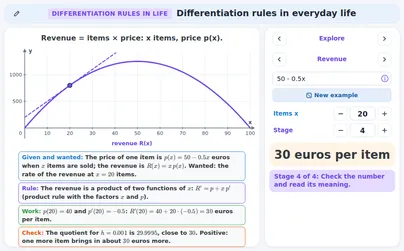
Revenue is the number of items times the price per item. The product rule gives its rate: . It is not the price: selling one more item also lowers the price of all the others.
2550751004008001200xRA
Example
euro, : and , so euro per item.
Tip

Average cost: a quotient

The average cost is a quotient: tells how the average cost changes when one more item is made. It is where the cost of the next item equals the average cost.
2550751004812xAA
Example
at : and , so .
Tip

Cost over time: a chain

The cost depends on the amount and the amount depends on the days : . Multiply the two rates and keep the unit: euros per item times items per day gives euros per day.
Example
euro and items after days. At : , euro per item and items per day, so euro per day.
Tip

Where to look next

The derivative from the limit is in secant-to-tangent and first-principles, the points without a derivative in no-derivative-here, slopes and rates in rate-of-change and limit-zoom. Use differentiation-rules-quiz and the class round to practise.
Example
With the rules you can find where a slope is zero: gives at .

Exercises

and . Use the sum rule to find . Easy
Show solution
and , so and .
The sum rule: .
.
Check: has derivative , which is at .
Find the derivative of and the slope at . Easy
Show solution
The constant stays in front: .
, so .
At : .
; the slope is
Check: the slope of at is , and .
and . Find . Easy
Show solution
gives , and .
The difference rule: .
.
The slope is negative: is falling at . The other order would give , the wrong sign.
Take and . Use the product rule for and compare it with . Easy
Show solution
and .
.
This is , the same as .
The wrong rule would give another answer.
. Name the inner and the outer function and find at . Easy
Show solution
Inner: , outer: .
and .
At : , so .
Check with the power of a function: , which is at .
and . Find . Medium
Show solution
and gives ; and gives .
.
.
Check: has derivative , which is at .
Find the slope of at . Medium
Show solution
and : , , , .
The quotient rule: .
.
The bottom of the answer is , not .
. Find at . Medium
Show solution
Inner : at , and .
Outer : .
.
The outer rate is taken at , the inner rate at .
Where is the tangent of horizontal? Medium
−2−11234−55xyA
Show solution
.
.
gives .
Check: the parabola has its lowest point halfway between its zeros and , at .
A pupil says . Find the true derivative and say by how much the wrong answer is off at . Medium
Show solution
The product is , so the true derivative is ; at it is .
The wrong answer is at .
The difference is .
; at the wrong answer is too big
The product rule gives .
Find the slope of at . Medium
Show solution
The top is a constant: , ; the bottom is , .
.
At : .
The graph falls, so a negative slope fits.
Tap 1 gives litres in hours and tap 2 gives litres. What is the total flow rate at hours? Medium
Show solution
The rates: and .
At : and .
The sum rule: litres per hour.
litres per hour
If tap 2 were a drain, the net rate would be litres per hour.
. Find . Hard
Show solution
A product of and : and .
For use the chain rule: ; at : and .
.
Without the inner derivative you would get .
Show that the tangent of at is horizontal. Hard
Show solution
, ; , (chain rule).
At : , , , .
.
: the slope is zero, so the tangent is horizontal
The function has its highest point there, with value .
Find the equation of the tangent to at . Hard
xyA2
Show solution
.
, so .
The tangent: .
Check: at the line gives , the point of the graph.
A square sheet has side cm after seconds. How fast does the area grow at ? Hard
Show solution
Chain: and .
At : , so .
cm² per second.
cm² per second
Check: and at .
The price is euro for items. Find the rate of the revenue at and compare it with the price. Hard
Show solution
and .
The product rule: .
euro per item; the price is .
euro per item (the price is )
Check: and at .
The cost is euro for items. Find the rate of the average cost at . Hard
Show solution
and , so .
The quotient rule: .
(euro per item, per item).
euro per item per item
The average cost still falls at items: the next item costs , below the average .
Are you a teacher?

Start live lessons with these applications for your whole class. Free to try for one month.

Try it free

Fits these school years

IB (MYP, Diploma): Diploma, year 1, Diploma, year 2

Cambridge International: IGCSE, AS Level

Netherlands: Havo · Mathematics B, Vwo · Mathematics A, Vwo · Mathematics B

Türkiye (MEB): Year 12 (MEB)

England (GCSE, A Level): Year 12 (A Level), Year 13 (A Level)

USA (Common Core): Calculus

What the applications of this topic teach 5 applications

Sum and difference rules: from the limit

  • Finding (f + g)′(a) and (f − g)′(a) from the limit
  • Seeing why the limit of a sum is the sum of the limits
  • Differentiating a polynomial term by term

Product and quotient rules: from the limit

  • Seeing that fg and f/g are new functions mixing f and g
  • Testing a candidate rule at six points and seeing why f′g′ fails
  • Following the proof of the product and quotient rules
  • Using the product and quotient rules

Chain rule machines: rates multiply

  • Writing a composite function as two machines
  • Seeing that the rates multiply: Δy/Δx = Δy/Δu · Δu/Δx
  • Testing a candidate chain rule at six points
  • Differentiating a power of a function with the chain rule

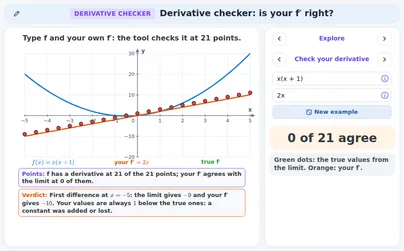
Derivative checker: is your f′ right?

  • Checking an own derivative against the true derivative from the limit
  • Finding where an own derivative first differs
  • Judging a claim like (fg)′ = f′g′ and why a check is no proof

Differentiation rules in everyday life

  • Picking the rule that fits a real problem
  • Typing own formulas and reading the rate with unit and sign
  • Saying why the rate of the revenue is not the price