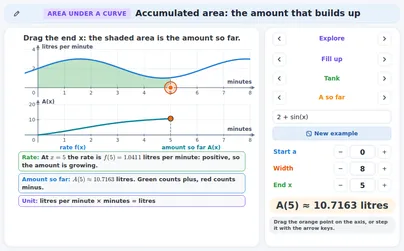
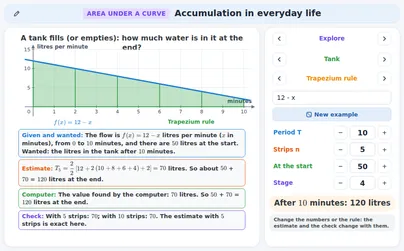
A rate graph shows how fast an amount changes, for example litres per minute. The area between the graph and the horizontal axis is the amount that was added. A constant rate r gives a rectangle: height × width.A=r⋅t
Example
A tap fills a tank at 3 litres per minute for 5 minutes: a rectangle 3 high and 5 wide.3⋅5=15 litres.
Rule
The unit of the area
The unit of the area is the unit of the rate times the unit of the horizontal axis: litres per minute × minutes = litres, metres per second × seconds = metres, kilowatts × hours = kilowatt-hours. Write the unit in every answer.
Example
A heater uses 1.5 kW for 4 hours; a kilowatt-hour costs 0.25 euro.1.5⋅4=6 kWh and 6⋅0.25=1.5 euros.
Rule
Above adds, below takes away
Where the rate is positive the graph is above the axis and its area adds to the amount; where the rate is negative the graph is below the axis and its area takes away. The result is the signed area: area above minus area below.
Example
A tank gets 4−t litres per minute for 6 minutes: it gains 21⋅4⋅4=8 litres in the first 4 minutes and loses 21⋅2⋅2=2 litres in the last 2.8−2=6 litres more in the tank.
Watch out!
Net change is not the total
The signed area is the net change: end minus start. If a car reverses, the net change is the change of position; the distance driven is the sum of both areas without their signs.
Example
A car has the velocity 6−2t metres per second for 5 seconds: 9 m forwards, then 4 m backwards.✘ position changes by 9+4=13 m. ✔ 9−4=5 m (the distance driven is 13 m).
Tip
Count the squares
Draw a grid under the curve. Squares completely under the curve are whole squares; squares the curve cuts are part squares. The area lies between the whole squares and whole plus part squares (in units of one square); whole plus half of the part squares is a good estimate.
Example
f(x)=21x2 on [0,4] with squares of 1 by 1: 6 whole squares and 10 part squares.The area is between 6 and 6+10=16 squares; the estimate is 6+10/2=11 squares. (The exact value is 332≈10.67.)
Rule
Smaller squares close in
With smaller squares more squares are whole and the part squares are thinner, so the two counts come closer to the area. This is the idea behind every sum of this subgroup: a lower and an upper estimate that close in.
Example
The same curve with squares of 0.5 by 0.5 (area 0.25 each): 34 whole and 20 part squares.Between 34⋅0.25=8.5 and 54⋅0.25=13.5; with squares of 1 by 1 it was between 6 and 16.
Definition
The Riemann sum
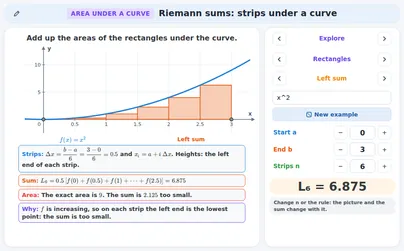
Cut [a,b] into n strips of the same width Δx=nb−a. On every strip build a rectangle as high as the curve at one point x∗ of the strip, and add up the rectangles.Sn=∑i=1nf(xi∗)Δx
Example
f(x)=x2 on [0,3] with n=5: Δx=0.6; the left ends give the heights 0;0.36;1.44;3.24;5.76.0.6⋅(0+0.36+1.44+3.24+5.76)=0.6⋅10.8=6.48.
Rule
Left, right, midpoint
The point x∗ can be the left end of a strip (left sum Ln), the right end (right sum Rn) or the middle (midpoint sum Mn). The left sum uses x0 to xn−1, the right sum x1 to xn (xi=a+iΔx).Ln=Δx[f(x0)+f(x1)+⋯+f(xn−1)]
Example
f(x)=x2 on [0,2] with n=4, Δx=0.5: the left ends are 0;0.5;1;1.5, the right ends 0.5;1;1.5;2 and the midpoints 0.25;0.75;1.25;1.75.L4=1.75, R4=3.75, M4=2.625; the exact area is 38≈2.6667.
Definition
Lower and upper sums
Build on every strip a rectangle as high as the smallest value of f on that strip: the lower sum sn. Build it as high as the largest value: the upper sum Sn. The lower rectangles lie inside the area and the upper rectangles cover it.sn≤A≤Sn
Example
f(x)=x2 on [1,3] with n=4: f rises, so the lowest point of a strip is on its left, the highest on its right.s4=6.75 and S4=10.75: 6.75≤A≤10.75 (really A=326≈8.6667).
Rule
Why too big or too small
If f is increasing, the left rectangles lie under the curve (the left sum is too small) and the right rectangles cover it (the right sum is too big). If f is decreasing it is the other way round. So for a monotone f the left and the right sum are the lower and the upper sum.
Example
f(x)=9−x2 falls on [0,3]; with n=3 (Δx=1) the left end is the highest point of every strip.L3=9+8+5=22 is too big, R3=8+5+0=13 is too small; the area is 18.
Special case
A curve that rises and falls
If f is not monotone on [a,b], the left and the right sum are no bounds for the area: both can be too small. The lower and the upper sum, with the smallest and the largest value on every strip, are always safe.
Example
f(x)=4x−x2 on [0,4] with n=4: L4=0+3+4+3=10 and R4=3+4+3+0=10, but the area is 332≈10.6667.The lower sum 0+3+3+0=6 and the upper sum 3+4+4+3=14 do enclose it.
Rule
The squeeze
For a monotone f the right sum minus the left sum is a telescoping sum: all the steps of f add up to one rectangle with the height ∣f(b)−f(a)∣ and the width Δx. The area lies between the two sums, and the gap is 10 times smaller when n is 10 times bigger.Rn−Ln=∣f(b)−f(a)∣Δx
Example
f(x)=x2 on [0,3]: ∣f(3)−f(0)∣=9 and Δx=3/n.n=5: 11.88−6.48=5.4=9⋅0.6; n=50 gives 0.54 and n=500 gives 0.054.
Rule
Midpoint against trapezium
For a smooth f the midpoint sum Mn and the trapezium rule Tn are usually much closer to the area than Ln and Rn. Their errors have opposite signs: where f curves up, Tn is too big and Mn is too small, and Mn is about twice as close.
Example
f(x)=x2 on [0,4] with n=4: M4=21 and T4=22; the area is 364≈21.3333.M4 is 31 too small, T4 is 32 too big.
Definition
The trapezium rule
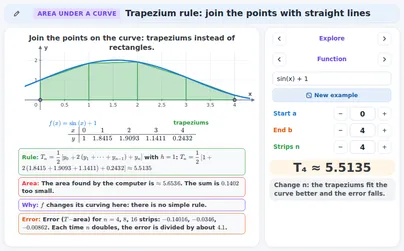
Join the points of the curve at the ends of the strips by straight lines: every strip becomes a trapezium. With the width h and the n+1 ordinates y0,…,yn the ends count once and the inside ordinates twice.Tn=2h[y0+2(y1+⋯+yn−1)+yn]
Example
f(x)=x3 on [0,2] with n=4, h=0.5: the ordinates are 0;0.125;1;3.375;8.T4=0.25[0+2⋅4.5+8]=4.25; the exact area is 4.
Tip
T is the mean of L and R
A trapezium is the average of the left rectangle and the right rectangle of its strip, so over the whole interval the trapezium rule is the mean of the left and the right sum. Handy when you already have Ln and Rn.Tn=2Ln+Rn
Example
f(x)=x3 on [0,2] with n=4: L4=2.25 and R4=6.25.22.25+6.25=4.25=T4.
Rule
Is T too big or too small
On every strip the top of a trapezium is the chord of the curve. Where f curves up (the chord lies above the curve) Tn is too big; where f curves down (the chord lies below the curve) Tn is too small. If f changes its curving, there is no simple rule.
Example
f(x)=x curves down. On [0,4] with n=4 the ordinates are 0;1.000;1.414;1.732;2.T4=0.5[0+2(1+1.414+1.732)+2]≈5.146 is smaller than the area 316≈5.333.
Rule
Halve h, quarter the error
For a smooth f the error of the trapezium rule is proportional to h2: halving h (doubling n) divides the error by 4. The midpoint sum behaves the same; for Ln and Rn the error is only halved.
Example
f(x)=x2 on [0,4], exact area 364: T2=24, T4=22, T8=21.5.The errors 38≈2.667, 32≈0.667 and 61≈0.167: each is a quarter of the one before.
Rule
A table of readings
When only readings are known (times and speeds), join the points by straight lines and add up the trapezia, also when the steps are not equal. Every piece is 21(yi+yi+1)Δxi and its unit is the unit of y times the unit of x.A≈∑21(yi+yi+1)(xi+1−xi)
Example
A car's speed in metres per second at the times 0;10;30;60 seconds is 0;12;18;15.The pieces are 21(0+12)⋅10, 21(12+18)⋅20 and 21(18+15)⋅30: 60+300+495=855 metres.
Special case
Strips of different widths
The strips need not be equal: the sum is ∑f(xi∗)Δxi with its own width Δxi on every strip. For the sums to close in on the area, the widest strip must go to 0: more strips alone are not enough.
Example
f(x)=x2 on [0,3] with the points 0;1;1.5;3 (widths 1;0.5;1.5) and left ends: 0⋅1+1⋅0.5+2.25⋅1.5=3.875.The widest strip is 1.5 wide; the area is 9.
Definition
Sigma notation
The sign ∑ means: add up. ∑i=1nai is read “the sum of ai for i from 1 to n”. The letter i runs through the whole numbers from the bottom number to the top number and every value is put into the term.∑i=1nai=a1+a2+⋯+an
Example
∑i=14(2i+1): for i=1,2,3,4 take 2i+1 and add.3+5+7+9=24.
Rule
Riemann sums with sigma
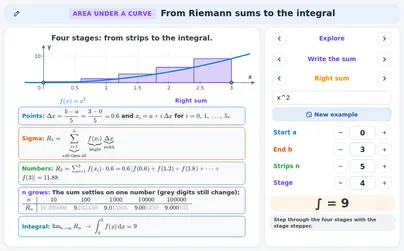
With xi=a+iΔx the left sum starts at i=0 and stops at n−1, the right sum starts at i=1 and stops at n. Useful for f(x)=x2: 1+4+9+⋯+n2=6n(n+1)(2n+1).Rn=∑i=1nf(xi)Δx
Example
f(x)=x2 on [0,3] with n=5: xi=0.6i, so R5=∑i=15(0.6i)2⋅0.6.=0.216(1+4+9+16+25)=0.216⋅55=11.88.
Definition
The limit is the integral
Let n grow, so that every strip gets thinner. For a continuous f the sums settle on one number, the area under the curve. This limit is written with an integral sign: ∑ becomes ∫ and Δx becomes dx.limn→∞∑i=1nf(xi)Δx=∫abf(x)dx
Example
f(x)=x2 on [0,3]: Rn=4.5(n+1)(2n+1)/n2 gives R5=11.88, R100=9.13545, R1000=9.0135045.The sums settle on 9: ∫03x2dx=9.
Rule
Read a limit as an integral
To turn a limit of sums into an integral, read the three parts: the factor Δx=nb−a gives the width b−a; the points xi=a+iΔx give the start a (and so b); whatever is done to xi inside the sum is f(x).
Example
limn→∞∑i=1n(n2i)3⋅n2: the width is 2, the points are 0+i⋅n2, so a=0 and b=2, and cubing gives f(x)=x3.=∫02x3dx=4 (check: n=10 gives 4.84).
Rule
Rates in and out
When something flows in and something flows out, the net rate is in minus out. The signed area under the net rate is the net change, and end amount = start amount + net change.
Example
A tank holds 40 litres. Water flows in at 5 litres per minute and out at 0.5t litres per minute (t in minutes) for 10 minutes.The net rate 5−0.5t makes a triangle: 21⋅10⋅5=25 litres, so 40+25=65 litres.
Tip
Check with twice the strips
To trust an estimate, do it again with twice as many strips. If the two answers agree to the accuracy you need, stop; if not, double again. The difference of the two estimates also tells you how big the error is.
Example
∫12x1dx with the trapezium rule: T4=0.6970 and T8=0.6941.They agree in the first two digits: the area is about 0.69 (the exact value is 0.6931).
Tip
Which course needs what
The area under a rate graph, counting squares and Riemann sums with left, right and midpoint rectangles are asked in AP Calculus AB; the trapezium rule in Cambridge AS, in IB Applications and interpretation and at UK A level. The limit of a sum and the integral notation come with UK A level and AP Calculus. The exact value without sums follows later with the antiderivative.
Example
An exam asks: estimate ∫04x2dx with the trapezium rule and 4 strips.T4=22; the exact value is 364≈21.3333, so the estimate is 0.67 too big.
Exercises
A tap fills a tank at 3 litres per minute for 8 minutes. How many litres flow in? Easy
Show solution
The rate graph is a horizontal line at height 3: the area is a rectangle with the width 8.
Area = height × width = 3⋅8.
24 litres
Check: litres per minute × minutes = litres.
The speed of a car grows in a straight line from 0 to 6 m/s in 5 seconds. How far does it travel? Easy
Show solution
The distance is the area under the speed graph: a triangle with the base 5 and the height 6.
Area = 21⋅5⋅6.
15 metres
Check: the average speed is 3 m/s and 3⋅5=15.
Under a curve a grid of squares 1 by 1 has 14 whole squares and 9 part squares. Between which two numbers does the area lie, and what is a good estimate? Easy
Show solution
The whole squares lie completely under the curve: at least 14 squares.
Whole plus part squares cover the area: at most 14+9 squares.
Estimate: whole squares plus half of the part squares, 14+9/2.
between 14 and 23 squares; about 18.5 squares
Multiply by the area of one square to get the real area.
Find the left sum L2 of f(x)=x2 on [0,2] with 2 strips. Is it too big or too small? Easy
Show solution
Δx=22−0=1; the left ends are 0 and 1.
L2=1⋅[f(0)+f(1)]=1⋅(0+1).
f is increasing, so the left rectangles lie under the curve.
L2=1, too small
Check: the exact area is 38≈2.67, more than 1.
Write out and add: ∑i=143i. Easy
Show solution
Put i=1,2,3,4 into 3i: 3⋅1+3⋅2+3⋅3+3⋅4.
That is 3+6+9+12.
30
Check: 3⋅(1+2+3+4)=3⋅10.
The ordinates at x=0,1,2 are y0=2, y1=4 and y2=7. Use the trapezium rule with h=1. Easy
Show solution
T2=2h[y0+2y1+y2].
T2=21[2+2⋅4+7]=21⋅17.
T2=8.5
Check by pieces: 21(2+4)+21(4+7)=3+5.5.
Find L4 and R4 of f(x)=x2 on [0,2]. Between which two numbers does the area lie, and why? Medium
Show solution
Δx=0.5; the values at 0,0.5,1,1.5,2 are 0;0.25;1;2.25;4.
L4=0.5(0+0.25+1+2.25) and R4=0.5(0.25+1+2.25+4).
f is increasing, so L4 is a lower and R4 an upper bound.
L4=1.75 and R4=3.75: 1.75≤A≤3.75
Check: R4−L4=∣f(2)−f(0)∣⋅0.5=4⋅0.5=2.
Find the midpoint sum M4 of f(x)=x2 on [0,2] and say how far it is from the exact area 38. Medium
Show solution
Δx=0.5; the midpoints are 0.25;0.75;1.25;1.75.
Their squares are 0.0625;0.5625;1.5625;3.0625.
M4=0.5⋅(0.0625+0.5625+1.5625+3.0625); then 38−M4.
M4=2.625, about 0.0417 too small
Check: 38−2.625=241, much closer than L4 or R4.
Use the trapezium rule with 4 strips for ∫13x1dx. Is the answer too big or too small? Medium
Show solution
h=43−1=0.5; the ordinates at 1,1.5,2,2.5,3 are 1,2/3,1/2,2/5,1/3.
T4=20.5[1+2(32+21+52)+31].
f(x)=x1 curves up, so the chords lie above the curve.
T4≈1.1167, too big
Check: the exact area is about 1.0986, smaller than 1.1167.
A car's speed in m/s is measured at the times 0,2,5,9 seconds: 0,6,10,10. Estimate the distance. Medium
Show solution
The steps are not equal, so work out one trapezium at a time: 21(yi+yi+1)⋅Δxi.
21(0+6)⋅2, 21(6+10)⋅3 and 21(10+10)⋅4.
Add the three areas.
6+24+40=70 metres
The unit is m/s × s = m. It is an estimate: the speed between two readings is not known.
A tank holds 20 litres. For 5 minutes water flows at the rate 2t−6 litres per minute (t in minutes; a negative rate means water flows out). How much water is in the tank after 5 minutes? Medium
Show solution
The rate is 0 at t=3: negative before, positive after. From 0 to 3 a triangle below the axis, −21⋅3⋅6=−9; from 3 to 5 one above it, 21⋅2⋅4=4.
Net change −9+4; end amount = start amount + net change.
net change −5 litres, so 15 litres
Check: t2−6t from 0 to 5 is 25−30=−5.
Write limn→∞∑i=1n(1+n4i)⋅n4 as an integral and find its value. Medium
Show solution
The factor n4 is Δx, so b−a=4.
The points are xi=1+i⋅n4: a=1, so b=5, and the term is f(xi)=xi, so f(x)=x.
The area under y=x from 1 to 5 is a trapezium: 21(1+5)⋅4.
∫15xdx=12
Check: for n=10 the sum is 12.8, close to 12 (it is 12+8/n).
For f(x)=4x−x2 on [0,4] with n=4 find L4, R4, the lower sum and the upper sum. Which of them are sure bounds for the area? Hard
Show solution
Δx=1; f(0),…,f(4)=0,3,4,3,0, so L4=0+3+4+3 and R4=3+4+3+0.
Lowest values on the strips: 0,3,3,0; highest: 3,4,4,3. The area is 332≈10.67.
L4=R4=10, lower 6, upper 14: only the lower and upper sum are sure bounds
L4 and R4 are both below 332: no bounds.
For f(x)=x2 on [0,3] how many strips are needed so that Rn−Ln≤0.01? Hard
Show solution
f is increasing, so Rn−Ln=∣f(3)−f(0)∣⋅Δx=9⋅n3.
Solve n27≤0.01.
n≥27/0.01.
n=2700 strips (or more)
Check: 27/2700=0.01. Then the area is within 0.01 of both Ln and Rn.
The trapezium rule gives T4=22 and T8=21.5 for ∫04x2dx. The error of T8 is a quarter of the error of T4. Find the exact value. Hard
Show solution
Let e be the error of T8: T8−A=e and T4−A=4e.
Subtract: T4−T8=3e, so e=(22−21.5)/3.
A=T8−e.
A=21.5−61=364
Check: 343=364; the errors are 32 and 61, in the ratio 4.
f(x)=x2 on [0,3] is cut at the points 0;1;1.5;3. Find the right sum of this uneven partition. Is it too big or too small, and what is the widest strip? Hard
Show solution
The widths are 1,0.5,1.5 and the right ends are 1,1.5,3 with the heights 1,2.25,9.
Sum = 1⋅1+0.5⋅2.25+1.5⋅9.
f is increasing, so the right rectangles cover the area 9.
15.625, too big by 6.625; the widest strip is 1.5
The widest strip causes most of the error: splitting it is the best next step.
Find Rn for f(x)=x on [0,2] in terms of n, and its limit. (Use 1+2+⋯+n=2n(n+1).) Hard
Show solution
Δx=n2 and xi=n2i.
Rn=∑i=1nn2i⋅n2=n24⋅2n(n+1).
Simplify: Rn=n2(n+1)=2+n2, which goes to 2.
Rn=2+n2, and ∫02xdx=2
Check: n=100 gives 2.02, and the triangle under y=x has the area 21⋅2⋅2=2.
Water flows into a tank at 6 litres per minute and out at 0.5t litres per minute (t in minutes). When is the tank fullest, how much more water is in it then than at the start, and how much more after 20 minutes? Hard
Show solution
The net rate 6−0.5t is positive until t=12, then negative: fullest at t=12 with 21⋅12⋅6 litres more.
From 12 to 20 the net rate falls to −4: 21⋅8⋅4 litres less, so after 20 minutes 36−16.
fullest at t=12 (36 litres more); after 20 minutes 20 litres more
Check: 6⋅20−0.25⋅202=20.
Interactive applications for this topic
Free applications open with a free student account. Teachers can use all applications in a live lesson.