İnteraktif Dersler
Lecture notes Exercises

Applications of the derivative

Lecture notes

Definition

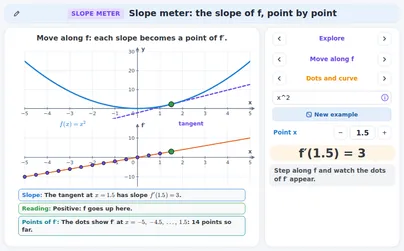
The slope of the tangent is a value of f′

At a point of the graph of the tangent has the slope . Do this for every and plot the slope against : the points form the graph of the derivative function . The height of the graph of above is the slope of at .
xyAB
Example
has . At the tangent has slope , so the graph of is at height above .
Rule

Rising, falling, flat

Where the tangents climb to the right and is increasing; where they go down and is decreasing; where the tangent is flat. A constant function has slope everywhere, so .
−112345−6−4−2246xyV
Example
has . : falls at . : rises at . : the tangent at is flat.
Definition

The sign table

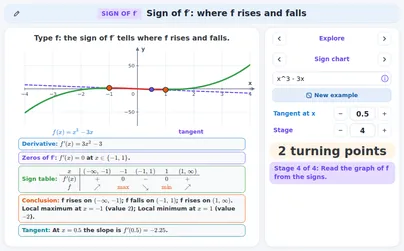
A sign table lists the intervals between the zeros of , the sign of on each interval and the way goes: means increasing (), means decreasing (). Steps: find , solve , test one number in every interval.
Example
: with zeros and . Test , , : the signs are and goes .
Rule

Local maximum and minimum

A local maximum is a point where stops rising and starts falling: changes from to . A local minimum is where changes from to . At both the tangent is flat, (the first derivative test). The value of there is the local maximum or minimum value.
xyMm
Example
has the signs around and . So there is a local maximum at with value and a local minimum at with value .
Rule

The graph of a polynomial from f′

To sketch a polynomial of degree 4 or less: find the zeros of , make the sign table, mark the turning points with their values and draw the curve rising and falling as the signs say. A polynomial of degree has at most turning points.
xy
Example
: with zeros , , and the signs . There are minima at with value and a maximum at with value .
Watch out!

f′(a) = 0 is not always a maximum or minimum

A flat tangent is not enough: must also change sign. For the derivative is at but positive on both sides, so keeps rising: there is no maximum and no minimum. Always look at the signs on both sides.
−2−112−3−2−1123xyO
Example
and : the sign does not change at , so is no local extremum.
Rule

The function k(x − a)²

For : has . This is at , negative for and positive for , so is decreasing before , increasing on and has its least value at .
xya
Example
has . At : and rises. At : and falls.
Rule

The function g(x) = −f(x) + 3

A minus turns the graph upside down and turns every slope over: has ; the only lifts it. So on gives there, and a minimum of becomes a maximum of .
−2−112−4−2246xy
Example
and : . At : and . The minimum becomes the maximum .
Rule

Sketching f from f′

If you know you know the shape of but not its height: every function with the same is the same curve moved up or down. Give one value, for example , and the curve is fixed.
xy
Example
gives . With : and , whose least value is .
Rule

Matching f and f′

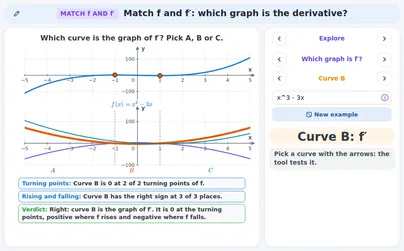
To decide which graph is , test it at the turning points of (the curve must be there), where rises (the curve is above the axis) and where falls (below it). A wrong curve fails one test: a curve turned over, one that is never negative or one that is moved up.
xy
Example
has turning points at . The curve is at both and positive where rises: it is . The curve is turned over and is never negative.
Watch out!

The sign of f′ is not the sign of f

tells whether goes up or down; tells whether the graph is above or below the axis. A positive function can fall and a negative one can rise. One example where it fails is enough to show that a claim is false.
xyP
Example
at : but . The graph is above the axis and falls.
Definition

A recipe for optimisation

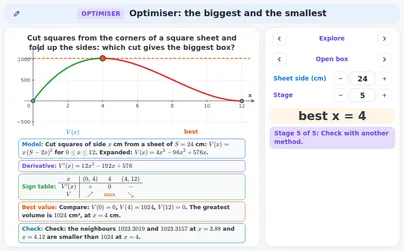
To find the biggest or smallest value: (1) write the quantity as a function of one variable and give its domain, (2) find and solve , (3) make the sign table, (4) compare the values at the turning points with the values at the ends of the domain, (5) answer in words with the unit and check the answer in another way.
246810102030xyM
Example
Two numbers add up to ; make their product as big as possible: for . at and goes from to . The ends give , so the greatest product is .
Rule

The open box

Cut a square of side from each corner of a square sheet of side and fold up the sides: the box has a base of side and height , so for . Solve and compare with the ends, where .
xyxx2424
Example
cm: and , which is at (the other zero gives ). cm³.
Rule

The fence

A rectangle with a given length of fence has the greatest area when the sides are equal (a square). If a wall is on one side, the fence goes round 3 sides and the side along the wall is twice the width.
102030100200300400500xA
Example
m of fence on 4 sides: and at , a by square with m². With a wall: and at , so m by m with m².
Rule

Revenue and profit

If items are sold at the price euros, the revenue is ; with a cost of euros per item the profit is . Both are quadratics in : find where the derivative is and check the domain.
816243240080012001600pWM
Example
items are sold at the price , one item costs euros: and at . euros.
Rule

The can

A cylinder with volume and radius has height and surface . The least surface has , so and : the height equals the diameter.
2468200400600800rSm
Example
cm³: , so cm and cm. The surface is cm².
Watch out!

Check the ends of the interval

On a closed interval the greatest and the smallest value are at a turning point or at an end. A turning point is not always the greatest value: compare it with and and name the end if it wins.
xyPQ
Example
on : , , , . The greatest value is at the end , not the local maximum ; the least value is (at and at ).
Special case

A corner: the derivative method fails

At a corner such as at there is no derivative, so solving cannot find it. A greatest or least value can sit exactly there: compare the corners and the ends with the turning points.
−4−224−112345xyPCQ
Example
on has no derivative at . , , : the greatest value is at and the least is at the corner .
Rule

A rate of change has a unit

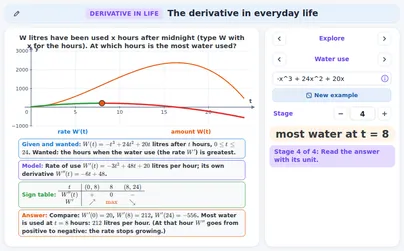
In a problem is the rate of change of per unit of : its unit is the unit of divided by the unit of (metres per second, litres per hour, euros per item). Positive means growing, negative means shrinking. Give the number, the unit and the moment.
1234306090tsA
Example
A ball falls metres in seconds: , so . After seconds the ball moves at metres per second.
Rule

Related rates: the ball

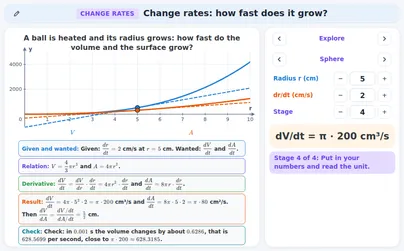
When a quantity depends on another one that changes in time, the chain rule links the rates: . For a ball gives and gives . Dividing: .
2468500100015002000rVA
Example
A ball is heated and its radius grows at cm/s. At cm: cm³/s and cm²/s.
Rule

Related rates: the ladder

Sometimes two lengths are linked by a relation: a ladder of length has , with the distance of the foot from the wall and the height of the top. Differentiate with respect to time: , so .
xyxy5
Example
m, the foot is m from the wall and slides away at m/s. Then m and m/s: the top goes down at m/s.
Rule

The mean value theorem

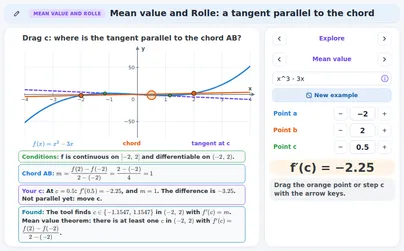
If is continuous on and differentiable on , there is a number in with : somewhere the tangent is parallel to the chord from to , which has the slope .
xyABc
Example
on : . gives , which lies in .
Rule

Rolle’s theorem

Rolle’s theorem is the mean value theorem with : the chord is horizontal, so there is a number in with . The conditions are the same: continuous on and differentiable on .
xyABd
Example
on : . gives , which lies in .
Watch out!

The conditions matter

If a condition fails, the theorem can fail: on has , but no tangent is horizontal, because there is a corner at where has no derivative. Check the conditions before you use the theorem.
−3−2−1123−11234xyABO
Example
: for and for , never , and at there is no derivative.
Tip

The speed check on the highway

A car covers km in 1 hour. By the mean value theorem the speed meter showed exactly km/h at least once (if the distance is a smooth function of the time), even if the driver never looked at it. The same holds for every average speed: it was reached at some moment.
tsBc
Example
km after hours: km, so the average speed is km/h. at : half an hour after the start the meter shows km/h.
Rule

The differential dy = f′(a) dx

For a small step the tangent line gives the estimate of the true change . The gap between them is small, and it gets much smaller when gets smaller.
xyAdxdye
Example
, : . For : and ; the gap is .
Tip

Where to look next

The derivative from the limit is in secant-to-tangent and first-principles, the points without a derivative in no-derivative-here, the rules in derivative-checker and differentiation-rules-in-life. For slopes and rates see rate-of-change and graphs-in-life. Use derivative-quiz and the class round to practise.
Example
With the derivative you can say where a function rises, where it has its extreme values and how fast it changes: has at and the least value .

Exercises

. What is the slope of the tangent at ? Easy
Show solution
The derivative is .
The slope at is .
.
Check: the graph of is at height above .
. Where is the tangent flat, and is rising or falling for ? Easy
Show solution
.
Solve : .
For , for example : , so is rising.
flat at ; is increasing for
The signs of are before and after , so is a local minimum.
. On which interval is increasing? Easy
Show solution
is increasing where .
gives .
So rises for and falls for .
At the sign of goes from to : a local maximum.
The tangent to at is a line. What is its height at ? Easy
Show solution
and .
The tangent line has the height .
At : .
Check: the curve is higher, , because bends upwards away from its tangent.
on . What is the slope of the chord from to ? Easy
Show solution
and .
The slope is .
.
The mean value theorem says that the tangent at has the same slope: .
A ball falls metres in seconds. How fast does it move at ? Give the unit. Easy
Show solution
The speed is the rate of change: .
At : .
The unit of is metres divided by seconds.
metres per second
Check: from to the ball falls m in s, about m/s, close to .
. Find the local maximum and the local minimum. Medium
xyMm
Show solution
is at and . The signs are : , , .
At the sign goes from to : a local maximum, .
At the sign goes from to : a local minimum, .
local maximum at ; local minimum at
A sign change from to gives a maximum and from to a minimum.
has . Is there a local maximum or minimum at ? Explain. Medium
Show solution
, so .
is positive on both sides of : and .
The sign does not change, so there is no turning point.
No: does not change sign, keeps rising
is needed for a local extremum, but it is not enough.
on . Find the number of the mean value theorem. Medium
xyABc
Show solution
The chord has the slope .
Solve .
, which lies in .
For a parabola the tangent is parallel to the chord at the middle of the interval.
A farmer has m of fence for a rectangular field with a wall on one side (the fence goes round 3 sides). Which width gives the biggest area, and how big is it? Medium
Show solution
The length is , so for .
gives , and goes from to .
. The ends give .
m (and length m); the area is m²
Check: the side along the wall is twice the width.
A ball is heated and its radius grows at cm/s. How fast does the volume grow when cm? () Medium
Show solution
The chain rule: .
Put in and : .
cm³ per second.
cm³/s (about cm³/s)
The unit is cm³ per second: volume per time.
. Find and the true change for . Medium
Show solution
, so and .
with .
.
and
The gap is : small, because is small.
A square sheet of cm gets squares of side cut from its corners and the sides are folded up into an open box. Find for the greatest volume, and the volume. Hard
Show solution
for and .
at (and at , where ); the signs go then .
.
cm and cm³
The ends give and , so is the greatest value.
items are sold at the price euros and one item costs euros. Which price gives the greatest profit, and how big is the profit? Hard
Show solution
and .
at , and the signs go then .
euros.
euros; the profit is euros
At the price the number sold is items.
Find the greatest and the least value of on . Hard
xyPQm
Show solution
at (the zero is outside ).
The values: , , .
Compare: the greatest value is at the end and the least at .
greatest at ; least at
The local minimum at is the least value, but the greatest value is at an end.
Find the greatest and the least value of on . Why can not be used? Hard
xyPCQ
Show solution
for and for : never , and at there is a corner without a derivative.
Compare the corner and the ends: , , .
The greatest value is at and the least is at the corner .
greatest at ; least at
The least value is at the corner, where the derivative method cannot see it.
A ladder of m leans against a wall. The foot is m from the wall and slides away at m/s. How fast does the top slide down? Hard
xyxy10
Show solution
and give .
, so .
m/s.
m/s: the top goes down at m/s
Check: , and the minus sign says that the height falls.
The greatest value of is at . Let . Where does have its least value, and how big is it? Hard
Show solution
is the graph of moved to the right: the maximum is now at .
The factor turns the graph over and halves it: the maximum becomes a minimum.
The least value is , at .
least value at
A greatest value of gives a least value of .
Are you a teacher?

Start live lessons with these applications for your whole class. Free to try for one month.

Try it free

Fits these school years

IB (MYP, Diploma): Diploma, year 1, Diploma, year 2

Cambridge International: IGCSE, AS Level

Netherlands: Havo · Mathematics A, Havo · Mathematics B, Vwo · Mathematics A, Vwo · Mathematics B, Vwo · Mathematics C

Türkiye (MEB): Year 12 (MEB)

England (GCSE, A Level): Year 12 (A Level), Year 13 (A Level)

USA (Common Core): Calculus

What the applications of this topic teach 7 applications

Slope meter: the slope of f, point by point

  • Seeing the slope of the tangent as a value of the derivative f′
  • Reading from f′ where f goes up, down or is flat
  • Testing a statement about f′ at several points

Sign of f′: where f rises and falls

  • Finding f′, its zeros and the sign table of a polynomial
  • Finding local maxima and minima from a sign change of f′
  • Predicting what happens to the graph and slopes of −f + 3, f(x − 2), 2f
  • Sketching a polynomial of degree 4 or less from its sign table

Match f and f′: which graph is the derivative?

  • Picking the graph of f′ for a given f
  • Explaining why a curve is not f′
  • Sketching one possible f from the signs of f′ and one value
  • Knowing that functions with the same f′ differ by a vertical shift

Optimiser: the biggest and the smallest

  • Writing the quantity to optimise as a function of one variable
  • Comparing turning points with the ends of the domain
  • Answering in a sentence and checking with another method
  • Seeing where the derivative method fails: at a corner

Change rates: how fast does it grow?

  • Writing the given rate and wanted rate for a growing ball or sliding ladder
  • Using the chain rule to link rates: dV/dt = dV/dr · dr/dt
  • Reading the answer with its unit and checking it

Mean value and Rolle: a tangent parallel to the chord

  • Finding the chord AB and a point where the tangent is parallel to it
  • Stating the mean value theorem and Rolle's theorem with conditions
  • Showing with an example that a theorem fails when a condition fails
  • Using dy = f′(a) dx as an estimate of the true change

The derivative in everyday life

  • Turning a problem about profit, a car or packaging into a function
  • Finding the best number of items or the cheapest box size
  • Reading each answer with its unit and meaning