Where do the graphs meet? f(x) = g(x)
This is a demo, open for everybody. A free account opens 140+ applications; Plus opens all of them.
Make a free account Log inWhat this application teaches
- I can say that the solutions of f(x) = g(x) are the x-coordinates of the meeting points.
- I can say how many solutions there are by picturing both graphs.
- I can read both solutions of a parabola and a line, and I know the y-coordinate is not a solution.
How to use it
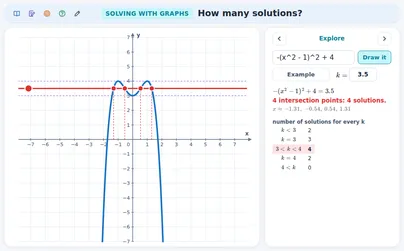
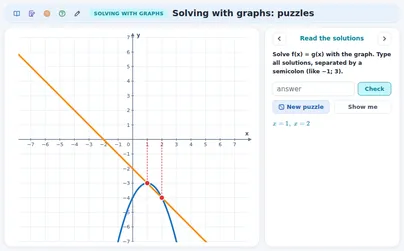
Aim: Type two functions and see where their graphs meet. In Guess first you only see the two formulas and say how many solutions f(x) = g(x) has. In You try a parabola and a line are drawn and you read the solutions.
- Choose Explore, Guess first or You try.
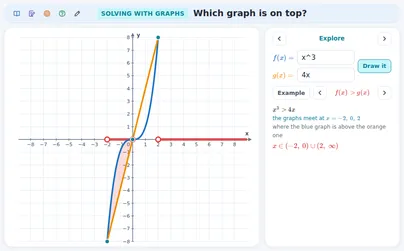
- In Explore type f(x) and g(x) and press Draw it, or press Example. Tick Difference h = f − g to see that the solutions are the zeros of h.
- In Guess first read the two formulas, choose no solution, 1 solution, 2 solutions or 3 solutions and press Show; the graphs and the reason appear. New pair gives another pair.
- In You try type the smaller solution, the larger solution and the y of the meeting point at the smaller one, and press Check; the meeting points appear. New graphs gives other graphs.
Tip for teachers: Ask: the graphs meet at (3, 6). What is the solution? Let the pupils say “x = 3” and explain why 6 is not an answer.
Fits these school years
IB (MYP, Diploma): MYP 5, Diploma, year 1
Cambridge International: IGCSE, AS Level
Netherlands: Year 3 (havo, vwo), Vmbo bb (years 3-4), Vmbo kb (years 3-4), Vmbo gt (years 3-4), Havo · Mathematics A, Havo · Mathematics B, Vwo · Mathematics A, Vwo · Mathematics B, Vwo · Mathematics C
Türkiye (MEB): Year 9 (MEB), Year 10 (MEB), Year 12 (MEB)
England (GCSE, A Level): Year 10 (GCSE), Year 11 (GCSE), Year 12 (A Level)
USA (Common Core): Algebra 1, Algebra 2