Number
1.8aDirect proportion
1Pupils recognise a direct proportion from a table, a graph or a situation, find the constant of variation, and write and solve an equation of the form y = kx.8
Linear functions1
Direct proportion: recognise it6
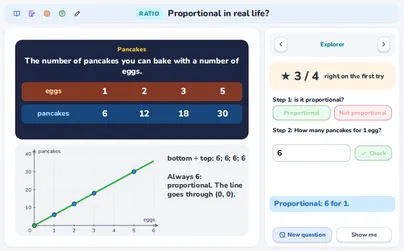 Proportional in real life?Decide whether an everyday situation is proportional, find the amount for 1 and explain why a situation is not.Open
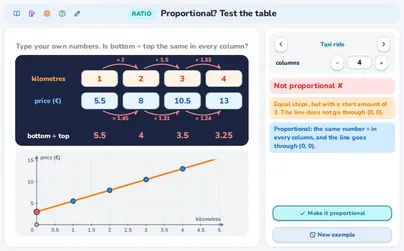 Proportional? Test the tableA table of your own, or a situation: apples, a taxi ride, ages, pancakes, mobile data.Open
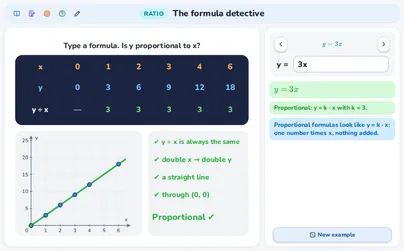 The formula detective: y = k · xType a formula of your own, or pick an example.Open
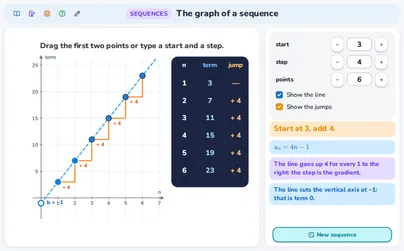
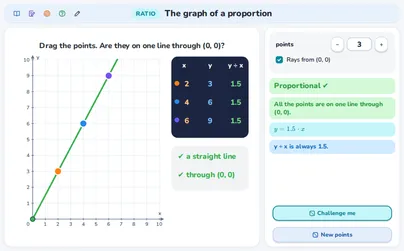 The graph of a proportion: a line through (0, 0)Drag 2 to 5 points of your own.Open
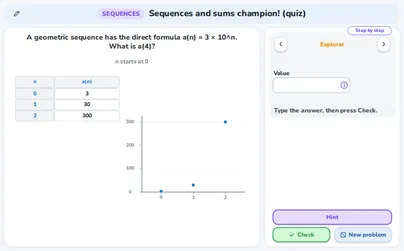
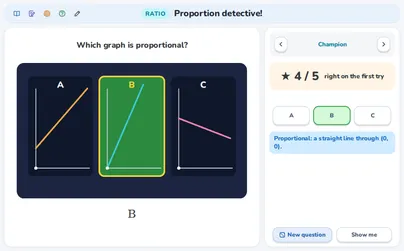 Proportion detective! (quiz) QuizEndless practice with a score on the topic ‘Direct proportion: recognise it’.Open
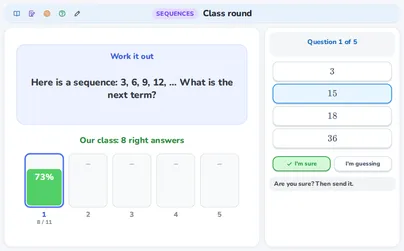
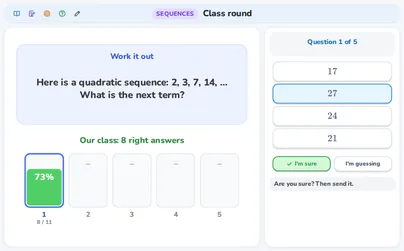
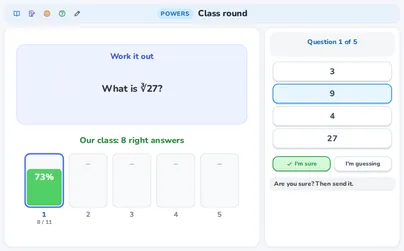
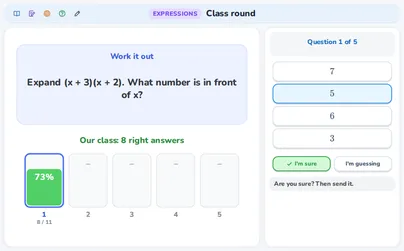
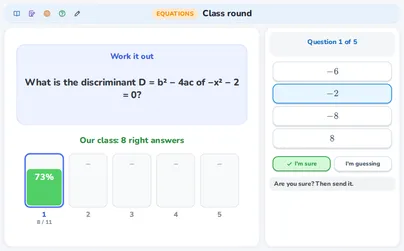
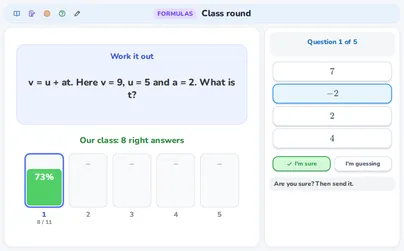
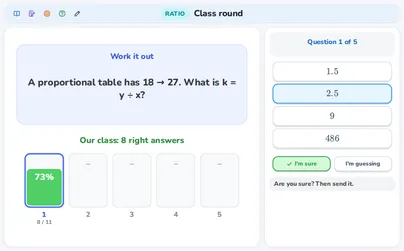 Class round: the whole class at once – Direct proportion: recognise it Class roundFive questions for the whole class at once: definitions, rules, true or myth, and sums.Open
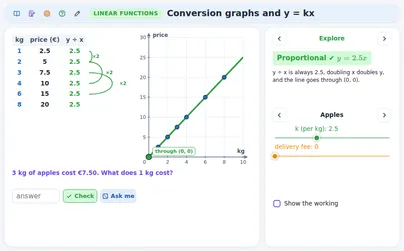
1.8bIdentify direct and inverse proportion
1Pupils decide whether a relationship is a direct proportion, an inverse proportion or neither, by testing what happens to one quantity when the other is doubled.10
Inverse proportion7
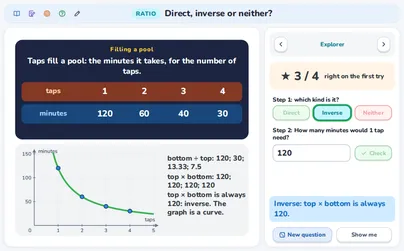 Direct, inverse or neither?A situation from everyday life with a small table.Open
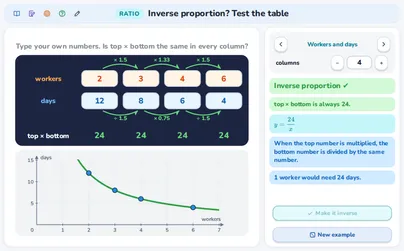 Inverse proportion? Test the tableType your own numbers in a table of two rows, or start from a situation (workers and days, driving, sharing a bill, filling a pool, apples, ages).Open
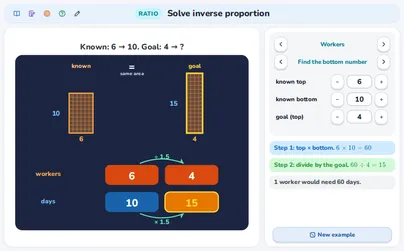 Solve inverse proportion: workers, speed, timeA known pair (6 workers need 10 days) and a goal.Open
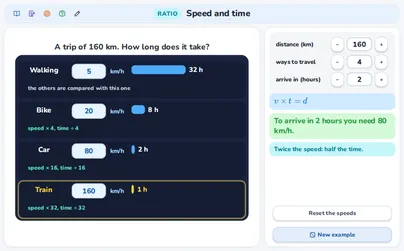 Speed and time: faster, shorterA trip of a fixed distance (type your own) and two to four ways to travel.Open
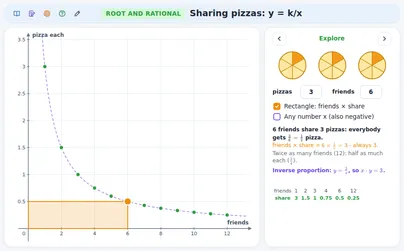
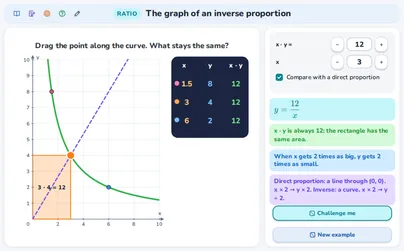 The graph of an inverse proportion: a curveChoose the number x · y = k and drag the point along the curve y = k ÷ x.Open
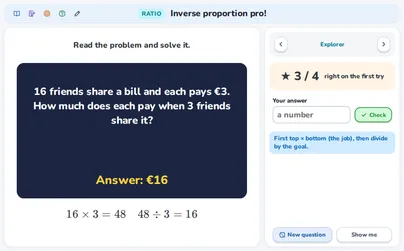 Inverse proportion pro! (quiz) QuizEndless practice with a score on the topic ‘Inverse proportion’.Open
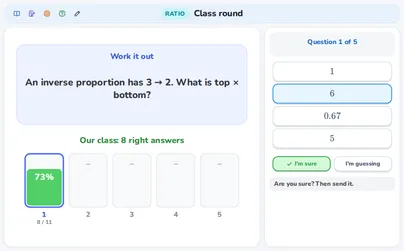 Class round: the whole class at once – Inverse proportion Class roundFive questions for the whole class at once: definitions, rules, true or myth, and sums.Open
1.8cInverse proportion
1Pupils write an inverse variation equation of the form y = k/x from given values, and use it to find missing values in problems.9
Inverse proportion7
- Direct, inverse or neither?A situation from everyday life with a small table.Open
- Inverse proportion? Test the tableType your own numbers in a table of two rows, or start from a situation (workers and days, driving, sharing a bill, filling a pool, apples, ages).Open
- Solve inverse proportion: workers, speed, timeA known pair (6 workers need 10 days) and a goal.Open
- Speed and time: faster, shorterA trip of a fixed distance (type your own) and two to four ways to travel.Open
- The graph of an inverse proportion: a curveChoose the number x · y = k and drag the point along the curve y = k ÷ x.Open
- Inverse proportion pro! (quiz) QuizEndless practice with a score on the topic ‘Inverse proportion’.Open
- Class round: the whole class at once – Inverse proportion Class roundFive questions for the whole class at once: definitions, rules, true or myth, and sums.Open
Applications that cover the topic in general5
These applications belong to the topic as a whole, not to one outcome.
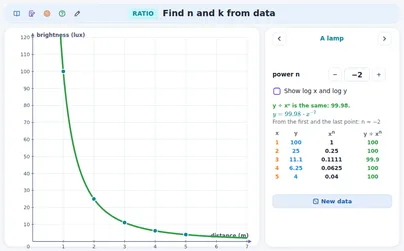 Find n and k from dataMeasurements follow y = k·xⁿ: square tiles, cubes, a pendulum, a lamp, gas in a pump, a falling stone, mystery data or your own points.Open
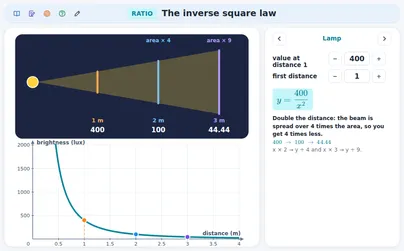 The inverse square law: light, sound, gravityA lamp, a loudspeaker or the Earth's pull: at distance x you get y = k ÷ x².Open
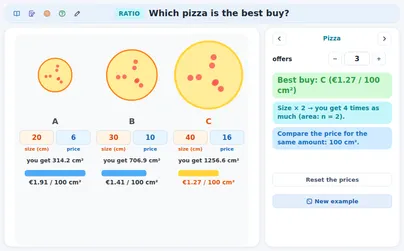 Which pizza is the best buy?Compare offers of the same thing in different sizes, round pizzas, square cakes or ice-cream scoops, and find the best buy.Open
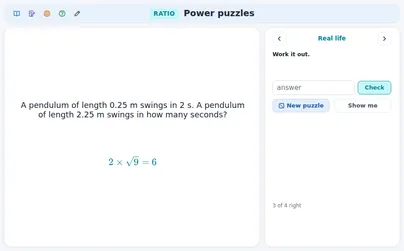 Power puzzlesEndless puzzles with a score about power relations: the factor, finding k and n from two points, working out y or x, and real life.Open
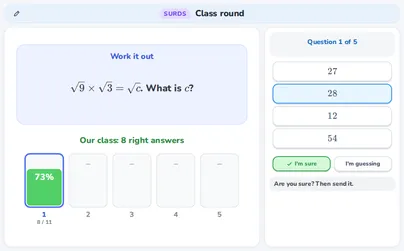
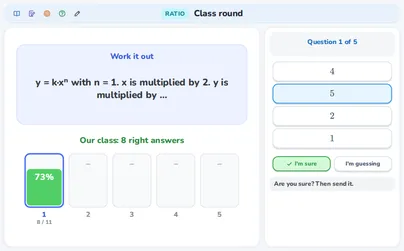 Class round: the whole class at once – Power relations Class roundFive questions for the whole class at once: definitions, rules, true or myth, and sums.Open