İnteraktif Dersler
Lecture notes Exercises

3D shapes: faces, edges, vertices, nets and cube buildings

Lecture notes

Definition

Names of solids

A cube has 6 equal squares. A cuboid has 6 rectangles. A prism has two equal ends joined by rectangles, a pyramid has a base and triangles that meet at the top. A cylinder, a cone and a sphere have a curved surface.
Example
A box is a cuboid.A tin can is a cylinder.A ball is a sphere.
Definition

Faces, edges, vertices

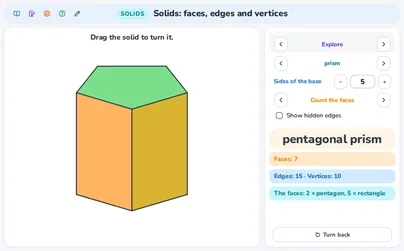
A face is a flat side, an edge is where two faces meet, a vertex is a corner. Count the ones at the back too: turn the solid.
Example
A cube: 6 faces,12 edges, 8 vertices
12345678
Definition

Flat and curved

A flat face is a polygon (triangle, square, rectangle …) or a circle. A curved surface has no corners. A sphere has no edges and no vertices; the tip of a cone is a vertex.
Example
Cylinder: 2 flat faces (circles)and 1 curved surface
Rule

Prisms by their base

A prism with a base of n sides has faces, 3n edges and 2n vertices.
Example
Pentagonal prism :7 faces, 15 edges, 10 vertices
Rule

Pyramids by their base

A pyramid with a base of n sides has faces, 2n edges and vertices.
Example
Square pyramid :5 faces, 8 edges, 5 vertices
Rule

Euler’s rule

For a solid with flat faces: faces + vertices − edges = 2. Use it to find a missing number.
F=5V=6E=9
Example
Cube → 12 faces and 20 vertices →, so E = 30
F=6V=8E=12
Definition

A net folds into a solid

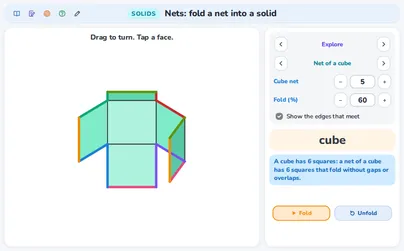
A net is the solid cut open and laid flat. The faces hang together by edges. When you fold, edges with the same letter meet.
aabbccddeeffgg
Example
Net of a triangular prism:2 triangles and 3 rectangles
aabbccddee
Rule

The 11 nets of a cube

A cube has 11 different nets of 6 squares. Not every six squares fold: if two squares land on the same face, it is not a net.
Example
Four squares in a rowwith one square on each sidefolds into a cube.
Tip

Opposite faces

In a net of a cube, two squares with exactly one square between them in a row lie opposite each other. On a dice opposite faces add up to 7.
413625
Example
Opposite the 4 is the
413625413625
Definition

Number plan

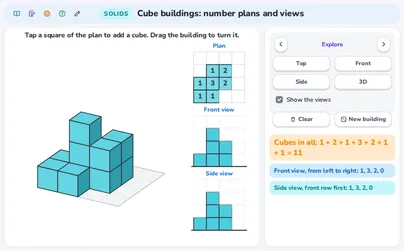
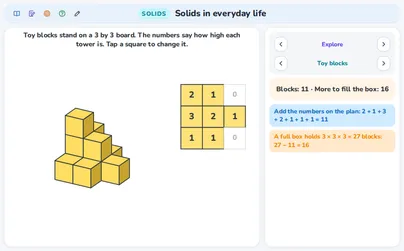
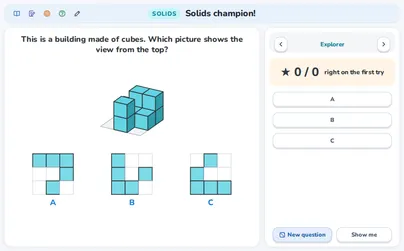
A cube building seen from above is a plan of squares. The number in a square says how many cubes stand on each other there. The total of the numbers is the number of cubes.
201130011
Example
Plan 2 1 0 / 0 3 1 / 1 0 2 → cubes
210031102
Definition

Top, front and side view

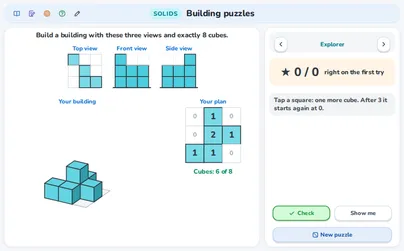
The top view shows where towers stand. The front view shows the highest tower of each column, from left to right. The side view shows the highest tower of each row, front row first.
2323
Example
Plan 2 1 / 0 3 (back row first):front view 2, 3side view 3, 2
2332
Rule

From the views to the building

Three views often fit more than one building. The most cubes: every tower as high as both views allow. The least: every column and every row still reaches its height.
643113
Example
Front view 2, 1 and side view 1, 2:most cubesleast cubes
532112
Definition

Isometric dot paper

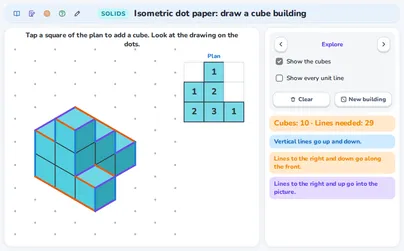
On isometric dot paper a cube building has three kinds of lines: vertical lines and two slanted kinds, to the right and down, to the right and up. Every edge you see is a line along the dots.
Example
One cube: 9 lines you can see(3 vertical, 3 and 3 slanted)
Definition

Horizon, eye point and vanishing point

In a perspective drawing the horizon is the line at the height of your eyes. The eye point O is the point of the horizon straight in front of your eye. Lines that are parallel in reality but go away from you meet in a vanishing point on the horizon. You look down on everything below the horizon and up at everything above it. In “Perspective drawing of a box: horizon, eye point and vanishing points” the tab Horizon and points shows all three.
horizonV = OO = eye point, V = vanishing point
Example
The eye is 5 above the ground and a box is 4 wide, 3 high and 8 deep. The top of the box (3) is below the horizon (5), so you see the top face. The front face is drawn true size, the back face is as large as the front face times a factor.The back face is 2 wide. Its bottom edge is 5/2 below the horizon, its top edge 1.
Rule

One-point and two-point perspective of a box

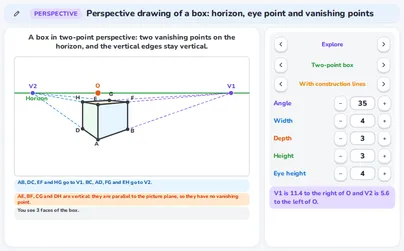
In one-point perspective the front face is parallel to the picture: it is drawn true size, vertical edges stay vertical, edges across stay horizontal and the edges that go away meet in one vanishing point V, the eye point O. In two-point perspective the box is turned: the edges to the right meet in V1 and the edges to the left in V2, both on the horizon with O between them; the vertical edges still stay vertical. In the application the eye is 8 in front of the picture, so for a turn with the vanishing points lie to the right and to the left of O. Try it in the tabs One-point box and Two-point box.
horizonV1V2Otwo vanishing points on the horizon
Example
Turn the box so that . Then V1 is to the right of O (about 10.7) and V2 is to the left.The angle is a right angle, so the product of the two distances is always .
Rule

The midpoint of a side in a perspective drawing

The middle of a side is not drawn in the middle: further away is drawn smaller, so the near half looks longer than the far half. To find the midpoint of every side of a rectangle, draw the diagonals; they cross in the centre M. The line through M and the vanishing point of one pair of sides (a horizontal line when those sides are parallel to the picture) cuts the other two sides in their midpoints. Do the same for the other pair. The tab Midpoints builds this step by step.
horizonABDCMKNLPV = O
Example
The floor of the box seen from eye height 5: A is 5 below the horizon, D is 5/2. The diagonals cross in M, 10/3 below the horizon. The drawn middle of AD is below it, so M is nearer to the far side. The near half of AD is 5/3 long and the far half 5/6: twice as long, although both halves are 4 in reality.
Rule

Check a drawing against the four rules

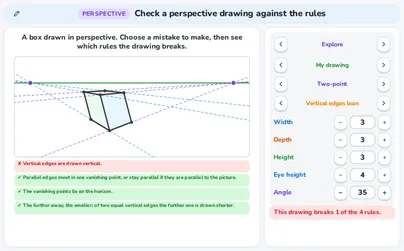
A perspective drawing follows four rules. Rule 1: vertical edges are drawn vertical. Rule 2: parallel edges meet in one vanishing point (or stay parallel when they are parallel to the picture). Rule 3: the vanishing points lie on the horizon. Rule 4: the further away, the smaller. Test the rules one at a time, on what is drawn. A drawing can break more than one rule: count them. In “Check a perspective drawing against the rules” the tab My drawing lets you make a mistake and shows the rules it breaks.
horizondrawn parallelV = O
Example
A box whose edges that go away are drawn as parallel lines. Rule 2 is broken: the lines never meet. Rule 4 is broken: the back face is as large as the front face. Rules 1 and 3 hold. So the drawing breaks 2 of the 4 rules.
Rule

A polygon in perspective: columns and rows

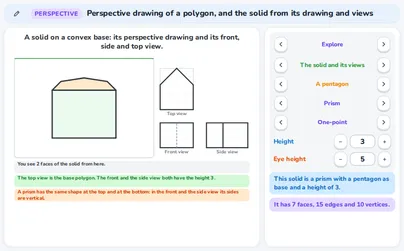
To draw a polygon that lies on the ground in one-point perspective, draw the grid of its plan first. The columns (the lines with = a number) go to the vanishing point V = O and the rows (the lines with = a number) stay horizontal. Every corner is where its column meets its row. A point at depth is drawn smaller by the factor . Type your own corners in “Perspective drawing of a polygon, and the solid from its views” in the tab Polygon on the ground.
horizonABCDEV = Ocolumns go to V = O, rows stay horizontal
Example
Eye height 6. The corner C (4, 8) is 8 deep: the factor is , so it is drawn to the right of O and below the horizon. The corner D (0, 24) is 24 deep: the factor is , so it is drawn 0 across and below the horizon.
Rule

Describe a solid from its views

The top view, the front view and the side view describe a solid. The top view shows the base, a polygon: count its sides. If the sides stay vertical in the front and the side view, the solid is a prism; if they slope to a point, it is a pyramid. A prism has faces, edges and vertices, a pyramid faces, edges and vertices. The volume of a prism is base area times height, of a pyramid a third of that. The tab The solid and its views shows the views next to the drawing.
Example
The top view is a pentagon () and the sides stay vertical: a prism with faces, edges and vertices. With a base area of 12 and a height of 3 the volume is . A pyramid on the same base has faces and the volume .
Tip

Linked topics

A cut through a prism parallel to the base gives the base again (cross-section). Surface area from a net and the volume of a cuboid come later in Surface area and volume.
Example
A cut parallel to the base:the cross-section is the base again

Exercises

How many faces, edges and vertices does a cube have? Check with Euler’s rule. Easy
Show solution
6 squares: 6 faces
F=6
edges
E=12
4 on top and 4 below: 8 vertices
V=8
Answer → 6 faces, 12 edges, 8 vertices
It is always 2.
A pentagonal prism has a base with 5 sides. How many faces, edges and vertices? Easy
Show solution
Faces →
F=7
Edges →
E=15
Vertices →
V=10
Answer → 7 faces, 15 edges, 10 vertices
Check → .
A pyramid has 10 edges. How many sides does its base have? Medium
Show solution
A pyramid has edges
, so
n=5
Answer → 5 sides (a pentagonal pyramid)
Faces and vertices are both .
A solid has 12 faces and 20 vertices. How many edges does it have? Medium
Show solution
Euler: faces + vertices − edges = 2
Answer → 30 edges
This is a dodecahedron.
On a dice opposite faces add up to 7. What is opposite the 4? And the 1? Medium
412??
Show solution
Opposite the 4 →
4123?
Opposite the 1 →
41236
Answer → 3 and 6
Opposite faces are never next to each other.
A box is 3 cm long, 4 cm wide and 5 cm high. You glue ribbon along every edge. How many centimetres of ribbon? Hard
3 cm4 cm5 cm
Show solution
A box has 12 edges: 4 of each length
3 cm4 cm5 cm
Answer → 48 cm
Do not count only the 3 edges you see at the front.
A building has the number plan 1 1 0 / 0 3 1 / 1 0 2 (back row first). How many cubes? And how many more fill a box of 3 by 3 by 3? Hard
110031102
Show solution
Add the numbers →
A full box holds
27
Answer → 9 cubes, 18 more
The numbers are heights, not the number of towers.
Are you a teacher?

Start live lessons with these applications for your whole class. Free to try for one month.

Try it free

Fits these school years

IB (MYP, Diploma): PYP, MYP 1, MYP 2, MYP 3

Cambridge International: Primary, stage 4, Primary, stage 5, Primary, stage 6, Lower Secondary, stage 7, Lower Secondary, stage 8, Lower Secondary, stage 9

Netherlands: Groep 5, Groep 6, Groep 7, Groep 8, Year 1, Vmbo bb (years 3-4), Vmbo kb (years 3-4), Vmbo gt (years 3-4), Vwo · Mathematics C

Türkiye (MEB): Year 4 (MEB), Year 5 (MEB), Year 6 (MEB), Year 7 (MEB), Year 8 (MEB)

England (GCSE, A Level): Year 4, Year 5, Year 6, Year 7, Year 8, Year 9

USA (Common Core): Grade 4, Grade 5, Grade 6, Grade 7, Grade 8

What the applications of this topic teach 9 applications

Solids: faces, edges and vertices

  • Naming a cube, cuboid, prism, pyramid, cylinder, cone and sphere
  • Counting faces, edges and vertices, also hidden ones
  • Knowing flat faces and curved surfaces
  • Using Euler's rule: faces + vertices − edges = 2

Nets: fold a net into a solid

  • Folding nets of a cube, cuboid, prism and pyramid
  • Knowing the 11 nets of a cube
  • Finding the face opposite a given face in a net
  • Drawing a net of a cube with a wish

Cube buildings: number plans and views

  • Building a cube building from a number plan
  • Finding the top, front and side view of a building
  • Finding the building that fits three views
  • Finding the least and most cubes for the same views

Isometric dot paper: draw a cube building

  • Reading an isometric drawing and finding its number plan
  • Knowing the three kinds of lines on isometric dot paper
  • Drawing a cube building on isometric dot paper
  • Drawing a building from its number plan

Perspective drawing of a box: horizon, eye point and vanishing points

  • Name the horizon, the eye point and a vanishing point in a perspective drawing and say how many vanishing points a box has.
  • Make a one-point and a two-point drawing of a box and work out where the back face and the vanishing points lie.
  • Find the midpoint of every side of a rectangle in a perspective drawing with the diagonals.

Perspective drawing of a polygon, and the solid from its views

  • Draw a polygon on the ground in one-point and two-point perspective with its columns and rows.
  • Describe a prism or a pyramid from its front, side and top view.
  • Tell which perspective drawing fits three given views.

Check a perspective drawing against the rules

  • Name the four rules of perspective drawing.
  • Check a drawing against the rules and say how many rules it breaks.
  • Say what must be changed to make a drawing correct.

Solids in everyday life

  • Counting straws and clay balls to build a prism or pyramid
  • Knowing opposite faces of a die add up to 7
  • Using the 12 edges of a cuboid for the ribbon round a gift box
  • Counting blocks still missing from a full box

Building puzzles

  • Building a cube building from its three views
  • Building one with exactly a given number of cubes
  • Building the ones with the most and the least cubes