İnteraktif Dersler

Angles with parallel lines and a transversal

Lecture notes

Definition

Parallel lines

Parallel lines have the same direction and never meet. In a figure they carry arrow marks › or ››. Lines that are not parallel meet on one side.
Example
Rails of a train track: parallelLines p and q with ›: p ∥ q
pq
Definition

The transversal and the eight angles

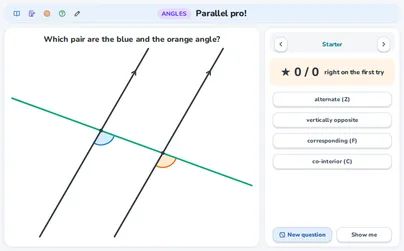
A transversal crosses two lines. That makes eight angles, four at each crossing. They lie between the lines (inside) or outside, on the same side or on opposite sides of the transversal.
pqt12345678
Example
2 crossings × 4 angles: angles
12345678
Rule

At one crossing

At one crossing, vertically opposite angles are equal and neighbours on a straight line add up to 180°.
abab
Example
One angle 65°:opposite 65°, neighbour °
65°115°65°115°
Rule

Corresponding angles (F)

Corresponding angles lie in the same place at the two crossings. At parallel lines they are equal. Why: slide one crossing along the transversal onto the other. The angle does not turn.
aa
Example
The F shape.Top 65°: the F angle at the bottom is also 65°
65°65°
Rule

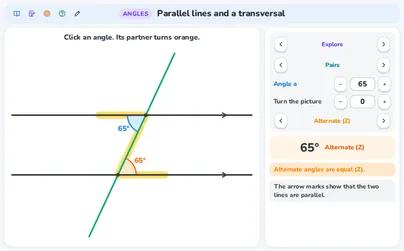
Alternate angles (Z)

Alternate angles lie between the lines, on opposite sides of the transversal. At parallel lines they are equal. Why: a corresponding angle, and then its vertically opposite angle.
aa
Example
The Z shape.Top 65°: corresponding 65°, opposite to that 65°: the Z angle is 65°
65°65°
Rule

Co-interior angles (C)

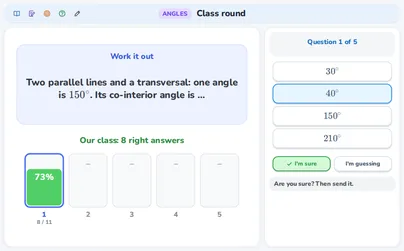
Co-interior angles lie between the lines, on the same side of the transversal. At parallel lines they add up to 180°. Why: a corresponding angle, and then the straight line.
ba
Example
The C shape.Top 65°: the C angle is °
65°115°
Rule

Only two sizes

At two parallel lines only two sizes occur: a and 180° − a. One angle gives all eight.
a180°−aa180°−aa180°−aa180°−a
Example
a = 65°: four angles of 65° and four of °Together °
65°115°65°115°65°115°65°115°
Tip

F, Z and C in any position

The shapes can be turned, stretched or mirrored. Look for the letter between the two lines, then name the pair.
Example
A Z turned a quarter turn is still a Z:alternate angles
65°65°
Watch out!

Not parallel: not equal

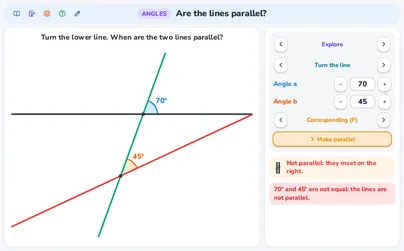
On lines that are not parallel the pairs still exist, but the angles are not equal. Use F, Z and C only when the lines are parallel.
ab
Example
Corresponding angles 70° and 80°:not equal, so the lines are not parallel
70°80°
Rule

The test for parallel lines

The other way round also works: if corresponding or alternate angles are equal, or co-interior angles add up to 180°, the lines are parallel.
aa
Example
Corresponding 65° and 65°: parallelC angles 100° and 70°: °, not 180°: not parallel
100°70°
Special case

Where they meet

Lines that are not parallel meet on the side where they come closer. The angle between them at that point is the difference of the two angles.
aba−b
Example
Corresponding 70° and 55°:they meet at an angle of °
70°55°15°
Rule

Draw a parallel with a set square

Put a ruler along the set square (geodriehoek), slide the set square along the ruler and draw a line at every stop. It does not turn, so the corresponding angle with the ruler stays the same: all lines are parallel.
45°45°
Example
The set square keeps 60° with the ruler:all the lines make 60°, so they are parallel
60°60°
Rule

Angle chasing with reasons

Find an unknown angle in steps. For every step write the size and the reason: vertically opposite, straight line, F, Z or C.
aax
Example
Given 65°.Step 1, alternate (Z): 65°Step 2, straight line: °
65°65°x
Rule

Algebra in the angles

When x is in two angles: equal angles (F, Z, opposite) give an equation "one = the other", co-interior angles give "sum = 180°". Solve it, then give the angles. See Linear equations.
(2x)°50°
Example
F angles (2x)° and 50°: , C angles (3x)° and 120°: ,
(2x)°50°120°(3x)°
Rule

The bend between parallel lines

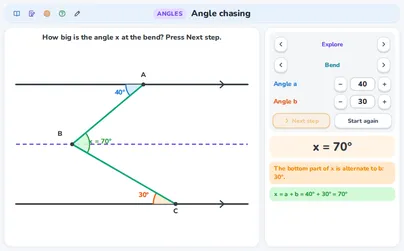
Draw a helper line through the bend, parallel to both lines. It splits x into two alternate angles: x = a + b.
abx
Example
a = 35°, b = 50°:°
35°50°x
Rule

The triangle proof

A line through the top of a triangle, parallel to the base, gives two alternate angles at the top. Together with the top angle they make a straight line: A + B + C = 180°. See Triangles › Angle sums.
abcabABC
Example
A = 50°, B = 60°:°
50°60°c50°60°ABC
Rule

The trapezium

In a trapezium the two parallel sides make the angles along each leg co-interior: they add up to 180°. See Quadrilaterals › Parallelogram.
abABCD
Example
Angle at A 70°:the angle at D is °
70°xABCD
Tip

Before and after

Measuring angles and the facts at one point come first: see Measuring and drawing angles. Solving the equations: see Linear equations.
Example
Opposite and straight-line facts: Measuring and drawing anglesSolve : Linear equations

Exercises

Parallel lines and a transversal. One angle is 70°. Give its corresponding angle, its alternate angle and its co-interior angle. Easy
70°
Show solution
Corresponding (F): equal, 70°
Alternate (Z): equal, 70°
Co-interior (C):
70°70°110°70°
Answer → 70°, 70° and 110°
F and Z are equal, C adds up to 180°.
Two lines are crossed by a transversal. The co-interior angles are 100° and 70°. Are the lines parallel? Easy
100°70°
Show solution
170 is not 180: the rule for parallel lines does not hold
Answer → no, not parallel
Co-interior angles must add up to 180°.
Two parallel lines are crossed by a transversal. One angle is 65°. Which sizes do the eight angles have, and what do they add up to? Medium
65°
Show solution
Only a and 180° − a: 65° and °
65°115°65°115°65°115°65°115°
Four of each:
Answer → 65° and 115°, together 720°
Check: 2 crossings × 360° = 720°.
The angles (3x)° and 60° are alternate angles at parallel lines. Find x. Medium
(3x)°60°
Show solution
Alternate angles are equal:
Answer → x = 20
Equal angles give "one = the other".
A path bends between two parallel lines. The angles at the lines are 35° and 50°. How big is the angle x at the bend? Hard
35°50°x
Show solution
Draw a helper line through the bend, parallel to the two lines
35°50°x
Two alternate angles: 35° and 50°
Answer → 85°
x = a + b.
Co-interior angles at parallel lines are (x + 40)° and 100°. Find x and both angles. Hard
100°(x+40)°
Show solution
They add up to 180°:
, so
The angles: and 100, together
Answer → x = 40, angles 80° and 100°
Co-interior: "sum = 180°".
Are you a teacher?

Start live lessons with these applications for your whole class. Free to try for one month.

Try it free

Fits these school years

IB (MYP, Diploma): MYP 2, MYP 3

Cambridge International: Lower Secondary, stage 8, Lower Secondary, stage 9

Netherlands: Year 1, Year 2, Year 3 (havo, vwo), Vmbo bb (years 3-4), Vmbo kb (years 3-4), Vmbo gt (years 3-4), Havo · Mathematics B, Vwo · Mathematics B

Türkiye (MEB): Year 6 (MEB), Year 7 (MEB)

England (GCSE, A Level): Year 7, Year 8, Year 9

USA (Common Core): Grade 8, Grade 7

What the applications of this topic teach 5 applications

Parallel lines and a transversal: F, Z and C angles

  • Naming the eight angles a transversal makes
  • Knowing vertically opposite angles are equal and neighbours add to 180°
  • Knowing corresponding, alternate and co-interior angles
  • Recognising F, Z and C angles in any position

Are the lines parallel? Test with angles

  • Seeing where non-parallel lines meet and at what angle
  • Testing whether lines are parallel with angles
  • Finding the angle that makes two lines parallel
  • Drawing parallel lines by sliding a set square along a ruler

Angle chasing: step by step with reasons

  • Using opposite angles and angles on a line as steps
  • Finding an unknown angle in steps with a reason for each
  • Writing an equation with x in two angles and solving it
  • Showing why the angles of a triangle add up to 180°

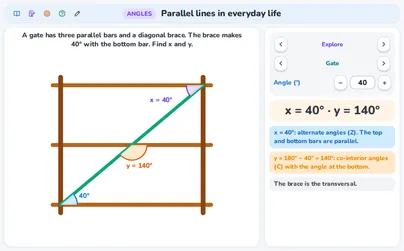
Parallel lines in everyday life

  • Using corresponding angles in real scenes
  • Using alternate angles: gate bars and a periscope
  • Using co-interior angles and a straight line
  • Naming the transversal in a scene

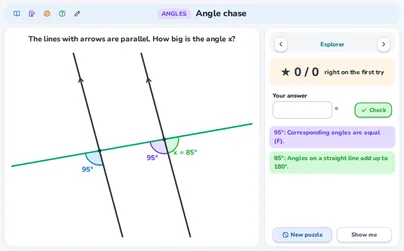
Angle chase (puzzles)

  • Naming the eight angles and their pairs in any position
  • Finding an angle in one or two steps with a chain of reasons
  • Solving harder puzzles: a bend and a triangle between parallels