İnteraktif Dersler

Approximate solutions: iteration

Lecture notes

Definition

Iteration

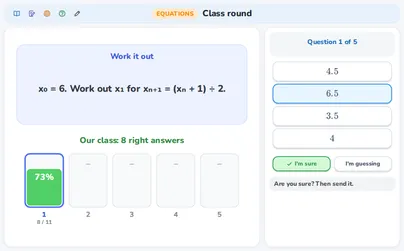
Use the answer of one step as the input of the next step, again and again: . Start with , then find , , …
x0x1x2x3…ggg
Example
with :, , …
0467…x0x1x2x3÷2+4÷2+4÷2+4
Definition

The solution of x = g(x)

If the values settle down to a number, that number does not change any more: . On a graph it is where the curve meets the line .
246810246810xyL
Example
: the values settle at , so ., and ✔
24610246810xy8
Definition

Converge and diverge

The iteration converges when the values come closer and closer to one number. It diverges when they run away, bounce about or stop.
048L
Example
from 0: … converges to 8 from 1: … diverges
04677.5…✔124816…×2×2×2×2✘
Rule

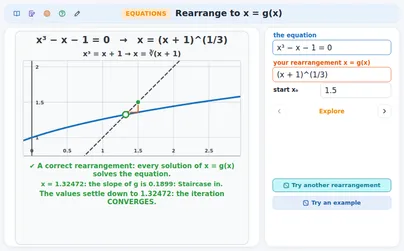
Rearrange the equation

To solve an equation like , write it as . For example , so . The same equation has many rearrangements.
x³−x−1=0x³=x+1x=g(x)
Example
Check with the solution 3: ✔
x²−x−6=0x²=x+6x=√(x+6)
Rule

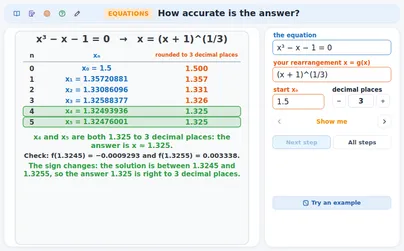
Use a table

Write … in a table. When two values in a row are equal to the number of decimal places you need, stop: that is the answer.
n01234x04677.5
Example
, , to 2 decimal places: two equal in a row:
n12345x2.652.942.993.003.00✔✔
Rule

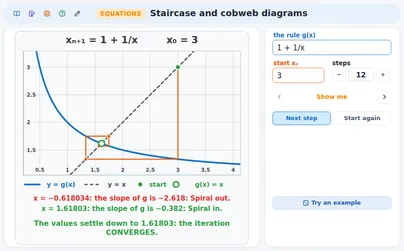
Staircase and cobweb

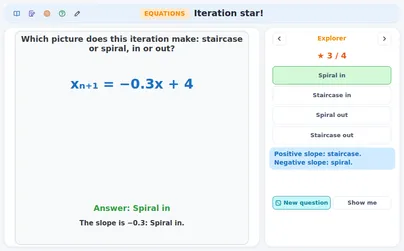
Draw the curve and the line . From go to the curve, across to the line, to the curve again … With a positive slope you get a staircase, with a negative slope a spiral.
xy3xy2
Example
, : curve at , across to the line at ,curve at , line at … a staircase up to
24610246810xy8
Rule

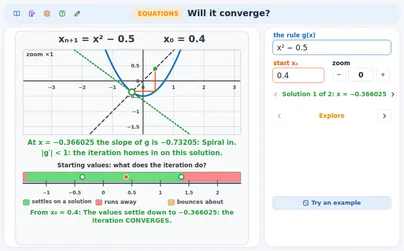
The slope rule

Close to the solution the iteration converges when the slope of is between and . If the slope is more than or less than it moves away.
246810246810xy1m
Example
: slope , between and converges to 8: slope , more than from : runs away
xy8✔xy✘
Rule

Check by a sign change

To check an answer to 3 decimal places, put the two ends of the rounding interval into the equation: if left minus right changes sign, the solution is between them.
xf1.5−1.6+
Example
, answer : test the ends 1.5155 and 1.5165. and : sign change ✔
xf1.5155−1.5165+
Tip

Try another rearrangement

If one rearrangement diverges, rearrange the equation in a different way. Look at the slope of at the solution to see which one will work.
Example
, solution 3: has slope at 3 diverges. has slope from : … closing in on 3
xy✘xy✔
Tip

Start close

A good start is a number near the solution: find two whole numbers around it first (a sign change).
12−6612xy−35
Example
: , Sign change the solution is between 1 and 2: start at
11.52−35x0
Tip

Use the picture

On the cobweb diagram you can see at once if the path walks to the crossing or away from it.
xy8✔xy✘
Example
Step sizes of from 0: shrinking, closing in on 8Step sizes of from 7: growing, away from 8
04678421✔−19−172618✘
Watch out!

Not every rearrangement works

Some rearrangements diverge, even though they are correct. Try for : the values run away.
123123xy✘
Example
, :✘ : … runs away ✔ : … settles at 3
xy✘xy3✔
Watch out!

Stopping too early

Do not stop when you like the number. Stop when two values in a row agree to the decimal places you need, and check with a sign change.
Example
from , 2 decimal places: ✘ stop at , it looks fine ✔ stop at (two equal in a row), then check with a sign change
n12345x3.323.053.013.003.00✘✔
Watch out!

A lost solution

A rearrangement with a square root only finds the positive solution: the negative one is lost, because a root is never negative.
−44812xy−23
Example
has two solutions: 3 and .: , not only 3 can be found
xy3✘2
Special case

Slope exactly 1

If the slope at the solution is exactly or the rule does not decide. Look at the path of the iteration.
xy11
Example
: , and the slope at 0 is exactly .From : moves away. From : moves in
xy
Special case

Bouncing

Some iterations bounce between two numbers for ever, like from : the values are …
−101
Example
, :, , … bounces between 1 and 3 for ever
01234x0x1
Special case

No number

If a value makes the rule impossible (a square root of a negative number) the iteration stops.
246−1123xy✘
Example
, : : impossible the iteration stops
3g1g?✘

Exercises

Use with . Find and . Easy
Show solution
05/320/9x0x1x2gg
Answer → ,
The values settle down to 5/2: put in the rule and it stays 5/2.
The solution of is . What does the iteration look like? Easy
Show solution
Check:
The slope of is : negative, between and
1341234xy2
Answer → a spiral that goes in
The values jump above and below 2 and come closer.
Rearrange into and find and from . Medium
Show solution
, so
x³=x+1x=g(x)
1.51.3571.331x0x1x2gg
Answer → ,
The solution is about 1.3247.
The iteration for gives and . What is the solution to 3 decimal places? Check it. Medium
Show solution
Both are 1.325 to 3 decimal places
Check: put in 1.3245 and 1.3255
and
xf1.3245−1.3255+
Answer →
The sign changes, so the solution is between 1.3245 and 1.3255.
Which rearrangement of finds the large solution (about 3.73): or ? Hard
Show solution
For the slope is : at 3.73 that is
For the slope is : at 3.73 that is more than 1
xy✔xy✘
Answer →
The other one finds the small solution 0.27, where its slope is .
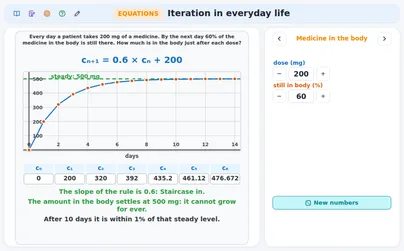
A patient takes 200 mg each day and 60% of the medicine stays until the next day. How much is in the body after each dose, and where does it settle? Hard
Show solution
, ,
It settles when , so
246246x×1005
Answer → 200, 320, 392 … settling at 500 mg
The slope is 0.6 (less than 1): a staircase in.
Are you a teacher?

Start live lessons with these applications for your whole class. Free to try for one month.

Try it free

Fits these school years

IB (MYP, Diploma): MYP 4, MYP 5

Cambridge International: IGCSE

Netherlands: Vwo · Mathematics A, Vwo · Mathematics C, Vwo · Mathematics D

Türkiye (MEB): Year 10 (MEB), Year 11 (MEB)

England (GCSE, A Level): Year 10 (GCSE), Year 11 (GCSE)

USA (Common Core): Algebra 2
What the applications of this topic teach 6 applications

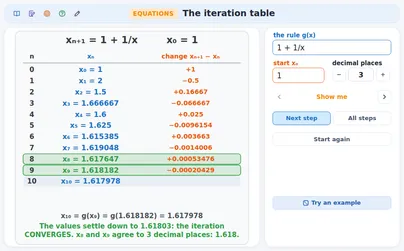
The iteration table

  • Working out terms from a rule x(n+1) = g(x(n))
  • Seeing if the values settle down, run away or bounce
  • Knowing when to stop: two values in a row agree

Staircase and cobweb diagrams

  • Reading a staircase or cobweb diagram
  • Seeing the solution of x = g(x) as the crossing of y = g(x) and y = x
  • Telling from the picture if the iteration converges

Rearrange to x = g(x)

  • Rearranging an equation into x = g(x)
  • Checking that a rearrangement is correct
  • Choosing a rearrangement that converges

Will it converge?

  • Knowing that iteration converges when the slope of g is between −1 and 1
  • Seeing that the start value matters
  • Telling a staircase from a spiral by the sign of the slope

How accurate is the answer?

  • Giving a solution to a number of decimal places by iteration
  • Knowing when to stop: two values agree after rounding
  • Checking the answer with a sign change

Iteration in everyday life

  • Using iteration in a real situation
  • Saying what the steady value means in the story
  • Saying if the story settles down or keeps growing