İnteraktif Dersler

Lines, polygons and quadrilaterals: drawing, properties and angle problems

Lecture notes

Definition

Polygon

A polygon is a closed figure made of straight sides. It has as many corners (vertices) as sides: a triangle 3, a quadrilateral 4, a pentagon 5, a hexagon 6.
3456
Example
A figure with 5 sides also has 5 corners.
12345
Definition

Point, line, segment and ray

A point has a place but no size. Through two points goes exactly one line, and it never ends. A segment [AB] has two end points and a length |AB|. A ray [AB starts at A and goes on without end.
AABABAB[AB]AB[AB
Example
A and B are 6 cm apart.
AB6 cm
Definition

Angle and vertex

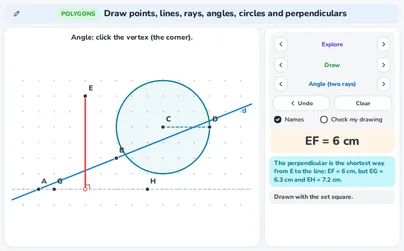
Two rays with the same starting point make an angle. The starting point is the vertex. In the name ∠ABC the vertex B is the middle letter. A right angle is 90°.
ACαB
Example
The rays go through A and C, the vertex is B.
AC∠ABCB
Rule

Circle, perpendicular and parallel

Every point of a circle is the same distance r from the centre. The diameter is two radii. The perpendicular from a point to a line is the shortest way to it. Parallel lines never meet and stay the same distance apart.
OrdPFd
Example
A circle has a radius of 3 cm.
O3 cm6 cm
Definition

Triangle: corners, sides and kinds

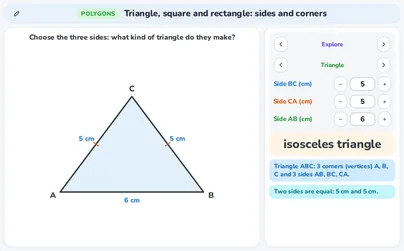
Triangle ABC has 3 corners A, B, C and 3 sides AB, BC, CA. By its sides it is scalene (all different), isosceles (two equal) or equilateral (all three equal).
Example
Sides 4 cm, 4 cm and 6 cm: two sides are equal, so it is isosceles.
6 cm4 cm4 cm
Special case

Sticks that cannot close

Three sticks make a triangle only if the two shorter ones together are longer than the longest.
abcg✘
Example
Sticks of 3, 4 and 8 cm do not close.
3481✘
Definition

Rectangle and square

A rectangle ABCD has 4 corners and 4 sides. Opposite sides are equal and all four corners are right angles. A square is a rectangle with all four sides equal, so every square is a rectangle.
ABCDABCD
Example
AB = 5 cm and BC = 3 cm.
ABCD5353
Rule

Polygons from lines

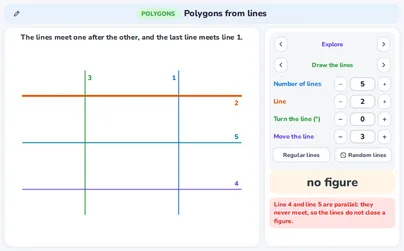
Lines that meet one after the other (line 1 with line 2, line 2 with line 3, … and the last with line 1) close a polygon. Each line holds one side and each crossing is a corner: n lines make n sides and n corners.
1231234
Example
Five lines close a figure: 5 sides and 5 corners, a pentagon.
12345
Watch out!

Lines that do not close

Two parallel neighbours never meet, so there is no corner. Three lines through one point cross only there. A figure that crosses itself is not a polygon.
✘P✘✘
Example
✘ Three lines through one point make a triangle.✔ They only meet at that point: no triangle.
P✘
Rule

Regular polygon

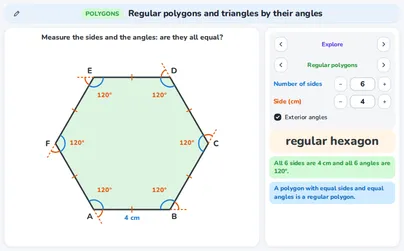
A regular polygon has equal sides AND equal angles. Equal angles alone are not enough (a rectangle) and equal sides alone are not enough (a rhombus). A square and an equilateral triangle are regular.
✘✘✔
Example
A rectangle has 4 right angles, but its sides are 5 and 3. → not regular
53✘
Rule

Angle sum of a triangle

The three angles of a triangle always add up to 180°: cut off the corners and join them, they make a straight angle. By its angles a triangle is acute, right or obtuse, and it has at most one right or obtuse angle.
αβγαβγ
Example
Two angles are 50° and 60°.
50°60°?50°60°?
Rule

Isosceles and equilateral triangles

Equal sides have equal angles opposite to them. The two base angles of an isosceles triangle are equal. An equilateral triangle has three angles of 60°.
ααβ60°60°60°
Example
The top angle is 80°.
??80°
Rule

Exterior angle

An exterior angle lies between a side and the extension of the next side. Interior + exterior angle = 180°. An exterior angle of a triangle equals the sum of the two angles that are not next to it.
αγα+γACB
Example
A = 40° and C = 70°. The exterior angle at B is their sum.
40°70°?ACB
Rule

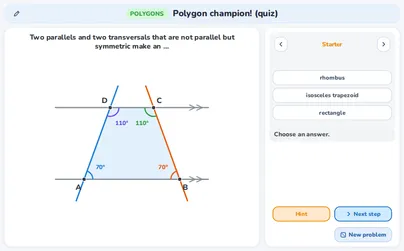
Two parallels and two transversals

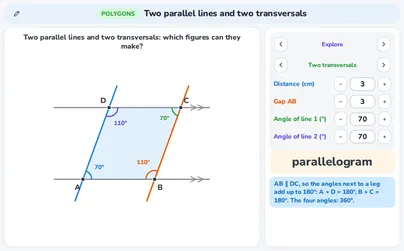
Two parallel lines and two transversals make a trapezoid, a parallelogram, a rhombus, a rectangle, a square or a triangle. When AB ∥ DC the angles next to a leg add up to 180° and the four angles of a quadrilateral add up to 360°.
αδABCDα+δ=180°
Example
AB ∥ DC and A = 70°.
70°?ABCD
Definition

The family of quadrilaterals

A trapezoid has one pair of parallel sides. A parallelogram has two pairs. A rhombus is a parallelogram with four equal sides, a rectangle one with four right angles, a square is both. So a square is also a rectangle, a rhombus, a parallelogram and a trapezoid.
Example
Is every rectangle a parallelogram? Yes: both pairs of opposite sides are parallel.
✔
Definition

Trapezium: a pair of parallel sides

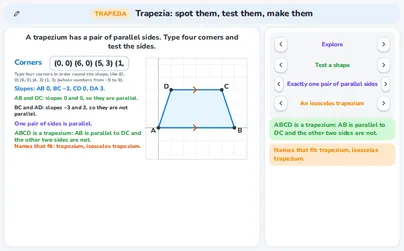
A trapezium is a quadrilateral with a pair of parallel sides; the other two sides are not parallel. To spot one, look at the directions of the sides, not at their lengths or at the angles. The angles at the two ends of one of the other two sides are co-interior angles: they add up to 180°. In the application "Trapezia: spot them, test them, make them" the tab Test a shape tests the sides of four corners that you type.
ABCD
Example
ABCD with A(0, 0), B(6, 0), C(4, 3), D(1, 3): AB and DC both have slope 0, so they are parallel. BC has slope −3/2 and AD has slope 3: not parallel. One pair: ABCD is a trapezium. Angle A is about 71.6°, so angle D = 180° − 71.6° = 108.4°.
0−3/203ABCD
Rule

Testing two sides with slopes

The slope of a side is how far it goes up divided by how far it goes across, from one corner to the next. Two sides are parallel when their slopes are equal. To test a quadrilateral, test the two pairs of opposite sides: AB with DC, and BC with AD. A side that goes straight up has no slope; two sides that both go straight up are parallel. Count the pairs: 0, 1 or 2. In Test a shape the page writes the four slopes and tests both pairs.
1/2−21/23ABCD
Example
A(0, 0), B(4, 2), C(3, 4), D(1, 3): AB goes across 4 and up 2: slope 2 ÷ 4 = 1/2. DC goes from D to C, across 2 and up 1: slope 1 ÷ 2 = 1/2. The same, so AB and DC are parallel. BC has slope −2 and AD has slope 3: not parallel. One pair: a trapezium. For A(0, 0), B(5, 1), C(4, 4), D(−1, 2) the four slopes are 1/5, −3, 2/5 and −2: AB and DC differ, and BC and AD differ. No pair: not a trapezium.
1/5−32/5−2ABCD
Special case

One pair or at least one pair?

Not every book defines the trapezium in the same way. With exactly one pair of parallel sides, a parallelogram is not a trapezium. With at least one pair, every parallelogram, rectangle, rhombus and square is also a trapezium. Find out which rule your book and your teacher use. In the application you choose the rule with Exactly one pair of parallel sides or At least one pair of parallel sides: the verdict, the figures in Sort the shapes and the tasks in Make one follow your choice.
ABCD
Example
A(0, 0), B(5, 0), C(7, 3), D(2, 3): AB and DC have slope 0 and BC and AD have slope 3/2: two pairs of parallel sides. With exactly one pair this is not a trapezium (it is a parallelogram). With at least one pair it is a trapezium, and a parallelogram too.
Rule

Diagonals that bisect each other

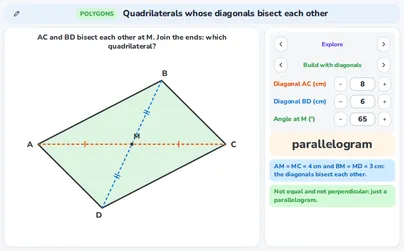
A diagonal joins two corners that are not neighbours. If the diagonals bisect each other, the quadrilateral is a parallelogram. Equal diagonals make it a rectangle, perpendicular diagonals a rhombus, both a square.
ABCDM
Example
AC = 10 cm and the diagonals bisect each other at M.
ABCDM55
Watch out!

Only one diagonal bisected

If only one diagonal is bisected, the quadrilateral is not a parallelogram. With perpendicular diagonals it is a kite. Perpendicular or equal diagonals alone do not make a parallelogram.
M✘
Example
✘ The diagonals are perpendicular, so it is a rhombus.✔ Only one is bisected: a kite.
M✔
Tip

Solving an angle problem

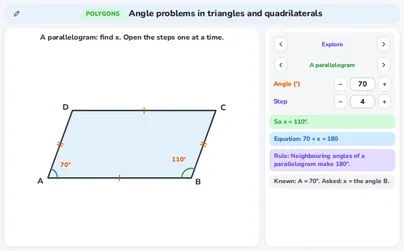
Go in steps: what is known and what is asked, which rule connects them, the equation with x, the answer, and the check with 180° or 360°.
Example
The angles are x, 2x and 3x.
x3x2x30°90°60°
Tip

Two circles make a triangle

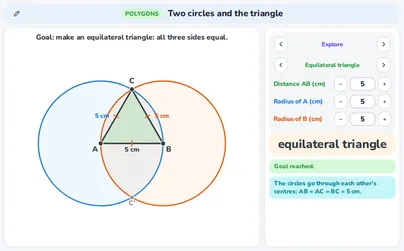
If two circles cross at C, then AC and BC are radii, so you need no ruler. Two circles cross in two points when the distance AB is smaller than r1 + r2 (and bigger than their difference).
ABCABr1r2
Example
Radii 4 and 6, AB = 9. → scalene: 9, 4, 6
ABC946

Exercises

A triangle has the angles 60° and 70°. How big is the third angle? Easy
60°70°?
Show solution
The three angles make 180°.
60°70°50°
Answer → 50°
Check: .
In the rectangle ABCD the side AB is 7 cm and BC is 4 cm. How long are CD and DA? Easy
ABCD7 cm4 cm
Show solution
Opposite sides of a rectangle are equal.
CD is opposite to AB, so .
ABCD7474
DA is opposite to BC, so .
Answer → CD = 7 cm and DA = 4 cm
Not CD = 4: AB and BC are next to each other, not opposite.
Six lines meet one after the other and the last meets the first. What figure do they close, and how many corners does it have? Easy
Show solution
One line holds one side, so there are 6 sides.
A polygon has as many corners as sides: 6 corners.
A figure with 6 sides is a hexagon.
123456
Answer → a hexagon with 6 corners
Hexa means six.
The top angle of an isosceles triangle is 70°. How big is each base angle? Medium
??70°
Show solution
The two base angles are equal and all three angles make 180°.
55°55°70°
Answer → 55° each
Check: .
In the parallelogram ABCD the angle A is 65°. How big are the angles B, C and D? Medium
65°???ABCD
Show solution
Neighbouring angles add up to 180°: B is next to A.
Opposite angles are equal: and .
65°115°65°115°ABCD
Answer → B = 115°, C = 65°, D = 115°
Check: .
A triangle has the angles and . How big is the exterior angle at B? Medium
45°60°?ACB
Show solution
An exterior angle is the sum of the two angles not next to it.
A and C are not next to the exterior angle at B.
45°60°105°ACB
Answer → 105°
Check: , and .
The trapezoid ABCD has , and . How big are the angles D and C? Hard
80°70°??ABCD
Show solution
The angles next to the leg AD add up to 180°.
The angles next to the leg BC add up to 180°.
80°70°110°100°ABCD
Answer → D = 100° and C = 110°
Check: .
The angles of a triangle are in the ratio 2 : 3 : 4. How big is the biggest angle? Hard
2x3x4x
Show solution
Write the angles as 2x, 3x and 4x. Together they make 180°.
40°60°80°
Answer → 80°
Check: .
Circle A has the radius 4 cm and circle B the radius 6 cm. The centres are 9 cm apart. Do the circles cross, and what kind of triangle is ABC? Hard
ABC946
Show solution
The circles cross when the distance is smaller than the radii added up and bigger than their difference.
and : they cross.
The sides are AB = 9, AC = 4 (radius of A) and BC = 6 (radius of B).
649
9, 4 and 6 are all different.
Answer → they cross; ABC is scalene
No ruler needed: the circles give the lengths.
Are you a teacher?

Start live lessons with these applications for your whole class. Free to try for one month.

Try it free

Fits these school years

IB (MYP, Diploma): PYP, MYP 1, MYP 2, MYP 3

Cambridge International: Primary, stage 4, Primary, stage 5, Primary, stage 6, Lower Secondary, stage 7, Lower Secondary, stage 8

Netherlands: Groep 6, Groep 7, Year 1, Groep 8, Year 2

Türkiye (MEB): Year 4 (MEB), Year 5 (MEB), Year 6 (MEB), Year 7 (MEB)

England (GCSE, A Level): Year 4, Year 5, Year 6, Year 7, Year 8

USA (Common Core): Grade 3, Grade 4, Grade 5, Grade 6, Grade 7, Grade 8

What the applications of this topic teach 9 applications

Triangle, square and rectangle: sides and corners

  • Naming the sides and corners of a triangle, rectangle and square
  • Saying how sides and corners are related
  • Naming a triangle by its sides and knowing a square is a rectangle

Draw points, lines, rays, angles, circles and perpendiculars

  • Recognising the tools for point, line, segment, ray, angle and circle
  • Drawing figures with pencil, ruler, compass and set square
  • Telling what drawings show: equal radii, the shortest perpendicular

Polygons from lines

  • Looking at what happens when lines meet one after the other
  • Forming triangles, quadrilaterals and pentagons from lines
  • Saying a polygon has as many lines, sides and corners

Regular polygons and triangles by their angles

  • Finding properties of regular polygons and diagonals
  • Finding interior and exterior angles and the angle sum of a triangle
  • Naming triangles by angles and sides

Two circles and the triangle

  • Guessing what triangle two crossing circles give
  • Finding numbers for scalene, isosceles and equilateral triangles
  • Saying when the circles give no triangle

Two parallel lines and two transversals

  • Guessing which figures two parallels and two transversals make
  • Listing figures by parallel sides, equal sides and angles
  • Stating the angle sum of a triangle and quadrilateral properties

Quadrilaterals whose diagonals bisect each other

  • Guessing which quadrilaterals have diagonals that bisect each other
  • Building quadrilaterals with diagonals of own length and angle
  • Judging what bisecting, equal and perpendicular diagonals say

Trapezia: spot them, test them, make them

  • Saying which property makes a quadrilateral a trapezium
  • Sorting figures into trapezia and other quadrilaterals
  • Finding a missing corner or angle of a trapezium

Angle problems in triangles and quadrilaterals

  • Naming what is known and asked in an angle problem
  • Choosing the rule that connects the angles and writing an equation
  • Solving in steps and checking with 180° or 360°