İnteraktif Dersler

Measuring accurately: instruments, uncertainty and screens

Lecture notes

Definition

A measure is never exact

Every measure has a small error. An instrument has a step: the distance between its smallest marks. A reading is the nearest mark, and the instrument adds a small wobble. In the application every instrument is simulated: it has a step and a small error, so measuring again shows a spread. The real ruler in your hand stays real; the instruments and the objects are our own drawings, with no brand and no photograph.
Example
A pen is 14.16 cm long. A ruler with a step of 1 mm shows the nearest mark: 14.2 cm. The reading is 0.04 cm off; the exact length 14.16 cm is not on the ruler.
Definition

The step: the finest difference

The step of an instrument is the smallest difference that it can show. A ruler with marks 1 mm apart cannot tell 14.16 cm from 14.2 cm: both are written as 14.2 cm. A smaller step shows finer differences, but see the card about the range.
Example
With a step of 1 mm every length from 14.15 cm up to just below 14.25 cm is written as 14.2 cm. So a pen of 14.16 cm and a pen of 14.2 cm look the same on the ruler.
1414.114.214.314.414.1614.2
Rule

Measure again: the middle value

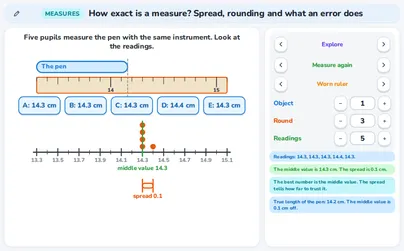
One reading can be a little off, so measure again. In the tab Measure again up to 5 pupils measure the same object. Put the readings in order: the middle value is the one in the middle (the third of five). It is a good best number: small errors up and down balance out, and one wild reading does not move it. The biggest reading is often the one with the biggest error.
Example
Five pupils measure a pen and write 14.1, 14.2, 14.2, 14.3 and 14.5 cm. In order they are 14.1, 14.2, 14.2, 14.3, 14.5. The middle value is the third: 14.2 cm. The biggest reading, 14.5 cm, is 0.3 cm above it.
1414.114.214.314.414.514.6middle value 14.2
Definition

The spread

The spread is the biggest reading minus the smallest reading. A small spread means that the readings lie close together. A big spread means: do not trust one single reading too much, and measure again or use a finer instrument.
Example
Set A, 14.1, 14.2, 14.2, 14.3 and 14.5 cm: spread . Set B, 13.9, 14.3, 14.4, 15.0 and 15.3 cm: spread , and the middle value is 14.4 cm. The readings of B lie further apart, so one of them says little.
13.81414.214.414.614.81515.215.4middle value 14.4spread 1.4
Watch out!

A small spread does not mean right

The spread only shows how far the readings lie apart, not whether they are right. A worn ruler adds the same amount to every reading, so all readings are off in the same way: the spread stays small and the middle value is wrong too. The worn ruler of the application adds 2 mm to every reading.
Example
A pen is 14.2 cm long. The good ruler gives 14.1, 14.2, 14.2, 14.3 and 14.5 cm: middle value 14.2 cm, spread 0.4 cm. The worn ruler gives 14.3, 14.4, 14.4, 14.5 and 14.7 cm: the spread is still 0.4 cm, but the middle value is 14.4 cm, 0.2 cm, that is 2 mm, too long.
1414.214.414.614.8middle value 14.4true length 14.2spread 0.4
Rule

What a reading stands for

A reading is rounded to the step, so it stands for a range: from half a step below to half a step above. For a step of 0.1 cm that is 0.05 cm on each side. “12.3 cm” means: between 12.25 cm and 12.35 cm. In the tab What a number stands for you type the lowest and the highest length.
Example
A reading of 12.3 cm with a step of 0.1 cm: the lowest length is and the highest length is .
12.112.212.312.412.512.312.2512.35
Tip

12.30 says more than 12.3

One more digit claims a finer step. 12.30 cm is read to a hundredth of a centimetre: it stands for 12.295 to 12.305 cm, a range ten times narrower than that of 12.3 cm. But an extra zero does not make a measure better: only a better instrument does. Never write more digits than the instrument can show.
Example
12.3 cm: from 12.25 to 12.35, a width of 0.1 cm. 12.30 cm: from 12.295 to 12.305, a width of 0.01 cm. And .
12.112.212.312.412.512.3: 12.25–12.3512.30: 12.295–12.305
Rule

Add the errors: a total

Every length has its own error, and in a sum the errors add up. Two lengths that are each read to the nearest cm can each be 0.5 cm off, so their total can be off. The lowest total is the sum of the lowest values and the highest total the sum of the highest values. In Add the errors choose Sum and type the highest total.
Example
A table top is 120 cm by 60 cm, each side to the nearest cm. The lengths stand for 119.5 to 120.5 cm and 59.5 to 60.5 cm. Lowest total of the two sides → . Highest total → .
178179180181182180179181
Rule

The error of an area

In a product the error grows faster than in a sum. The area is the highest when both sides are the highest and the lowest when both sides are the lowest. Multiply the two highest values for the highest area and the two lowest values for the lowest area. In Add the errors choose Area.
Example
Table top , each side to the nearest cm: lowest area , highest area . The middle is , so the area can be about 90 cm² more or less: a bigger error than the 0.5 cm of each side.
7100715072007250730072007110.25–7290.25
Definition

Percent error (older pupils)

This card is for older pupils. The same error matters more on a small measure. The percent error is the error divided by the measure, times 100. In the tab Percent error the same error is compared with a measure ten times bigger.
Example
An error of 1 mm (0.1 cm) on a length of 20 cm is , so 0.5% of the measure. The same 1 mm on 2 m (200 cm) is , so 0.05%: ten times smaller.
Rule

Tolerance: how far off is allowed

Many things are made to a tolerance: a size and the number of mm that it may be off. A pipe of 10.0 cm with a tolerance of 1 mm passes when its length is from 9.9 to 10.1 cm; a pipe that is exactly 1 mm off still passes. In the tab Tolerance you tap the pipes that pass: 8 pipes are shown and the tolerance goes from 1 to 5 mm.
Example
Pipes 9.87, 9.93, 10.08 and 10.12 cm, tolerance 1 mm: allowed from to . The pipes of 9.93 and 10.08 pass; those of 9.87 and 10.12 do not. Pipes that pass: 2.
9.79.89.91010.110.210.39.9–10.1
Definition

An instrument has a range and a step

Every instrument has a range, the smallest and the biggest size that it can measure, and a step. There are 12 instruments in the application: Ruler, Tape measure, Folding rule, Trundle wheel, Caliper, Kitchen scale, Bathroom scale, Measuring jug, Measuring spoons, Stopwatch, Thermometer and Protractor, all our own drawings. In the tab Instruments pick one to see its range, its step, what it does well and where it fails.
Example
The ruler: range 0–30 cm, step 1 mm. The tape: 0–3 m, step 1 mm. The caliper: range 0–15 cm, step 0.01 mm. The caliper is times finer than the ruler, but only small things fit between its jaws.
Rulerrange: 0–30 cmstep: 1 mmTape measurerange: 0–3 mstep: 1 mmCaliperrange: 0–15 cmstep: 0.01 mm
Rule

Three questions: possibilities, limits, accuracy

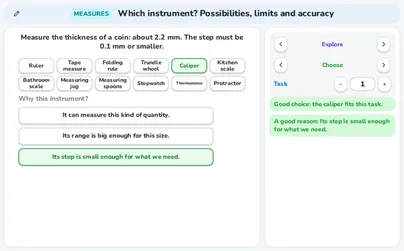
Choose an instrument with three questions. What do I measure? (the possibilities: a length needs a ruler, not a scale.) How big is it? (the limits: the range must hold the size.) How exact must it be? (the accuracy: the step must be small enough.) In the tab Choose you pick an instrument and then a reason from three; each reason is judged on its own, and the application names a better choice when there is one.
Example
The thickness of a coin, about 2.2 mm: the step must be 0.1 mm or smaller. The kitchen scale measures mass, not length. The ruler has a step of 1 mm: too big. The caliper measures lengths, holds 2.2 mm and has a step of 0.01 mm: it fits.
Caliper✔range: 0–15 cmstep: 0.01 mmRuler✘range: 0–30 cmstep: 1 mmKitchen scale✘range: 0–5 kgstep: 1 g
Watch out!

The smallest step is not always the best

A tiny step does not help when the range is too small. The caliper has the smallest step of all the length instruments, but it measures only up to 15 cm. No instrument is the best for everything: the best one depends on the task.
Example
The school corridor, about 38 m, to the nearest metre. The caliper (0–15 cm) is far too small. The trundle wheel (up to 9 999 m, step 1 m) fits.
Caliper✘range: 0–15 cmstep: 0.01 mmTrundle wheel✔range: 0–9999 mstep: 1 m
Rule

Estimate first, then measure and judge

Estimate before you measure. Then compare the reading with your estimate and with the step. A reading that is far too big or too small has probably slipped: the decimal point is in the wrong place. In the tab Estimate, measure, judge about one reading in 4 has such a slip; you say whether the reading is sensible. When it is not, measure again.
Example
A pencil of about 17.5 cm. A reading of 175 cm is and a reading of 1.75 cm is → the point slipped. Neither can be a pencil. Measure again.
Rule

Good enough?

A shelf must fit a gap. Both the gap and the shelf are measured, and each can be off by half a step: together that is one step. So the step of the instrument must be at most the play that is allowed. The range must hold the gap as well. In the tab Good enough? you tap the instruments that are good enough.
Example
A gap of 80 cm, a play of 2 mm. The ruler (0–30 cm) is too short. The tape (0–3 m, step 1 mm) → , so it is good. The folding rule (0–2 m, step 5 mm) → , too coarse. Only the tape is good enough.
Ruler✘range: 0–30 cmstep: 1 mmTape measure✔range: 0–3 mstep: 1 mmFolding rule✘range: 0–2 mstep: 5 mm
Rule

Two instruments, one object

Two instruments give two readings, and each reading stands for half a step each way. When the two ranges overlap, both readings can be right. When they do not overlap, at least one instrument is off: trust the instrument with the smaller largest error. In the tab Two instruments, one object you pick the reading that you trust; the worn ruler adds 2 mm.
Example
Ruler: 17.5 cm, which stands for 17.45 to 17.55 cm. Worn ruler: 17.7 cm, which stands for 17.65 to 17.75 cm. The ranges do not overlap. The largest error of the ruler is 1.5 mm and that of the worn ruler 3.5 mm: trust the ruler.
17.417.517.617.717.8ruler 17.5worn ruler 17.7
Definition

A screen shows only a few digits

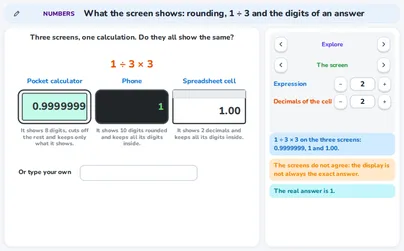
A screen has room for a few digits only, so it cuts off or rounds the rest. In the tab The screen one calculation runs on three simulated screens: a Pocket calculator with 8 digits (it cuts off the rest and keeps only what it shows), a Phone with 10 digits (it rounds, and keeps all its digits inside) and a Spreadsheet cell that shows a chosen number of decimals. They are our own models, with no brand; the 0 before the point counts as a digit.
Example
has endless threes. The calculator shows 0.3333333, the phone 0.333333333 and the cell with 2 decimals 0.33. None of the three is exact.
1 ÷ 3Pocket calculator0.3333333Phone0.333333333Spreadsheet cell0.33
Watch out!

1 ÷ 3 × 3 is not always 1

The calculator keeps only what it shows, so gives 0.9999999 there. The phone keeps 15 digits inside and shows 1 after rounding. The cell shows 1.00. A displayed result is not always the exact answer. Real calculators differ: try your own and compare.
Example
On the calculator gives 0.3333333 and . On the phone the number inside, 0.333333333333333, times 3 is 0.999999999999999, which rounds to 1.
1 ÷ 3 × 3Pocket calculator0.9999999Phone1Spreadsheet cell1.00
Rule

Round only at the end

Rounding in the middle throws away digits that the next steps still need. Calculate with all the digits and round once, at the end. In the tab Round at the end you see both ways side by side and how much they differ.
Example
to one decimal. In the middle → , rounded 7.9; then , rounded 13.4. At the end → , rounded 13.3. The two results differ → .
Rule

How many digits: sums and differences

An answer cannot be more exact than the data. For a sum or a difference keep as many decimals as the number with the fewest decimals. In the tab How many digits choose Decimals and type the answer with the right number of digits.
Example
on the screen. 12.3 has one decimal and 4.56 has two, so the answer has one decimal: 16.9.
Definition

Significant digits: products and quotients (older pupils)

This card is for older pupils. For a product or a quotient keep as many significant digits as the number with the fewest. The significant digits are the digits from the first one that is not zero: 5.2 has two and 3.14 has three. In the tab How many digits choose Significant digits.
Example
on the screen. The fewest significant digits is 2 (from 5.2), so the answer has two significant digits: 16.
Definition

E-notation

Very big and very small numbers appear on a screen in E-notation: mE+n means m × 10 to the power n, and mE-n means m × 10 to the power −n. A positive power moves the point to the right (a big number), a negative power to the left (a small number). In the tab E-notation you type the ordinary number.
Example
1E+12 means . 2.5E-3 means .
Watch out!

A cell shows rounded amounts

A spreadsheet cell can show 2 decimals and still hold more digits. You add the amounts that you see, the total cell adds the real amounts, and the two totals can be a cent off. In the tab Format of a cell you choose a set of amounts and the number of decimals shown.
Example
The cells hold 2.504, 3.504 and 4.504 and show 2.50, 3.50 and 4.50. Added by hand → . The total cell adds and shows 10.51: a cent off.
Tip

Before you trust a screen

Ask three things. Is the answer sensible? (Estimate first.) How many digits do the data allow? Did I round only at the end? A long string of digits looks exact, but it is only as exact as the numbers that you put in.
Example
shows 16.328. Estimate → . The answer 16 is close and has the digits of the data; 16.328 claims too much.
Tip

The quiz

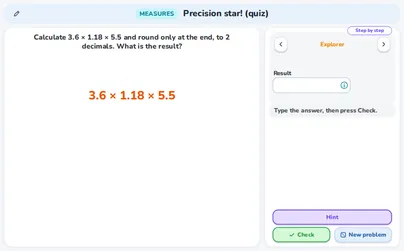
The quiz is practice only, with a level (Starter, Explorer or Champion) and the help buttons Hint, Next step and Show answer. Its questions mix the three applications: the range a reading stands for, the highest area, the instrument for a task, a sensible reading, the digits of an answer and the result of on a model. Every question is new.
Example
A question can be: a reading is 8.4 cm with a step of 0.1 cm; what is the lowest length that is written as 8.4 cm? The answer is .
Tip

The class round

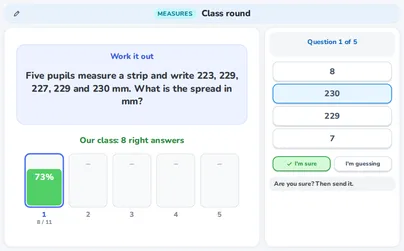
The class round asks 5 questions to the whole class at once: a definition, a rule, a true-or-myth statement and two calculations. The bank holds 14 questions and 3 generators make new numbers every round: the spread of five readings, the number of instruments with a small enough step, and how far below 1 a calculator ends for .
Example
Five pupils write 61, 63, 62, 65 and 62 mm. The spread is .
Tip

Keys, what is sent and what is simulated

Everything works by keyboard. Chips, cards and buttons are real buttons: Tab goes to one, Enter (or Space) chooses it. The arrow keys change a slider, and Enter in a number field checks the answer. Esc closes this page. Nothing you type is sent anywhere: every answer is checked in the browser. All measuring is simulated; the real instruments stay in your hands. The situations are original: the objects, the instruments and the screens are our own drawings and models.
Example
In the tab Instruments press Tab until a card is lit, press Enter to pick it, then Tab on to the next card and press Enter again. Press Esc to close this page.

Exercises

A reading is 8.4 cm and the step is 0.1 cm. What are the lowest and the highest length that are written as 8.4 cm? Easy
Show solution
The step is 0.1 cm, so half a step is 0.05 cm.
Go half a step down → .
Go half a step up → .
Answer → from 8.35 cm to 8.45 cm
Check → → the range is one step wide.
Five pupils measure a pen and write 9.7, 9.9, 9.8, 10.1 and 9.8 cm. What are the middle value and the spread? Easy
Show solution
Put the readings in order: 9.7, 9.8, 9.8, 9.9, 10.1.
The middle value is the third reading: 9.8 cm.
The spread is the biggest minus the smallest → .
9.69.79.89.91010.110.2middle value 9.8spread 0.4
Answer → middle value 9.8 cm, spread 0.4 cm
Check → one reading is smaller than 9.8, two are bigger and two are equal to it: 9.8 sits in the middle of the ordered list.
A letter has a mass of about 20 g and you must know it to the nearest 2 g. Which fits: the kitchen scale (0–5 kg, step 1 g) or the bathroom scale (0–150 kg, step 500 g)? Easy
Show solution
The step must be 2 g or smaller.
The kitchen scale has a step of 1 g → . The bathroom scale has a step of 500 g → .
Kitchen scale✔range: 0–5 kgstep: 1 gBathroom scale✘range: 0–150 kgstep: 500 g
Both measure mass, and the kitchen scale holds 20 g in its range of 0–5 kg: it fits.
Answer → the kitchen scale
Check → on the bathroom scale 20 g and 25 g look the same, because its step is 500 g.
What do the pocket calculator and the phone show for ? Easy
Show solution
The pocket calculator keeps only what it shows → gives 0.3333333.
Then .
The phone keeps 15 digits inside → , which it shows rounded as 1.
1 ÷ 3 × 3Pocket calculator0.9999999Phone1Spreadsheet cell1.00
Answer → calculator 0.9999999, phone 1
Check → → the calculator ends a tiny bit under 1.
A screen shows 4E+3 and 7.5E-2. Write both as ordinary numbers. Easy
Show solution
4E+3 means → move the point 3 places to the right: 4 000.
7.5E-2 means → move the point 2 places to the left: 0.075.
Answer → 4 000 and 0.075
Check → .
A table top is 80 cm by 50 cm, each side measured to the nearest cm. What are the highest total of the two sides and the highest area? Medium
Show solution
Each side can be 0.5 cm longer: 80.5 cm and 50.5 cm.
Highest total → .
Highest area → .
Answer → total 131 cm, area 4 065.25 cm²
Check → , so the area can be 65.25 cm² more → .
A shelf must fit a gap of 60 cm with a play of 2 mm. Which are good enough: the ruler (0–30 cm, step 1 mm), the tape (0–3 m, step 1 mm) or the folding rule (0–2 m, step 5 mm)? Medium
Show solution
Both the gap and the shelf are measured: together one step, so the step must be at most 2 mm.
The ruler has a step of 1 mm, but its range of 0–30 cm does not hold 60 cm.
The tape fits → and its range holds 60 cm. The folding rule has a step of 5 mm → .
Ruler✘range: 0–30 cmstep: 1 mmTape measure✔range: 0–3 mstep: 1 mmFolding rule✘range: 0–2 mstep: 5 mm
Answer → only the tape
Check → on the tape each of the two measures is at most 0.5 mm off → , which is at most 2 mm.
Pipes must be 10.0 cm long and 2 mm off is allowed. The pipes measure 9.84, 9.91, 10.17, 10.25 and 10.2 cm. How many pipes pass? Medium
Show solution
2 mm is 0.2 cm, so the allowed lengths run from to .
9.84, 9.91 and 10.17 lie inside. 10.2 is exactly 0.2 cm off: it still passes.
9.79.89.91010.110.210.39.8–10.2
10.25 is more than 0.2 cm off: it does not pass.
Answer → 4 pipes
Check → , which is more than 0.2.
Calculate and keep one decimal. Round once in the middle (after ) and once only at the end. Which result do you give? Medium
Show solution
In the middle → , rounded 8.8; then , rounded 13.2.
At the end → , rounded 13.1.
The two results differ → . Round only at the end.
Answer → 13.1
Check → the exact product 13.125 lies between 13.05 and 13.15, so it rounds to 13.1.
An error of 2 mm is made on a length of 40 cm and the same error on a length of 4 m. What percent of the measure is the error in each case? Medium
Show solution
Write the error in cm: 2 mm is 0.2 cm.
On 40 cm → , so 0.5%.
On 4 m (400 cm) → , so 0.05%.
Answer → 0.5% and 0.05%
Check → 400 cm is ten times 40 cm, so the percentage is ten times smaller → .
The screen shows . Write the answer with the right number of decimals. Medium
Show solution
3.2 has one decimal and 14.75 has two.
A sum keeps as many decimals as the number with the fewest: one decimal.
17.95 rounded to one decimal is 18.0.
Answer → 18.0
Check → → the answer is rounded by half a step of 0.1.
A pupil estimates the width of a desk at 120 cm. The tape shows 12.2 cm. Is the reading sensible? If not, what did the tape probably show? Hard
Show solution
12.2 cm is far from the estimate of 120 cm, and a desk is not 12 cm wide: the reading is not sensible.
The decimal point has probably slipped → .
122 cm is close to the estimate → .
Answer → not sensible; probably 122 cm
Check → .
The ruler shows 17.5 cm and the worn ruler shows 17.7 cm for the same object. The step of both is 1 mm and each reading stands for half a step each way. Do the two ranges overlap? Which reading do you trust? Hard
17.417.517.617.717.8ruler 17.5worn ruler 17.7
Show solution
Ruler → and . Worn ruler → and .
, so the two ranges do not overlap: at least one instrument is off.
The ruler has the smaller largest error: 1.5 mm against 3.5 mm. Trust the ruler.
Answer → they do not overlap; trust the ruler
Check → the worn ruler adds 2 mm (0.2 cm) → .
A table top is 40 cm by 30 cm and each side is measured to the nearest 2 cm. What are the lowest and the highest area? Hard
Show solution
The step is 2 cm, so half a step is 1 cm: the sides stand for 39 to 41 cm and 29 to 31 cm.
Lowest area → .
Highest area → .
Answer → from 1 131 cm² to 1 271 cm²
Check → lies in between → .
Three spreadsheet cells hold 1.335, 2.335 and 3.335 and show two decimals (rounded half up). What do they show? What do you get when you add the shown amounts, and what does the total cell show? Hard
Show solution
Rounded to two decimals the cells show 1.34, 2.34 and 3.34.
Added by hand → .
The total cell adds the real amounts → , and shows 7.01.
Answer → by hand 7.02, total cell 7.01: a cent off
Check → .
A screen shows . Write the answer with the right number of significant digits. Hard
Show solution
12.5 has three significant digits and 3.2 has two.
A quotient keeps as many as the number with the fewest: two.
Two significant digits of 3.90625: 3.9.
Answer → 3.9
Check → , which is close to 12.5.
Are you a teacher?

Start live lessons with these applications for your whole class. Free to try for one month.

Try it free

Fits these school years

IB (MYP, Diploma): MYP 1, MYP 2, MYP 3

Cambridge International: Lower Secondary, stage 7, Lower Secondary, stage 8, Lower Secondary, stage 9, Primary, stage 6

Netherlands: Year 1, Year 2, Groep 8, Vmbo bb (years 3-4), Vmbo kb (years 3-4), Vmbo gt (years 3-4)

Türkiye (MEB): Year 5 (MEB), Year 6 (MEB), Year 7 (MEB), Year 8 (MEB), Year 4 (MEB)

England (GCSE, A Level): Year 7, Year 8, Year 9, Year 6

USA (Common Core): Grade 6, Grade 7, Grade 8, Grade 5

What the applications of this topic teach 3 applications

How exact is a measure? Spread, rounding and what an error does

  • Knowing that a measure is never exact: step, error and spread
  • Finding the middle value and the spread of several readings
  • Giving the lowest and highest value a reading stands for
  • Working out a percent error and deciding on a tolerance

Which instrument? Possibilities, limits and accuracy

  • Knowing that every instrument has a range and a step
  • Choosing an instrument for a task and giving a reason
  • Estimating first, judging a reading and seeing a decimal slip

What the screen shows: rounding, 1 ÷ 3 and the digits of an answer

  • Knowing that a screen shows only a few digits
  • Rounding only at the end of a calculation
  • Writing an answer with the right number of decimals or significant digits
  • Reading E-notation