İnteraktif Dersler

Polynomial functions

Lecture notes

Definition

Degree and leading coefficient

A polynomial function is a sum of terms a·xᵏ with whole k ≥ 0. The degree n is the highest power of x; the leading coefficient is the number in front of it. In a factored form add up the powers of the brackets for the degree and multiply the numbers in front of x for the leading coefficient.
xyn=1xyn=2xyn=3xyn=4
Example
has degree 3 and leading coefficient 3:
xy1−2/3
Rule

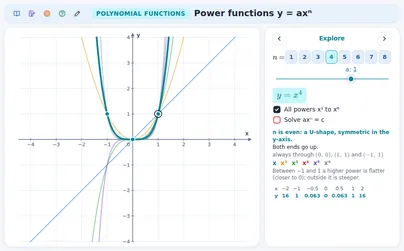
Power functions y = axⁿ

Even n: a U-shape, mirror image in the y-axis. Odd n: an S-shape, half a turn about the origin. All go through (0, 0) and (1, a). Between −1 and 1 a higher power is flatter (closer to 0); outside it is steeper.
xyx²x⁴xyxx³
Example
At : but x⁴ is much lower:
xyx²x⁴0.50.250.0625
Rule

Power equations axⁿ = c

Divide by a, then take the n-th root. Odd n: always exactly one solution. Even n: two solutions ± when c/a > 0, one (x = 0) when c/a = 0, none when c/a < 0.
xyx²=4xyx²=0xyx²=−4xyx³=8
Example
3x⁴ = 48 gives x⁴ = 16, so or :
xy−2482
Rule

End behaviour

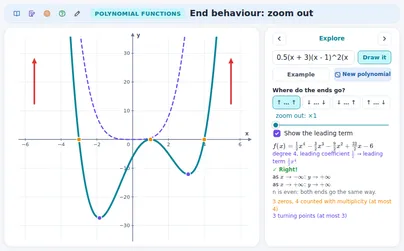
Far from the origin only the leading term a·xⁿ counts. Even n: both ends go the same way (up if a > 0, down if a < 0). Odd n: the ends go opposite ways (right end up if a > 0, down if a < 0).
xyx⁴xy−x⁴xyx³xy−x³
Example
has odd n and : the left end goes up, the right end down. At the leading term already gives:
−22−40−202040xy
Rule

Zeros and multiplicity

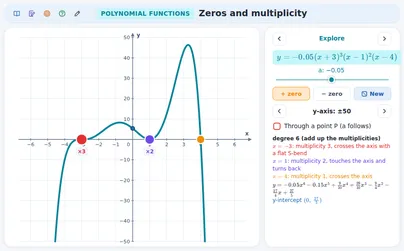
A bracket (x − r)ᵐ gives the zero r with multiplicity m. Odd m: the graph crosses the x-axis (m = 3: with a flat S-bend). Even m: it touches the axis and turns back. The degree is the sum of the multiplicities: at most n zeros and at most n − 1 turning points.
xym=1xym=2xym=3
Example
: touches , crosses with a flat bend :
xy−21
Rule

A polynomial from its zeros and a point

Write f(x) = a·(x − r₁)(x − r₂)… with the right multiplicities. The zeros do not fix a. Put in one more point, for example (0, y), and solve for a.
xyP
Example
Zeros −1, 2 and 3, through : , so and :
xy12−123
Rule

Sign chart and inequalities

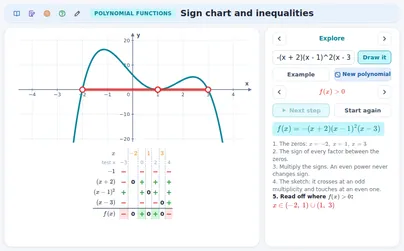
Find the zeros, then the sign of f in every interval between them: test one x, or count. The sign changes at a zero of odd multiplicity. For f(x) > 0 take the intervals with +, for f(x) ≥ 0 also the zeros.
xy−+−+
Example
: test between −1 and 2. The sign is − there, so + on and :
xy−16+−−+
Watch out!

An even zero does not change the sign

At a zero of even multiplicity the graph touches the axis and turns back, so the sign stays the same on both sides. Do not switch + and − there. For f(x) > 0 that zero is left out; for f(x) ≥ 0 it is included.
xy−+m=1xy++m=2
Example
is positive on both sides of :
xy1234−++
Rule

Division and the remainder theorem

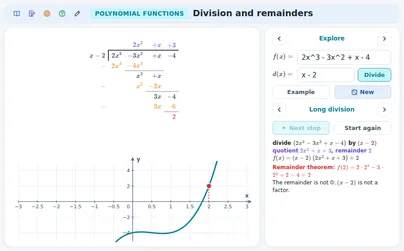
Dividing gives f(x) = d(x)·q(x) + r(x). Long division or synthetic division (Horner) finds q and r. The remainder theorem: the remainder of f(x) ÷ (x − a) is f(a), so you can find it without dividing.
xyar
Example
The remainder of divided by is :
−2−10xy28
Rule

The factor theorem

(x − a) is a factor of f(x) exactly when f(a) = 0. Try the candidates ±p/q (p divides the constant term, q the leading coefficient), divide by the factor you find and repeat. Watch the sign: the factor (x + 3) has the zero −3.
xyx+3x−1x−2
Example
: , and Horner by gives 1, −5, 6, 0, so :
1234−55xy
Tip

Polynomial models

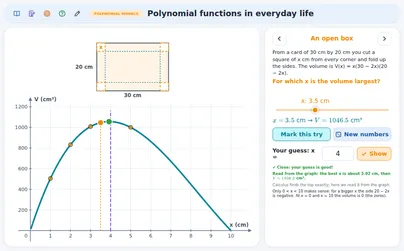
A box, a parcel, a medicine curve or a hill is often a cubic. The zeros tell where the model stops making sense; only the part between them is used. Read the best value from the graph or a table (calculus finds it exactly later).
20 cm14 cmx246100200300400xV
Example
A box from a card of 20 cm by 14 cm: gives a bigger volume than .
6100200400xV23203336

Exercises

What are the degree and the leading coefficient of ? Easy
Show solution
Degree: add the powers of the brackets: .
Leading coefficient: multiply the numbers in front of x: .
xy
Answer → degree 4, leading coefficient 2
Check: the leading term is 2x⁴.
Solve . Easy
Show solution
Divide by 2: .
Odd power: one solution, the cube root of −27 is −3.
xy−3−54
Answer →
Check: and .
Find the remainder of divided by , without dividing. Easy
Show solution
Remainder theorem: the remainder is .
.
xy21
Answer → remainder 1
Check: the remainder is not 0, so is not a factor.
. Give the degree, the largest possible number of turning points and say where the graph crosses or touches the x-axis. Medium
Show solution
Degree: .
At most turning points.
and are odd: the graph crosses. is even: it touches.
xy−213
Answer → degree 6, at most 5 turning points; crosses at −2 and 3, touches at 1
Check: the leading term is x⁶, so both ends go up.
A cubic has the zeros −2 and 1 (a double zero) and goes through . Find its formula. Medium
Show solution
.
Put in : .
So .
xy8
Answer →
Check: .
Solve . Medium
Show solution
Zeros: −1, 2 and 5 (all simple, so the sign changes at each).
Test (between −1 and 2): , so + there.
Signs from the left: − , + , − , +.
xy−+−+
Answer → or
Check: gives .
has the factor . Find k. Hard
Show solution
Factor theorem: .
.
, so .
xy
Answer →
Check: at gives .
Factorise completely. Hard
Show solution
Candidates: the divisors of 6, ±1, ±2, ±3, ±6. Try 1: , so is a factor.
Horner by on 1, 0, −7, 6 gives 1, 1, −6 and remainder 0: the quotient is .
, because and .
xy
Answer →
Check: the product of the zeros is minus the constant term.
A box is folded from a card of 24 cm by 15 cm: . Which whole x between 2 and 4 gives the largest volume, and what is the domain? Hard
Show solution
Domain: both sides must be positive, , so .
: . : . : .
xy244034864448
The largest of the three is .
Answer → (V = 486 cm³); domain
Check: V is 0 at , 7.5 and 12 (the zeros); only the part between 0 and 7.5 is a real box.
Are you a teacher?

Start live lessons with these applications for your whole class. Free to try for one month.

Try it free

Fits these school years

IB (MYP, Diploma): Diploma, year 1, Diploma, year 2

Cambridge International: IGCSE, AS Level, A Level

Netherlands: Year 3 (havo, vwo), Vmbo kb (years 3-4), Vmbo gt (years 3-4), Havo · Mathematics B, Vwo · Mathematics A, Vwo · Mathematics B, Vwo · Mathematics C

Türkiye (MEB): Year 10 (MEB), Year 12 (MEB)

England (GCSE, A Level): Year 11 (GCSE), Year 12 (A Level), Year 13 (A Level)

USA (Common Core): Algebra 2, Precalculus

What the applications of this topic teach 7 applications

Power functions y = axⁿ

  • Sketching y = axⁿ for even or odd n and positive or negative a
  • Saying why a higher power is flatter between −1 and 1
  • Solving axⁿ = c and counting its solutions

End behaviour: zoom out

  • Giving the degree and leading coefficient of a polynomial
  • Saying where the two ends of the graph go
  • Saying how many zeros and turning points there are at most

Zeros and multiplicity: beads on the axis

  • Telling from the multiplicity whether the graph crosses or touches
  • Writing a polynomial from its zeros, multiplicities and a point
  • Saying the degree from the multiplicities

Sign chart and polynomial inequalities

  • Finding the sign of a factored polynomial between the zeros
  • Telling at which zeros the sign changes
  • Solving f(x) > 0 and f(x) ≤ 0 and writing intervals

Division, remainder and factor theorem

  • Dividing a polynomial by x − a with long and synthetic division
  • Finding the remainder of f(x) ÷ (x − a) with f(a)
  • Using the factor theorem to factorise a cubic

Polynomial puzzles

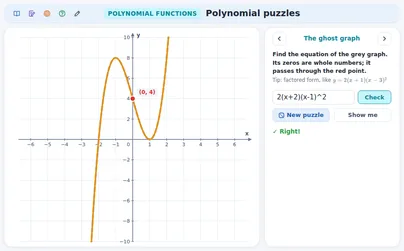
  • Finding the equation of a polynomial from its graph
  • Finding k so that x − a is a factor
  • Finding a remainder with the remainder theorem

Polynomial functions in everyday life

  • Reading a cubic model: sensible domain, best value, meaning of a zero
  • Guessing a best value first and comparing with the graph
  • Saying why the model stops making sense at a zero