İnteraktif Dersler

Pythagoras theorem

Lecture notes

Definition

The right triangle

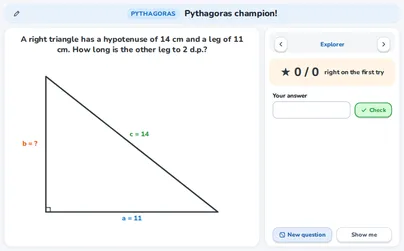
A right triangle has one right angle (90°). The two sides next to it are the legs. The side opposite the right angle is the hypotenuse: it is always the longest side.,
bac
Example
Legs 3 and 4, hypotenuse 5: the 5 is the longest side.
435
Definition

Squares on the sides

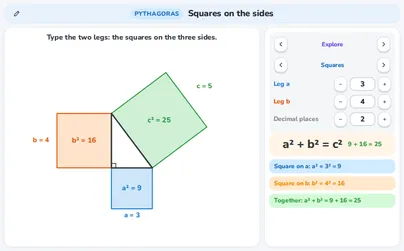
Draw a square on each side of a right triangle. The area of a square is the side times itself: , and .
a²b²c²
Example
Legs 3 and 4, hypotenuse 5:
91625
Rule

a² + b² = c²

In a right triangle the squares on the two legs together have the same area as the square on the hypotenuse: . This is the theorem of Pythagoras; c is the hypotenuse.
a²b²c²
Example
Legs 3 and 4:
91625
Rule

Counting squares: the frame

Put the tilted square on the hypotenuse in a frame of side a + b. The frame minus the four corner triangles is the tilted square: .
a+bc²
Example
Legs 3 and 4:
725
Rule

Proof by dissection

Four equal right triangles fit in a square of side a + b in two ways. First they leave a tilted square c² empty, then they leave two squares a² and b² empty. Same triangles, same big square: the empty space is the same, so .
a+bc²a+ba²b²
Example
Legs 3 and 4: the empty space is the same both times.
7257916
Watch out!

Only for right angles

is true for a right angle only. If the angle between a and b is smaller than 90°, c² is smaller than a² + b². If it is bigger than 90°, c² is bigger.
60°abcc²<a²+b²abcc²=a²+b²120°abcc²>a²+b²
Example
Sides 4, 5 and 6: but . Not equal, so no right angle.
45641≠36
Rule

Finding the hypotenuse

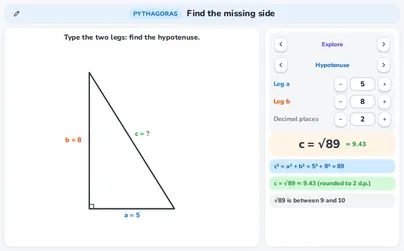
Both legs known: add the squares, then take the square root: .
ba?
Example
Legs 6 and 8:
68?
Rule

Finding a leg

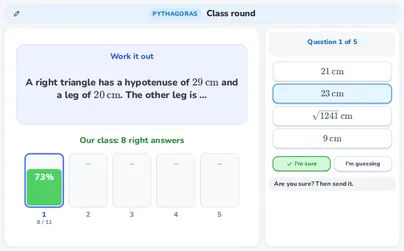
Hypotenuse and one leg known: subtract the squares, then take the square root: .
?ac
Example
Hypotenuse 13, leg 5:
5?13
Rule

Exact and decimal answers

If the number under the root is not a square number, the root is not a whole number. Give the exact answer with √, or a decimal with the number of decimal places asked. A calculator shows more digits than you need.
53√34
Example
Legs 3 and 5:
53√34≈5.83
Rule

A root between two whole numbers

Find the square numbers just below and just above the number under the root. The root lies between their roots: because . This tells you if your decimal is sensible.
495264
Example
The root of 52:
78√52
Definition

Pythagorean triples

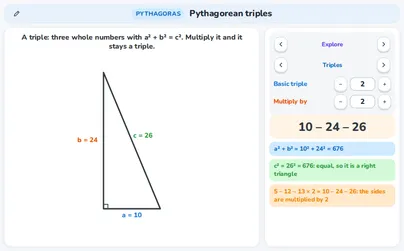
A Pythagorean triple is three whole numbers with , like 3, 4, 5 or 5, 12, 13. Multiply all three by the same number k and you get another triple: . A triple with no common factor is a basic triple.
4354k3k5k×k
Example
3, 4, 5 times 2:
4358610×2
Special case

Rational sides

The theorem also works with decimals and fractions: . It is the triple 3, 4, 5 on a scale of tenths.
4350.40.30.5
Example
Sides 0.3, 0.4 and 0.5:
0.090.160.25
Rule

Euclid's recipe

Choose whole numbers m > n. Then is always a Pythagorean triple.
m²−n²2mnm²+n²
Example
m = 3 and n = 2:
51213
Rule

The converse

If the sides satisfy (c the longest side), the angle opposite c is a right angle: .
?abcabc
Example
Sides 5, 12 and 13:✔
?5121351213✔
Rule

Acute and obtuse

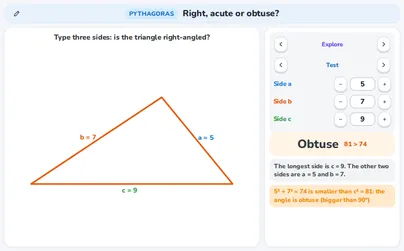
Compare c² (c the longest side) with a² + b². If the triangle is acute (all angles below 90°). If it is obtuse (one angle above 90°). If they are equal it is right-angled.
60°abcc²<a²+b²abcc²=a²+b²120°abcc²>a²+b²
Example
Sides 4, 5, 6: , acute. Sides 3, 4, 6: , obtuse.
<90°45636<41>90°34636>25
Rule

The triangle inequality

Three sticks make a triangle only if the two shorter ones together are longer than the longest: .
abca+bc
Example
Sticks 3, 4 and 6: , so they make a triangle.
34676
Special case

No triangle

If the two short sticks lie flat on the long one: a line, no corner. If they cannot reach each other: there is a gap.
abc✘abcg✘
Example
Sticks 2, 3 and 6: . The gap is 1.
2361✘
Rule

The third side

If two sides a and b are given, the third side c lies between the difference and the sum: .
|a−b|a+b
Example
Sides 4 and 9: , so the whole numbers 6, 7, …, 12 work: 7 values.
45678910111213513
Rule

The larger angle is opposite the longer side

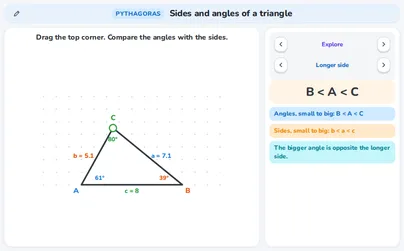
In every triangle the larger angle is opposite the longer side, and equal sides have equal angles opposite them. So the biggest angle is opposite the longest side.
ABCabc
Example
Sides 5, 7 and 9: the biggest angle is opposite 9, the smallest is opposite 5.
579
Rule

Ladders and ramps

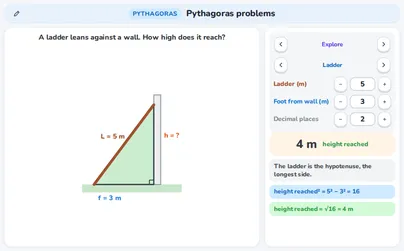
A ladder against a wall makes a right triangle: the ladder is the hypotenuse, the wall and the ground are the legs. A ramp is the same: its length is the hypotenuse, the run and the rise are the legs. Draw the triangle first, then decide: add or subtract the squares.
hdcrlc
Example
A ladder of 5 m, foot 3 m from the wall: m
?3 m5 m
Rule

Diagonal of a rectangle

A diagonal cuts a rectangle into two right triangles. The sides are the legs and the diagonal is the hypotenuse: . A square is a rectangle with l = w.
lwd
Example
A rectangle of 12 by 5:
125?
Rule

Distance on a grid

Go across Δx and up Δy from one point to the other. The straight distance is the hypotenuse: .
xyABΔxΔyd
Example
From (1, 2) to (7, 10): Δx = 6 and Δy = 8.
2468246810xy68d
Rule

Height of an isosceles triangle

The height of an isosceles triangle halves the base and makes two right triangles. The legs are the height and half the base; the hypotenuse is an equal side: .
shb/2b/2
Example
Base 10, equal sides 13:
13?55
Rule

The rhombus

The diagonals of a rhombus cross at a right angle and halve each other. A side is the hypotenuse of the triangle with half of each diagonal: side .
p/2q/2s
Example
Diagonals 12 and 16:
68?
Rule

Slant height of a cone or pyramid

In a cone the height, the radius and the slant height make a right triangle: . In a square pyramid the height and half the base side are the legs, and the slant height of a face is the hypotenuse.
hrhrl
Example
A cone with radius 5 and height 12:
125125?
Rule

The space diagonal of a box (H)

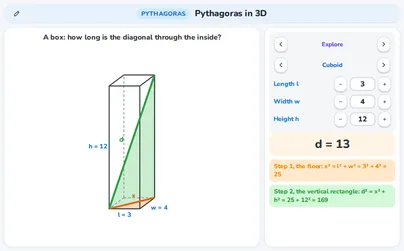
Use two right triangles. First the diagonal x of the floor, then the space diagonal d with x and the height. In one go: .
lwhxd
Example
A box of 3 by 4 by 12:
34125?
Rule

The height of a square pyramid (H)

The height meets the middle of the base. A corner is half a diagonal away from it, so the slant edge e satisfies . A face height m uses half the base side: .
ms/2h
Example
Base 6, height 4: the face height is
?34
Rule

The root spiral (H)

Put right triangles one after another, each with legs √n and 1. The hypotenuse is √(n + 1), and it is the leg of the next triangle: . This builds √2, √3, √4, …
√2√3√4√5√6√71
Example
Legs √3 and 1:
1√32
Tip

Choose the right calculation

Which side do you want? The hypotenuse (opposite the right angle): add the squares, then take the root. A leg: subtract the squares, then take the root. Check: the hypotenuse is longer than each leg and shorter than the legs together.
ba?a²+b²?acc²−a²
Example
Legs 5 and 12: the hypotenuse is 13, and .
1112131415161718121317
Watch out!

Do not add the sides

A common mistake is to add the sides, or to add the squares and forget the root. The theorem adds the squares, and then you take the root to get the side.
ba✘bac✔
Example
Legs 3 and 4: is wrong. is c², so .
43✘435✔
Tip

Everyday numbers

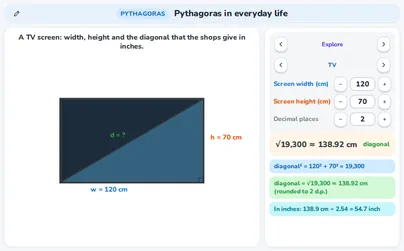
Many everyday sizes use the theorem: a TV size is the diagonal in inches (1 inch = 2.54 cm), a slope in % is rise ÷ run × 100, and a shortcut across a park saves the difference between the two paths and the diagonal.
dbad
Example
A park with paths of 30 m and 40 m at a right angle: m
30 m40 m50 m

Exercises

A right triangle has legs 9 and 12. Find the hypotenuse. Easy
912?
Show solution
81144225
Answer → 15
The hypotenuse is opposite the right angle: add the squares, then take the root.
A right triangle has a hypotenuse of 17 and a leg of 8. Find the other leg. Easy
?817
Show solution
64225289
Answer → 15
For a leg you subtract the squares.
A ladder of 10 m stands 6 m from a wall. How high does it reach? Easy
?6 m10 m
Show solution
8 m6 m10 m
Answer → 8 m
The ladder is the hypotenuse, so the height is a leg.
A right triangle has legs 4 and 7. Give the hypotenuse exactly and to 2 decimal places. Medium
47?
Show solution
(exact)
(2 d.p.)
Check: , so c is between 8 and 9
89√65
Answer → √65 ≈ 8.06
65 is not a square number, so the root is not a whole number.
A triangle has sides 6, 8 and 11. Is it right-angled, acute or obtuse? Medium
6811
Show solution
The longest side is 11:
, so c² is bigger: obtuse
>90°6811121>100
Answer → obtuse
Always use the longest side as c.
Find the distance between the points (−2, 1) and (4, 9). Medium
−224246810xyAB
Show solution
and
−224246810xyAB68d
Answer → 10
Across and up are the legs, the distance is the hypotenuse.
A box is 4 by 6 by 12. Find its space diagonal. Hard
4612?
Show solution
Floor:
4612xd
Answer → 14
You do not need x itself: keep x² and add 12².
An isosceles triangle has a base of 10 and equal sides of 13. Find its height and its area. Hard
13?10
Show solution
Half the base is 5
12513
Answer → h = 12 and area 60
Use half the base, not the whole base, in the right triangle.
A triangle has sides 7 and 12 and a third side x. Between which numbers is x, and how many whole numbers x are possible? Hard
712x
Show solution
The difference is and the sum is
x = 6, 7, …, 18, so values
5791113151719519
Answer → 5 < x < 19, 13 whole numbers
5 and 19 themselves are not allowed: the sticks would lie flat.
Are you a teacher?

Start live lessons with these applications for your whole class. Free to try for one month.

Try it free

Fits these school years

IB (MYP, Diploma): MYP 4, MYP 5, MYP 1, MYP 2, MYP 3

Cambridge International: Lower Secondary, stage 8, Lower Secondary, stage 9, Lower Secondary, stage 7, IGCSE

Netherlands: Year 2, Vmbo kb (years 3-4), Vmbo gt (years 3-4), Vwo · Mathematics C, Year 1, Havo · Mathematics B, Vwo · Mathematics B, Year 3 (havo, vwo)

Türkiye (MEB): Year 8 (MEB)

England (GCSE, A Level): Year 9, Year 7, Year 8, Year 10 (GCSE), Year 11 (GCSE)

USA (Common Core): Grade 8, Grade 7

What the applications of this topic teach 9 applications

Squares on the sides: a² + b² = c²

  • Naming the legs and the hypotenuse of a right triangle
  • Drawing a square on each side and reading the areas a², b² and c²
  • Following a proof by dissection
  • Knowing the relation holds for a right angle only

Find the missing side

  • Finding the hypotenuse from the two legs: c² = a² + b²
  • Finding a leg from the hypotenuse and the other leg
  • Giving an answer exactly with √ and as a decimal
  • Choosing whether to add or subtract the squares

Pythagorean triples

  • Knowing what a Pythagorean triple is: 3, 4, 5
  • Multiplying a triple by k to get another triple
  • Checking whether three numbers form a triple
  • Making triples with Euclid's recipe

Right, acute or obtuse? The converse

  • Testing whether a triangle with three given sides is right-angled
  • Telling acute from obtuse by comparing c² with a² + b²
  • Finding the third side that makes a right angle

Sides and angles of a triangle

  • Telling if three sticks make a triangle: a + b > c
  • Finding which lengths the third side may have
  • Knowing the larger angle is opposite the longer side
  • Combining angle–side relation, triangle inequality and Pythagoras

Pythagoras problems

  • Finding the height of a ladder against a wall
  • Finding the diagonal of a rectangle or a square
  • Finding the distance between two points on a grid
  • Finding the height of an isosceles triangle and the side of a rhombus

Pythagoras in 3D

  • Finding the space diagonal of a box with two right triangles
  • Using d² = l² + w² + h² in one go
  • Finding the height and slant edge of a square pyramid
  • Building the root spiral: √2, √3, √4

Pythagoras in everyday life

  • Finding how high a ladder reaches and where its foot is safe
  • Finding the diagonal of a TV in cm and in inches
  • Finding the length of a ramp and its slope in %
  • Finding a pitch diagonal, a park shortcut and a kite string

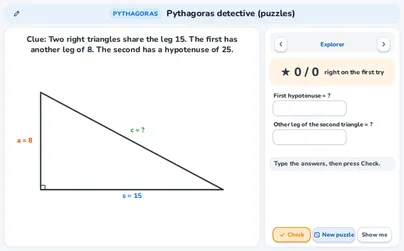
Pythagoras detective (puzzles)

  • Solving two-step puzzles: the first answer feeds the second
  • Finding a hypotenuse, leg, diagonal, grid distance or height
  • Using Pythagoras twice in a row: box, rhombus, pyramid