Two triangles are similar when they have the same shape: matching angles are equal and matching sides are in the same ratio, the scale factork. Congruent triangles are similar with k=1.ABDE=BCEF=ACDF=k
Example
Triangle ABC has the sides 5, 4 and 6; triangle DEF has the sides 10, 8 and 12. Are they similar?510=48=612=2, so yes, with k=2
Rule
Two equal angles are enough (AA)
If two angles of one triangle equal two angles of another triangle, the triangles are similar (AA). The third angles are equal too, because the angles of a triangle add up to 180°.∠A=∠D and ∠B=∠E⇒△ABC∼△DEF
Example
One triangle has the angles 50° and 60°, another has 60° and 70°. Are they similar?180°−50°−60°=70°: both have 50°, 60° and 70°, so yes
Rule
Scale factor and matching sides
Matching sides lie opposite equal angles, and their ratio is the scale factor k. Every length of the big triangle is k times the matching length of the small one, so the perimeter is multiplied by k too.ADAB=k, so BC=k⋅DE
Example
Triangle ADE is similar to triangle ABC with AD=3, DB=6 and DE=4. Find BC.k=ADAB=39=3, so BC=3×4=12
Rule
A parallel to a side
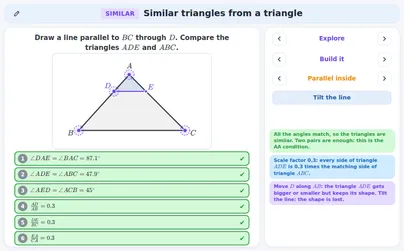
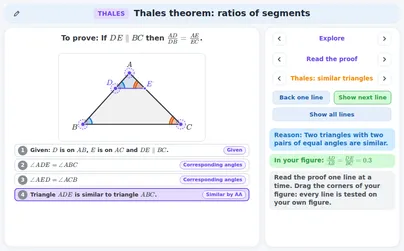
A line DE parallel to BC with D on AB and E on AC cuts off a triangle ADE similar to ABC: the angle at A is shared and the angles at D and E are corresponding angles of the angles at B and C.ABAD=ACAE=BCDE
Example
DE∥BC, ∠A=70° and ∠B=48°. Find ∠ADE and ∠AED.∠ADE=∠B=48° and ∠AED=∠C=180°−70°−48°=62°
Rule
A parallel beyond the corner
If D and E lie beyond A on the lines BA and CA and DE∥BC, triangle ADE is a turned copy of a triangle similar to ABC: the angles at D and E are alternate angles and the angles at A are vertical angles. The same ratios hold.ABAD=ACAE=BCDE
Example
AD=3, AB=5 and BC=10. Find DE.10DE=53, so DE=10×53=6
Rule
The altitude to the hypotenuse
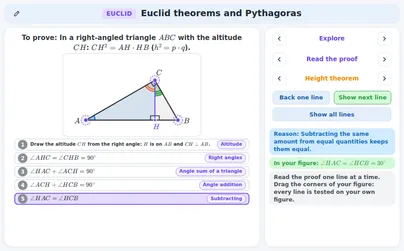
In a right-angled triangle the altitude CH to the hypotenuse AB cuts it into two triangles that are similar to ABC and to each other: each has a right angle and shares an acute angle with ABC.△AHC∼△ACB and △CHB∼△ACB
Example
C=90° and ∠A=35°. Find ∠B and ∠HCB.∠B=90°−35°=55°, and ∠HCB=∠A=35°
Rule
Thales theorem
Thales theorem: a line parallel to a side of a triangle cuts the other two sides in the same ratio. Proof: ADE is similar to ABC, so ABAD=ACAE; subtract both sides from 1 and divide.DE∥BC⇒DBAD=ECAE
Example
DE∥BC, AD=4, DB=6 and AE=6. Find EC.64=EC6, so EC=6×46=9
Rule
Thales by areas
A second proof. ADE and BDE have the same height from E, so their areas are in the ratio of the bases AD and DB; likewise ADE and CDE give AE and EC. BDE and CDE have the base DE and, because DE∥BC, the same height: equal areas.[BDE][ADE]=DBAD, [CDE][ADE]=ECAE, [BDE]=[CDE]
Example
AD=2, DB=3 and [ADE]=8. Find [BDE] and the ratio AE:EC.[BDE]=8×23=12=[CDE], so AE:EC=8:12=2:3
Rule
Converse of Thales
If D on AB and E on AC cut the sides in the same ratio, then DE∥BC. Proof: ADE and ABC share the angle at A and the sides next to it are in proportion (SAS), so the triangles are similar and the angles at D and B are equal.DBAD=ECAE⇒DE∥BC
Example
AD=6, DB=4, AE=9 and EC=6. Is DE∥BC?46=23 and 69=23: equal, so yes
Rule
Height theorem
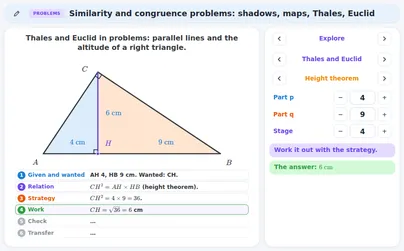
In a right-angled triangle the square of the altitude to the hypotenuse equals the product of the two parts of the hypotenuse. Proof: AHC and CHB are similar, so CHAH=HBCH.CH2=AH⋅HB
Example
AH=4 and HB=9. Find CH.CH2=4×9=36, so CH=6
Rule
Leg theorem
In a right-angled triangle the square of a leg equals the whole hypotenuse times the part of it next to that leg (the projection of the leg). Proof: BHC and BCA are similar, so BCBH=BABC.BC2=BH⋅BA and AC2=AH⋅AB
Example
AB=9 and BH=4. Find BC.BC2=4×9=36, so BC=6
Rule
Pythagoras from Euclid
Add the two leg theorems: the parts of the hypotenuse make the whole hypotenuse, and Pythagoras follows. The proof may not use Pythagoras itself.BC2+AC2=(BH+AH)⋅AB=AB2
Example
AH=5, HB=4 and AB=9.BC2=4×9=36 and AC2=5×9=45, so BC2+AC2=81=92
Rule
Acute and obtuse triangles
Compare the square of the longest side c with a2+b2: equal means a right angle, larger an obtuse angle, smaller an acute triangle. With the altitude AH and x=CH the proof is Pythagoras twice and the extra term 2ax, plus for an obtuse angle at C and minus for an acute one.c2=a2+b2±2ax
Example
A triangle has the sides 5, 6 and 8. Which kind is it?82=64 and 52+62=61; 64>61, so it has an obtuse angle
Rule
Perimeter and area of similar figures
In similar figures every length is multiplied by the scale factor k, so the perimeter is too. The area is multiplied by k2, because an area is a length times a length. Double the sides and the area becomes four times as big.P2=k⋅P1 and A2=k2⋅A1
Example
The triangle with the sides 3, 4, 5 and the triangle with the sides 6, 8, 10 have k=2.Perimeter: 12×2=24Area: 6×22=24
Rule
Shadows: the same sun
At the same moment the sun's rays fall at the same angle. A pole and a tree both stand upright, so each makes a right-angled triangle with its shadow, and the two triangles are similar (AA). Height : shadow is the same for both. Call the pole h with the shadow s and the tree H with the shadow S.hH=sS
Example
A pole of 2 m has a shadow of 3 m. At the same moment a tree has a shadow of 9 m. How tall is the tree?k=39=3, so H=3×2=6 m
Rule
A mirror on the ground
A mirror on the ground sends light back at the angle at which it arrives. So the right-angled triangle of the eye and the mirror is similar to the right-angled triangle of the mirror and the top of the tree (AA). Height : distance is the same for both. Call the eye height h, the distance to the mirror d, the distance from the mirror to the tree D and its height H.hH=dD
Example
Eyes 2 m above the ground, 3 m from the mirror. The mirror is 12 m from a tree. How tall is the tree?k=312=4, so H=4×2=8 m
Rule
The scale of a map
A map is a similar copy of the ground. If 1 cm on the map is N m on the ground, every length is multiplied by N and every area is multiplied by N2 (1 cm² is N2 m²). Change the unit at the end.L=N⋅l and A=N2⋅a
Example
On a map 1 cm is 500 m. A road is 6 cm long on the map.6×500=3000 m =3 km
Rule
Congruent triangles: four conditions
Triangles are congruent when they have the same shape and the same size. It is enough to know SSS (three equal sides), SAS (two equal sides and the angle between them), ASA or AAS (two equal angles and a side) or RHS (a right angle, the hypotenuse and a leg).△ABC≅△QRP
Example
AB=QR=5, BC=RP=7 and ∠B=∠R=60°.Two sides and the angle between them are equal (SAS), so △ABC≅△QRP and AC=QP
Rule
Measuring across a pond
To find AB across a pond, stand at C and extend AC and BC beyond C to D and E with CD=CA and CE=CB. The vertical angles at C are equal, so the triangles are congruent (SAS) and DE=AB. Measure DE on dry land.△ABC≅△DEC, so AB=DE
Example
CA=CD=30 m, CB=CE=40 m and DE=45 m.AB=DE=45 m
Rule
The six stages of a problem
Work every problem in the same six stages.1 Given and wanted2 Relation: which triangles are similar or congruent, and why3 Strategy: how the given leads to the wanted4 Work: do the calculation5 Check: is the answer reasonable6 Transfer: which other problems the same strategy solves
Example
A lake lies between B and C. DE∥BC with AD=20, DB=40 and DE=35.Relation: △ADE∼△ABC. Strategy: k=2020+40=3.Work: BC=3×35=105. Check: 105>35 fits
Tip
Match the corners in the right order
Write △ABC∼△PQR with the corners in matching order: the first corner matches the first, the second the second, the third the third. The sides then match by their letters: AB with PQ, BC with QR, AC with PR.
Example
△ABC∼△PQR with AB=4, PQ=6 and BC=8. Find QR.k=46=23, so QR=23×8=12
Tip
Read the order of the letters
In △ABC≅△QRP the letters stand in matching order: A matches Q, B matches R and C matches P. So AB=QR, BC=RP and AC=QP, and ∠C=∠P, however the triangle is turned or flipped.
Example
△ABC≅△QRP with AB=8, BC=9 and ∠C=60°.QR=8, RP=9 and ∠P=60°
Watch out!
Not every line gives a similar triangle
Only a line parallel to BC cuts off a similar triangle. For another line through D the angles at D and E differ from those at B and C and the ratios are not equal. Sharing one angle is not enough: two pairs are needed.
Example
✘ A line through D and E with ∠ADE=50° but ∠B=60°: the triangles share only ∠A, so they are not similar.✔ ∠ADE=∠B only when DE∥BC
Watch out!
Areas grow with k², not with k
When the sides are k times as long, the area is not k times but k2 times as big. Using k for an area is the most common mistake in problems with similar figures. Test your answer: a figure three times as wide and as tall covers nine of the small ones.
Example
k=3 and the small area is 5 cm².✘ 5×3=15 cm²✔ 5×32=45 cm²
Rule
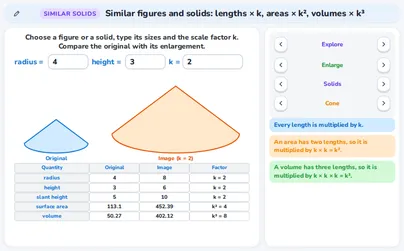
Volumes of similar solids grow with k³
When every length of a solid is k times as long, the surface is k2 times as big and the volume is k3 times as big: a volume has three lengths in it. A cube of edge 3 is built of 3×3×3=27 small cubes. In “Similar figures and solids: lengths × k, areas × k², volumes × k³” the tab Enlarge shows the original and the enlargement and the factors k, k2 and k3.l2=kl1A2=k2A1V2=k3V1
Example
A statue 2 m high has a mass of 500 kg and needs 12 m² of paint. A similar statue is 3 m high, so k=3/2 (1.5). Paint goes with the area, so 12×49=27 m². Mass goes with the volume, so 500×827=1687.5 kg.k2=49k3=827
Rule
From areas or volumes back to k
If you know two areas of similar figures, k is the square root of the ratio of the areas; for two volumes k is the cube root of the ratio of the volumes. Then use k for the other quantity: from areas to a volume you need k3, from volumes to an area k2. In “Similar figures and solids: lengths × k, areas × k², volumes × k³” the tab Find k does this for typed lengths, areas or volumes.k=A1A2k=3V1V2
Example
Two similar vases have surface areas 18 and 50 cm². The ratio is 1850=925, so k=35. A volume of 54 cm³ becomes 54×(35)3=54×27125=250 cm³. For the volumes 27 and 64 you get k=4/3 and the areas are multiplied by (34)2=16/9: 36 becomes 64.1850=925k=35
Definition
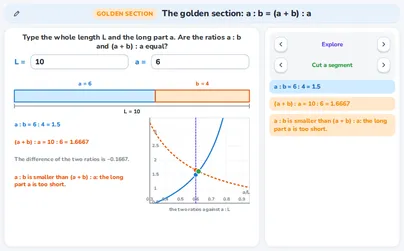
The golden section: a : b = (a + b) : a
A segment is cut in the golden section when the long part a is to the short part b as the whole is to the long part. Write x=a:b. Then (a+b):a=1+x1=x, so x2=x+1 and the positive root is x=21+5≈1.618. The other root, −0.618, is negative and is not a length. In “The golden section: a : b = (a + b) : a” the tab Cut a segment compares the two ratios for a cut that you type.a:b=(a+b):a=xx2=x+1x=21+5≈1.618
Example
A segment of 10 cm gives a=1.61810≈6.18 cm and b≈3.82 cm. Check with a:b≈1.618 and (a+b):a=10:6.18≈1.618. A cut in 6 and 4 is not golden, because 6:4=1.5 but 10:6≈1.667.x2−x−1=01+4×1=5
Rule
The golden rectangle keeps its shape
A rectangle is a golden rectangle when it keeps its shape after a square is cut off: what is left is similar to the whole, so l:w=w:(l−w). That gives l:w=x again, with x2=x+1. Cut off squares again and again: every rest is a smaller golden rectangle. In the tab Golden rectangle of “The golden section: a : b = (a + b) : a” you type the length and the width and see the squares.wl=l−wwl=xw
Example
A golden rectangle 10 cm wide is about 10×1.618=16.18 cm long. Cut off a 10 by 10 square: what is left is 10 by 6.18 and 10:6.18≈1.618, the same ratio as 16.18:10=1.618 (rounded). A 3 by 2 rectangle has the ratio 1.5; after cutting off a 2 by 2 square the rest is 2 by 1 with the ratio 2: not the same shape.l=1.618w3−2=1
Watch out!
Three equal angles or SSA are not enough
Three equal angles make triangles similar, not congruent: the size can differ. Two equal sides and an equal angle that is not between them (SSA) do not fix the triangle either. The equal angle must lie between the two equal sides.
Example
AB=AD=5, BD=6 and DC=4. The triangles ABC and ADC share AC and the angle at C.BC=6+4=10 but DC=4, so they are not congruent
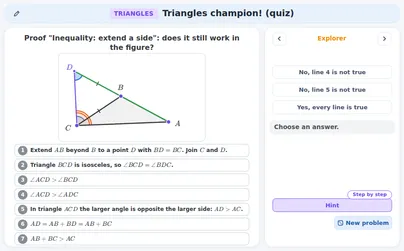
Special case
A proof can break beyond A
The proof of Thales by similar triangles uses AB=AD+DB. If D lies beyond A this is false and the proof breaks. The proof by areas never uses where D lies, so it still works. Test a proof in a new figure before you trust it.
Example
D lies beyond A with AD=2 and AB=5: then DB=2+5=7.AD+DB=2+7=9=5=AB
Exercises
DE∥BC in triangle ABC with D on AB. AD=3, AB=9 and DE=4. Find BC. Easy
Show solution
Triangle ADE is similar to triangle ABC: the angle at A is shared and DE∥BC gives equal corresponding angles.
The scale factor is k=ADAB=39=3.
BC=3×DE=3×4=12.
Answer → 12
Check: BCDE=124=31=ABAD
A triangle has the angles 40° and 75°. Another triangle has the angles 75° and 65°. Are the triangles similar? Easy
Show solution
Find the third angle of each triangle: 180°−40°−75°=65° and 180°−75°−65°=40°.
The first triangle has the angles 40°, 75° and 65°, the second 75°, 65° and 40°.
Both have the same three angles, so the triangles are similar (AA).
Answer → yes
Two equal angles were enough: the third pair follows.
DE∥BC with D on AB and E on AC. AD=4, DB=6 and AE=6. Find EC. Easy
Show solution
By Thales theorem the parallel line cuts both sides in the same ratio: DBAD=ECAE.
64=EC6
EC=6×46=9
Answer → 9
Check: 64=32 and 96=32
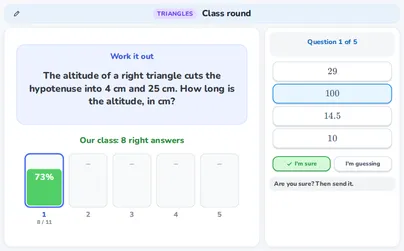
In a right-angled triangle ABC the altitude CH cuts the hypotenuse into AH=4 and HB=9. Find CH. Easy
Show solution
Use the height theorem: CH2=AH⋅HB.
CH2=4×9=36
CH=6 (a length is positive).
Answer → 6
Check: CHAH=64=32=96=HBCH
A pole of 2 m casts a shadow of 4 m. At the same moment a tree casts a shadow of 10 m. How tall is the tree? Easy
Show solution
The sun is at the same angle, so the two right-angled triangles are similar (AA).
Height : shadow is the same for both: 2H=410.
H=2×410=5 m.
Answer → 5 m
Check: the tree has the longer shadow, so it is taller than the pole.
On a map 1 cm is 250 m. Two villages are 8 cm apart on the map. How far apart are they in reality? Easy
Show solution
1 cm on the map is 250 m on the ground.
8×250=2000 m.
2000 m is 2 km.
Answer → 2000 m (2 km)
Check: 4 cm would be 1000 m, so 8 cm is 2000 m.
△ABC≅△QRP, AC=7 and ∠B=60°. Find QP and ∠R. Easy
Show solution
The letters are in matching order: A matches Q, B matches R and C matches P.
AC matches QP, so QP=AC=7.
∠B matches ∠R, so ∠R=60°.
Answer → QP=7, ∠R=60°
Check: congruent triangles have all matching sides and angles equal.
In a right-angled triangle ABC with the altitude CH the hypotenuse AB=20 and BH=5. Find the leg BC. Medium
Show solution
Use the leg theorem: the square of the leg equals the hypotenuse times the part next to it: BC2=BH⋅BA.
BC2=5×20=100
BC=10.
Answer → 10
The other part is AH=20−5=15, so AC2=15×20=300.
D lies on AB and E on AC with AD=3, DB=5, AE=6 and EC=8. Is DE parallel to BC? Medium
Show solution
By the converse of Thales the line is parallel exactly when DBAD=ECAE.
DBAD=53 and ECAE=86=43.
53=43, so the ratios are not equal.
Answer → no
For a yes both ratios would have to be the same.
In a right-angled triangle ABC the altitude CH cuts AB=10 into AH=2 and HB=8. Find AC2 and BC2 with the leg theorems and show that AC2+BC2=AB2. Medium
Show solution
AC2=AH⋅AB=2×10=20.
BC2=BH⋅BA=8×10=80.
AC2+BC2=20+80=100=102=AB2.
Answer → AC2=20, BC2=80, sum 100
In general AC2+BC2=(AH+HB)⋅AB=AB2.
A triangle has the sides 7, 9 and 12. Is it acute, right-angled or obtuse? Medium
Show solution
Compare the square of the longest side with the sum of the other two squares.
122=144 and 72+92=49+81=130.
144>130: the angle opposite the side 12 is obtuse.
Answer → obtuse
With sides 7, 9 and 11: 121<130, acute.
DE∥BC, where D lies beyond A on the line BA and E beyond A on the line CA. AD=3, AB=6 and BC=14. Find DE. Medium
Show solution
Alternate angles and vertical angles make triangle ADE similar to triangle ABC (AA).
BCDE=ABAD=63=21.
DE=21×14=7.
Answer → 7
The small triangle is half the size of the big one.
In a right-angled triangle ABC (C=90°) the altitude CH is drawn. ∠B=28°. Find ∠A, ∠ACH and ∠HCB. Medium
Show solution
In triangle ABC: ∠A=90°−28°=62°.
Triangle AHC is similar to triangle ACB and has a right angle at H: ∠ACH=∠B=28°.
Triangle CHB is similar to triangle ACB: ∠HCB=∠A=62°.
Answer → A=62°, ACH=28°, HCB=62°
Check: ∠ACH+∠HCB=28°+62°=90°
Two triangles are similar. Matching sides are 5 cm and 10 cm. The small triangle has the perimeter 18 cm and the area 12 cm². Find the perimeter and the area of the large triangle. Medium
Show solution
k=510=2.
The perimeter is multiplied by k: 18×2=36 cm.
The area is multiplied by k2: 12×22=48 cm².
Answer → perimeter 36 cm, area 48 cm²
Check: the area grows faster (×4) than the perimeter (×2).
A tall man's eyes are 2 m above the ground. He sees the top of a tower in a mirror on the ground. The mirror is 4 m from him and 20 m from the tower. How tall is the tower? Medium
Show solution
The angles at the mirror are equal, so the two right-angled triangles are similar (AA).
k=420=5.
H=5×2=10 m.
Answer → 10 m
Check: the tower is farther from the mirror than the man, so it is higher than his eyes.
On a map 1 cm is 2 km. A lake is drawn as a rectangle of 4 cm by 3 cm. What is the area of the lake in reality? Medium
Show solution
1 cm² on the map is 2×2=4 km²: areas are multiplied by 22.
The area on the map is 4×3=12 cm².
12×4=48 km².
Answer → 48 km²
Check: the real sides are 8 km and 6 km and 8×6=48.
To measure the width AB of a pond, Eda stands at C and extends AC and BC beyond C to D and E with CD=CA=24 m and CE=CB=45 m. She measures DE=51 m. Find AB. Medium
Show solution
CD=CA, CE=CB and the vertical angles at C are equal: △ABC≅△DEC (SAS).
Matching sides are equal: A matches D and B matches E, so AB=DE.
AB=51 m.
Answer → 51 m
Check: the third sides AB and DE are opposite the equal angles at C.
DE∥BC with D on AB and E on AC. AD=x, DB=6, AE=x+3 and EC=8. Find x. Hard
Show solution
Thales theorem: DBAD=ECAE, so 6x=8x+3.
Cross-multiply: 8x=6(x+3)=6x+18.
2x=18, so x=9.
Answer → x=9
Check: AD=9, AE=12 and 69=812=23
In a right-angled triangle ABC (C=90°) the altitude is CH=12 and AH=9. Find HB, AB, AC and BC. Hard
Show solution
Height theorem: CH2=AH⋅HB, so 144=9⋅HB and HB=16. Then AB=9+16=25.
Leg theorem: AC2=AH⋅AB=9×25=225, so AC=15.
Leg theorem: BC2=HB⋅AB=16×25=400, so BC=20.
Answer → HB=16, AB=25, AC=15, BC=20
Check: 152+202=225+400=625=252
A triangle has the sides BC=5, AC=6 and AB=9. Show that the angle at C is obtuse and find x=CH, where H is the foot of the altitude from A on the extension of BC. Hard
Show solution
The longest side is AB=9: AB2=81 and AC2+BC2=36+25=61.
81>61, so the angle at C is obtuse.
For an obtuse angle AB2=AC2+BC2+2⋅BC⋅x: 81=61+10x.
10x=20, so x=2.
Answer → obtuse at C, x=2
Check: BH=5+2=7, AH2=36−4=32 and AB2=49+32=81
D lies beyond A on BA with AD=2 and AB=5. The proof of Thales by similar triangles uses AB=AD+DB. Does it hold here? Which proof of Thales still works? Hard
Show solution
D lies on the other side of A, so DB=DA+AB=2+5=7.
AD+DB=2+7=9, but AB=5: the line is false and the proof by similar triangles breaks.
The proof by areas never uses where D lies, so it still works.
Answer → no (9=5); the proof by areas still works
Always test a proof in the new figure: here one line fails.
Ali says: “If the sides of a triangle become twice as long, the area becomes twice as big.” Test it with the triangle with the sides 3, 4, 5 and the triangle with the sides 6, 8, 10. Hard
Show solution
Both triangles are right-angled: the legs are the base and the height.
The areas are 23×4=6 and 26×8=24.
24=4×6: the area is four times as big, not twice. The claim is false.
Answer → false: k=2 gives the area ×4
One counterexample is enough to show that a claim is false.
In triangle ABC the line DE is parallel to BC, with D on AB and E on AC. AD=2, DB=4 and the area of ADE is 10. Find the area of ABC and of the trapezium DBCE. Hard
Show solution
△ADE∼△ABC and AB=2+4=6, so k=26=3.
The area is multiplied by k2: 10×32=90.
The trapezium is the rest: 90−10=80.
Answer → 90 and 80
Check: k2=9 and 10×9=90.
In a right-angled triangle ABC (C=90°) the altitude CH cuts the hypotenuse into AH=3 and HB=12. Find CH and the area of triangle ABC. Hard
Show solution
Height theorem: CH2=AH⋅HB=3×12=36, so CH=6.
The hypotenuse is AB=3+12=15.
The area is 215×6=45.
Answer → CH=6, area 45
Check: leg theorem AC2=AH⋅AB=3×15=45 and 62+32=45.
B, D and C lie on a line with AB=AD=5, BD=6 and DC=4. Are the triangles ABC and ADC congruent? What does this show about SSA? Hard
Show solution
Equal: AB=AD=5, the side AC and the angle at C.
But BC=BD+DC=6+4=10 and DC=4: the third sides differ.
Two sides and an angle are equal, yet the triangles are not congruent: the angle is not between the sides.
Answer → no: SSA is not a condition for congruence
The equal angle must lie between the two equal sides (SAS).
Interactive applications for this topic
Free applications open with a free student account. Teachers can use all applications in a live lesson.