İnteraktif Dersler

Sine and cosine rules

Lecture notes

Definition

Sides and opposite angles

Side is opposite angle , opposite , opposite . The longest side is opposite the largest angle.
ABCabc
Example
A = 30°, B = 70°:C is largest, so c is the longest side.
30°70°80°abc
Rule

Area with an angle

With two sides and the angle between them it is largest when :
Cabh
Example
a = 6, b = 8, C = 30°:
30°684
Special case

Two angles, one sine

An obtuse angle has a sine too, and a sine (or an area) gives two angles: and .
xabh180°−xabh
Example
Area 12, a = 6, b = 8: or
30°684150°684
Rule

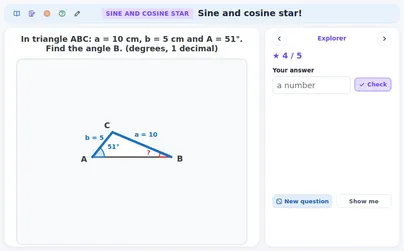
The sine rule

Use it when you know a side with its opposite angle.
ABCabc
Example
a = 6, A = 30°, B = 45°:
30°45°6?
Definition

The circle behind it

The common value is the diameter of the circle through the three corners.
Aa2R
Example
a = 6, A = 30°:, so
30°612
Rule

The cosine rule

Use it for two sides and the angle between them, or for three sides.
Cabc
Example
a = 3, b = 5, C = 120°:
120°35?
Special case

Pythagoras repaired

At , and nothing is taken away: Pythagoras. An acute makes smaller, an obtuse bigger.
<90°abc90°abc>90°abc
Example
a = 3, b = 4:: :
90°34c60°34√13
Rule

An angle from three sides

Turn the cosine rule round. A negative cosine means an obtuse angle.
?abc
Example
a = 3, b = 5, c = 7:
?357
Special case

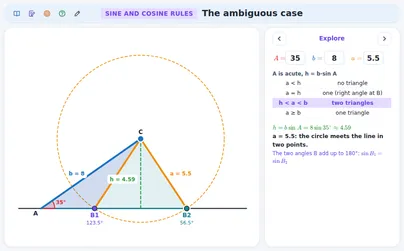
The ambiguous case

Two sides and an angle not between them (SSA): compare with and with .
AB₁B₂baah
Example
A = 30°, b = 8, so .a = 5: between 4 and 8, two triangles:, or
30°126.9°53.1°8554
Tip

Which rule first?

SSS or SAS: cosine rule. A side with its opposite angle: sine rule. Two angles: first the angle sum. A right angle: SOH-CAH-TOA.
Example
A = 40°, B = 75°, a = 10:then the sine rule for b and c.
40°75°?10
Watch out!

The usual mistakes

Forgetting the ½ in the area. Using cos where the area needs sin. Putting the sine rule upside down. Taking only the acute angle in the ambiguous case.
Example
✘ area ✔ area
Tip

Check the answer

Does the longest side sit opposite the largest angle? The three angles must add up to 180°.
Example
A = 100°, B = 50°, C = 30°:a is longest, c is shortest.
100°50°30°abc

Exercises

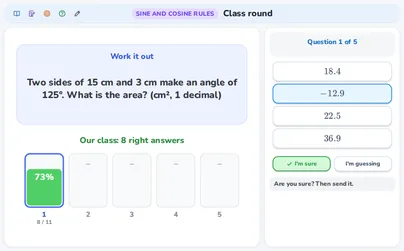
Two sides of 5 cm and 6 cm make an angle of . What is the area of the triangle? Easy
30°65
Show solution
Use .
.
Answer → 7.5 cm²
Check: is the parallelogram, half of it is 7.5.
In triangle ABC: a = 3, b = 4 and C = 90°. Find c with the cosine rule. Easy
90°34?
Show solution
.
, so .
.
Answer →
Check: it is the 3-4-5 triangle of Pythagoras.
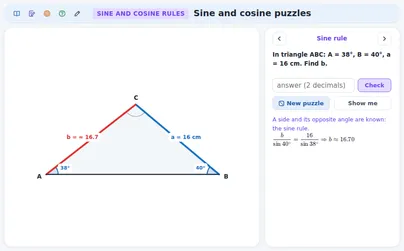
In triangle ABC: A = 45°, B = 30° and a = 10 cm. Find b. Medium
45°30°10?
Show solution
A side with its opposite angle is known: the sine rule, .
.
.
Answer → cm
Check: B is smaller than A, so b is shorter than a.
A triangle has sides 5, 6 and 7. How big is the angle C opposite the side 7? Medium
?567
Show solution
Three sides: the cosine rule backwards, .
.
.
78.5°567
Answer →
Check: 7 is the longest side, and 78.5° is the largest angle (the other two are smaller).
Two ships leave a port: one sails 12 km on a bearing of 040°, the other 9 km on a bearing of 100°. How far apart are they? Hard
040°100°129P?
Show solution
The angle between the paths is the difference of the bearings: .
60°129P
Two sides and the angle between them: the cosine rule.
.
.
Answer → about 10.82 km
Check: it lies between and km.
A and B are 100 m apart on a straight shore. A lighthouse L makes an angle of 50° with the shore at A and 70° at B. How far is L from A? Hard
50°70°100?ABL
Show solution
Two angles are known, so first the third: .
60°100?ABL
The side is opposite L, and AL is opposite B: the sine rule.
.
.
60°100108.5ABL
Answer → about 108.5 m
Check: , so is longer than .
In triangle ABC: A = 40°, b = 10 and a = 7. How many triangles fit, and what are the angles B? Hard
40°1077
Show solution
Height: .
40°6.43
(): two triangles.
, so .
The other one is .
113.3°66.7°
Answer → two triangles: and
Check: is below 180°, so the obtuse one fits.
Are you a teacher?

Start live lessons with these applications for your whole class. Free to try for one month.

Try it free

Fits these school years

IB (MYP, Diploma): MYP 5, Diploma, year 1

Cambridge International: IGCSE, AS Level

Netherlands: Havo · Mathematics B, Vwo · Mathematics B

Türkiye (MEB): Year 10 (MEB)

England (GCSE, A Level): Year 11 (GCSE), Year 12 (A Level)

USA (Common Core): Geometry, Precalculus

What the applications of this topic teach 7 applications

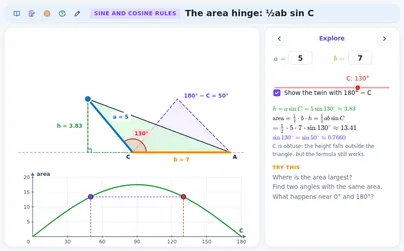
The area hinge: ½ab sin C

  • Finding the area of a triangle from two sides and the angle: ½ab sin C
  • Explaining why an angle and 180° − C give the same area
  • Finding the angle that gives a given area

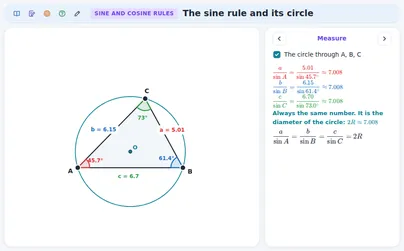
The sine rule and its circle

  • Measuring that a ÷ sin A, b ÷ sin B and c ÷ sin C are equal
  • Following two proofs of the sine rule: with a height and the circle
  • Finding a missing angle and sides with the sine rule

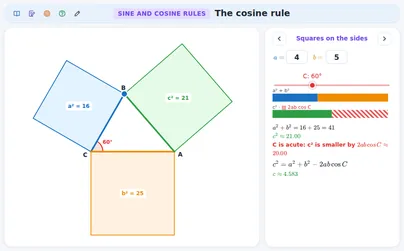
The cosine rule: Pythagoras repaired

  • Seeing the cosine rule as Pythagoras with a correction
  • Telling if c² is smaller, equal or bigger than a² + b² from angle C
  • Finding a side from two sides and the angle, and an angle from three sides

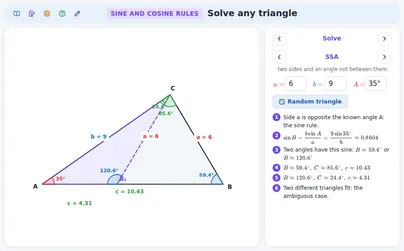
Solve any triangle

  • Choosing the right rule for SSS, SAS, ASA, AAS and SSA
  • Solving a triangle step by step with the cosine rule, sine rule, angle sum
  • Spotting when SSA gives two triangles or none

The ambiguous case: a swinging side

  • Explaining why two sides and a non-included angle give 0, 1 or 2 triangles
  • Using the height h = b sin A to count the triangles
  • Finding both angles B: x and 180° − x

Sine rule and cosine rule puzzles

  • Picking the sine rule, cosine rule or ½ab sin C for each puzzle
  • Finding a missing side or angle in a triangle
  • Finding the area of a triangle from two sides and the angle between

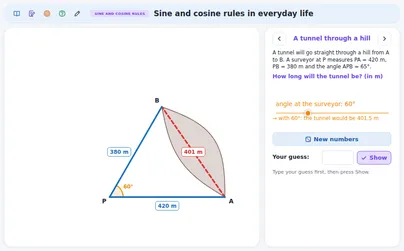
Sine and cosine rules in everyday life

  • Finding the area of a field from two fences and the angle
  • Finding a tunnel length or the distance between ships with the cosine rule
  • Finding the distance to a lighthouse with the sine rule