İnteraktif Dersler

Maps, routes and viewpoints

Lecture notes

Definition

Left, right and straight on depend on the way you face

Straight on is the way you face. A turn to the right is a quarter turn (90°) clockwise, a turn to the left is a quarter turn anticlockwise. Left and right change when you turn round, but north, east, south and west never change.
NESW90°
Example
Facing N and turning right: N + 90° → EFacing S and turning right: S + 90° → WFacing E and turning left: E − 90° → N
Rule

Describe a route: parts of straight on and turns

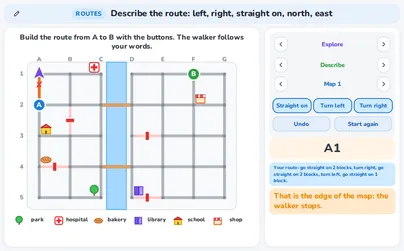
Start at A and say what the walker does: go straight on some blocks, turn left or right, go straight on again. Count the blocks of every part. A turn only changes the way the walker faces. The walker moves only when it goes straight on.
ABCDEF123412AB
Example
Start at A3, facing E.Go straight on 2 blocks. Turn right. Go straight on 1 block. Turn left. Go straight on 3 blocks. blocks. The walker ends at F4.
Rule

Follow a route: after each turn the walker faces a new way

Walk the words one by one on the map. After every part, write down the crossing the walker has reached. A crossing is named letter first, then number, like C3. After each turn, ask: which way does the walker face now?
ABCDEF1234AB
Example
Start A3, facing E. 2 blocks: C3.Turn right: facing S. 1 block: C4.Turn left: facing E. 3 blocks: F4.
Watch out!

Swapped left and right: another place

Mixing up left and right sends the walker to a different place. The same numbers of blocks with the turns swapped make another route. Imagine you are the walker: which hand points to the side you want?
ABCDEF1234A
Example
Right, then left: 2 blocks, right, 1 block, left, 3 blocks → F4.Swapped, left then right: 2 blocks, left, 1 block, right, 3 blocks → F2.
Rule

Count the blocks, then use the scale

Count the blocks of the route first. The scale of the map tells how long one block is in real life. The length of the route is the number of blocks times the length of one block.
Example
The route from A3 to F4 has blocks.One block is 100 m., which is 0.6 km.
Rule

The shortest route has the fewest blocks

To find the shortest route, count the blocks of each route and compare. Closed streets and a river with only a few bridges make some routes longer. The number of blocks decides, not how the route looks.
ABCDEFG12345AB
Example
Route S (orange): 10 blocks.Route F (blue): 12 blocks. → route S is 2 blocks shorter.
Watch out!

The route with the fewest turns is not always the shortest

A route with few turns is easy to tell, but it can be longer. A short route can need many turns. When you must choose the shortest route, count blocks, not turns.
ABCDEFG1234512345AB
Example
Route S: 10 blocks and 5 turns.Route F: 12 blocks and 2 turns.F has fewer turns, but it is blocks longer.
Rule

A walker stops at a closed street, a river without a bridge and the edge of the map

A closed street has a red bar: the walker may not go on. A river can only be crossed on a bridge. At the edge of the map there is nothing more. When a step is not possible, the walker stays where it is, and the route must be changed.
ABCDEFG12345
Example
At A1 facing E: the street to B1 is closed. The walker stays at A1.At D1 facing E: there is a bridge. The walker goes on to E1.At D3 facing E: no bridge in row 3. The walker stops.
Tip

Tell a route with landmarks

You can tell a route with landmarks: say where to turn by the church, the school or the park. Then you do not have to count blocks. A good landmark stands at a corner or along the way and is easy to recognise.
ABCDEF1234AB
Example
Go straight on to the school.Turn right and go straight on to the church.Turn left and go straight on, past the park, to B.
Definition

The four directions: north, east, south, west

A map has four main directions: north (N), east (E), south (S) and west (W). On most maps north is at the top, east on the right, south at the bottom and west on the left. The compass rose on a map shows them.
NESW
Example
On our invented map of a country: Groningen lies at the top, so it is in the north.Maastricht lies at the bottom: it is in the south.Arnhem lies on the right of the middle: it is in the east.
Definition

The eight directions

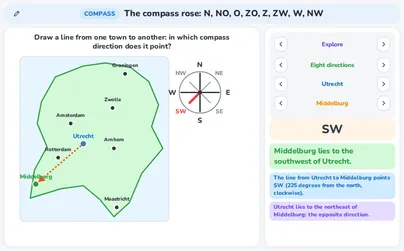
Between the four main directions there are four more: northeast (NE) between N and E, southeast (SE), southwest (SW) and northwest (NW). Together they are the eight directions. The letters on the screens of the applications are the letters of this page.
NNEESESSWWNW
Example
NE lies between N and E.SW lies between S and W.Clockwise from the top: N, NE, E, SE, S, SW, W, NW.
Rule

The direction of B seen from A

Count how many blocks B is east (or west) and north (or south) of A. The same number of blocks both ways gives a diagonal direction. If the numbers are different, draw the line from A to B and choose the direction of the rose that the line is closest to.
NNEESESSWWNW76°
Example
B is 3 blocks east and 3 blocks north of A: NE.B is 4 blocks east and 1 block north of A: the line is about 76° from the north. That is from E and from NE, so E.
Rule

Degrees from the north, clockwise

You can measure a direction as an angle from the north, going clockwise. North is 0°. Every next direction on the rose is 45° further. A whole turn is 360°.
N0°NE45°E90°SE135°S180°SW225°W270°NW315°
Example
N = 0°, NE = 45°, E = 90°, SE = 135°S = 180°, SW = 225°, W = 270°, NW = 315° → from N to SE is 3 steps. And .
Rule

The opposite direction is half a turn away

The opposite direction is straight across the rose: 4 steps of 45° further, which is half a turn of 180°. North and south are opposite, east and west are opposite, and so are the diagonal pairs.
NNEESESSWWNW
Example
NE ↔ SW → N ↔ S and E ↔ WSE ↔ NW
Rule

A wind is named after the place it comes from

The name of a wind tells where it comes from. The wind blows to the opposite direction. The arrow on a weather map shows where the wind goes to, the name tells where it comes from.
NNEESESSWWNW
Example
A wind from the northeast (NE) blows to the southwest (SW): NE ↔ SW.A wind from the east (E) blows to the west (W): E ↔ W.
Rule

Turning: a quarter turn is 90°, an eighth turn is 45°

Add the angle for a turn clockwise and subtract it for a turn anticlockwise. Go round the rose in steps of 45°. After 360° you are back at the start, so take 360° away when the sum is more than 360°.
NNEESESSWWNW135°
Example
Facing NW and turning 135° clockwise: NW + 135° → E, because and .Facing SE and turning 45° anticlockwise: SE − 45° → E, because .
Rule

A route in compass words

A route can be written as steps in compass directions: N 3 means 3 blocks north. A diagonal step like NE 1 goes one block east and one block north at the same time. To know how far east you are, count the steps east and take away the steps west.
ABCDEF12345AB
Example
Start at B5: N 3, E 2, NE 1. steps. The walker ends at E1.Blocks east of the start → .
Definition

A map and its legend

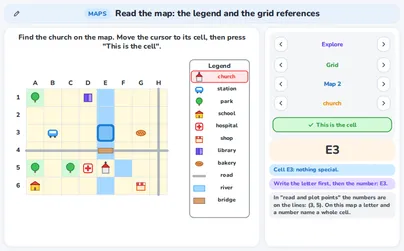
A legend tells what every symbol on a map means. Always read the legend first. Colours mean something too: blue is water. Our maps use eight symbols: church, station, park (a tree), school, hospital, shop, library and bakery. The maps are our own invented models, not real places.
ABCDEFGH123456
Example
The symbol of a house with a cross on the roof is the church.The blue cells are the river.The tree symbol is a park.
Rule

Read the legend first, then look for the symbol

To answer a question about a map: find the thing in the legend, look at its symbol, then find the same symbol on the map. To count things, count every symbol of that kind. Do not count a symbol that looks a bit the same.
ABCDEFGH123456
Example
How many parks are on the map?The legend says: a tree is a park.The trees are in B4 and G5: 2 parks.
Definition

The grid: letters across the top, numbers down the side

A grid map is cut into cells. The letters at the top name the columns and the numbers at the side name the rows. Every cell has a name made of a letter and a number, so a place can be found without a long description.
ABCDEFGH123456
Example
The church symbol is in column C, row 2: the cell is C2.The map has 8 columns and 6 rows → cells.
Rule

A grid reference: letter first, then number

Write the letter of the column first and the number of the row second: C2, never 2C. To find a cell, go along the top to the letter, go down the side to the number and meet in the cell.
Example
The school is in column F, row 2: F2 (not 2F).The station is in column E, row 1: E1.The bakery is in column H, row 3: H3.
Watch out!

A cell is not a point where lines cross

In a graph, a pair of numbers like (3, 5) names a point where two lines cross. On a grid map a letter and a number name a whole cell, a little square. The two are different ways to find a place, so do not mix them.
Example
(3, 5) is a point on the lines of a graph.C2 is a whole square of the map.
Rule

Move on the grid: to the right is the next letter, down is the next number

Going to the right changes the letter (A, B, C, D, ...). Going down changes the number (1, 2, 3, ...). Go across first, then down, and name the cell where you arrive.
ABCDEFGH12345623
Example
Start in B2. Move 2 to the right and 3 down.2 to the right: B → C → D, so D2.3 down: 2 → 3 → 4 → 5, so D5.
Rule

The distance in blocks: across plus down

To find the distance between two cells, count the cells across and the cells down and add them. Along the streets you can not cut across a block, so the distance is across plus down.
ABCDEFGH12345633
Example
From C2 to F5:across C → F is 3, down 2 → 5 is 3. blocks.
Rule

The scale: from blocks to metres

The scale of a map tells how long one block is in real life. Multiply the number of blocks by the length of one block. Two maps of the same place can have another scale, another legend or another grid, so they can look different.
Example
1 block = 100 m → .1 block = 250 m → , which is 1.5 km.1 block = 50 m → .
Definition

A plan, a photo and a 3D drawing show the same scene

A plan looks straight down from above. A photo looks from one spot along the ground. A 3D drawing shows the top and the sides at once. They show the same buildings in three ways, so you can use one to check another.
Example
The plan tells the heights with numbers: a wall is 1, a house 2, a tree 2, a tower 3.The photo shows tall blocks as tall shapes.The tower (3) looks taller than the house (2) when both are as far away.
Definition

A photo depends on where you stand and which way you look

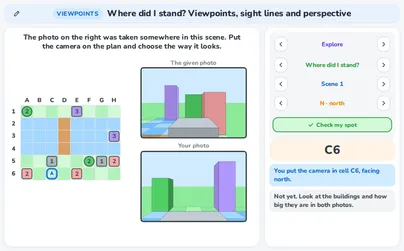
Two things decide what a photo shows: the standpoint (where the photographer stands) and the direction of the camera. Another standpoint, or another direction, gives another photo of the same scene. On a plan the standpoint is a dot and the direction is a wedge.
1223221ABCDEFGH123456
Example
From A3 facing E the house D3 is 3 blocks ahead.From D5 facing N the same house is 2 blocks ahead.
Rule

Where did I stand? Use clues

Look for things in the photo that you can find on the plan. See what is in front, what is left and what is right. Near things look big and far things look small. Put the camera on the plan, look at the photo you would get, and move until it looks like the given photo.
Example
In the photo the house is in front, big, and the tower stands behind it.On the plan the tower E3 is behind the house D3 in row 3.So the photographer stands in row 3, west of the house, and looks E.
Definition

A sight line and the heights of the blocks

A sight line is the straight line from your eye to what you look at. Your eyes are 1.5 high in our scenes. A block that is higher than your eyes (a house, a tree, a tower) hides a lot behind it. You can look over a block that is lower than your eyes (a wall) at things that are tall.
1223221ABCDEFGH123456
Example
Heights: wall 1, house 2, tree 2, tower 3. Eyes: 1.5. → you can look over a wall at tall things. → a house is higher than your eyes.
Rule

A block hides what is behind it when the sight line passes below its top

Look at the sight line where it passes a block. If the block is higher than the line there, the line is stopped and everything behind it on that line is hidden. If the line is higher, it passes over. When the line goes up, to something higher than your eyes, the lowest place is the front edge of the block. So a tall tower behind a house can be seen, and a low tree behind the same house cannot.
1223221ABCDEFGH123456
Example
Eye at A3, house D3 (height 2) in front.The line to the tower E3 (3) is about 2.4 high at the house → , so the tower is seen.The line to the tree F3 (2) is about 1.8 high there → , so the tree is hidden.
1223221ABCDEFGH123456
Rule

Count the cells you can see

From one spot some cells are in view and some are hidden behind blocks. Count the cells in view. The cell you stand in counts too. The cells in view and the hidden cells together make all the cells of the scene.
1223221ABCDEFGH123456
Example
From A3 you can see 30 of the 48 cells.The shaded cells are hidden: 18 cells..
Rule

If I can see you, you can see me

A sight line goes both ways. If nothing in between is higher than the eyes, we see each other. If a house is in between, neither of us sees the other. A mirror works the same: the line goes in and comes out at the same spot of the mirror.
1223221ABCDEFGH123456
Example
A3 and G3: the house D3 (2) is in between: no one sees the other.A3 and H1: nothing higher than 1.5 is in between: they see each other.
1223221ABCDEFGH123456
Rule

Perspective: far away looks smaller

In a photo or a drawing in perspective, things that are far away look smaller. Something twice as far away looks about half as big. The parallel edges of a street seem to meet far away. A box seen from the front shows one face, a box seen from a corner shows two faces, and the face on the side looks narrower.
Example
A person 4 blocks away is 2 times as far as a person 2 blocks away → .So the far person looks about times as tall: half as tall.
Rule

Does the photo fit the plan?

Check three things: what is in front of the camera, what is left and right, and what is nearer (bigger) and what is further away (smaller). The photographer stands on land (grass or the bridge), never in the water or inside a house.
Example
Plan: the camera is at A3 and looks E. The house D3 is 3 blocks ahead, the tower E3 4 blocks.A photo with the tower in front of the house does not fit: the house is nearer.No photo is taken from D3: a house is there.
Definition

A shadow points away from the sun

A shadow is the place where an object blocks the light of the sun. The shadow always points away from the sun, to the opposite direction. The sun in the applications is a simple model, accurate to about 1 degree: it is not the real sun of today. The times are sun times: at 12:00 the sun stands in the south.
NNEESESSWWNW
Example
The sun is in the south (S): the shadow points north (N), because S ↔ N.The sun is in the east (E): the shadow points west (W), because E ↔ W.
NNEESESSWWNW
Rule

The higher the sun, the shorter the shadow

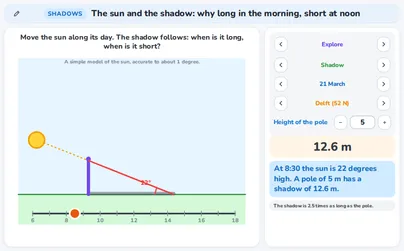
The height of the sun is its angle above the horizon. A high sun makes a short shadow and a low sun a long one. At 45° the shadow is as long as the pole. The shadow is the height of the pole times a number that only depends on the angle of the sun.
60°2 m1.2 m45°2 m2 m30°2 m3.5 m
Example
Sun 60°: the shadow is 0.58 times the pole → .Sun 45° → .Sun 30° → .
Rule

Long shadows in the morning and evening, short at noon

The sun is low in the morning and in the evening, so the shadows are long. Around noon the sun is highest, so the shadow is shortest. The shadow at 9:00 is as long as the shadow at 15:00, because the sun is just as high. At noon in the Netherlands the sun is in the south and the shadow points north.
Example
21 June, Delft, a pole of 2 m:7:00: the sun is 27° high, the shadow is 3.9 m.9:00: the sun is 45° high, the shadow is 2 m.12:00: the sun is 61° high, the shadow is 1.1 m.
Rule

In winter the sun is lower than in summer

At noon the sun is lowest on 21 December and highest on 21 June. So the noon shadow is longest in winter and shortest in summer. The nearer to the equator, the higher the sun: in Ankara (40° N) the sun is higher than in Delft (52° N).
15°2 m7.7 m38°2 m2.6 m61°2 m1.1 m
Example
Delft, noon, a pole of 2 m:21 December: 15° → 7.7 m. 21 March: 38° → 2.6 m. 21 June: 61° → 1.1 m. → the December shadow is about 7 times as long.Ankara, 21 June: 73° → 0.6 m.
Rule

Measure a tree with a stick and two shadows

At the same moment the sun has the same height for everything. So a tree and a stick have shadows in the same proportion. Measure both shadows. Divide the shadow of the tree by the shadow of the stick: that is how many times the tree is as tall as the stick.
34°8 m12 m1 m1.5 m
Example
Stick: 1 m, shadow 1.5 m. Tree: shadow 12 m. → the tree is 8 times as tall as the stick..
Watch out!

A shadow is not longest at noon

Around noon the sun is highest, so the shadow is shortest. The longest shadows are in the morning, in the evening and in winter. A taller pole gives a longer shadow at the same moment, but the proportion stays the same.
Example
21 June, Delft, a pole of 2 m: 12:00 → 1.1 m and 7:00 → 3.9 m. → the shadow in the morning is 2.8 m longer than at noon.
Definition

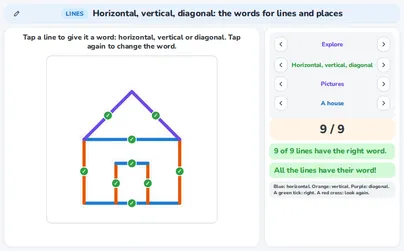
Horizontal, vertical and diagonal lines

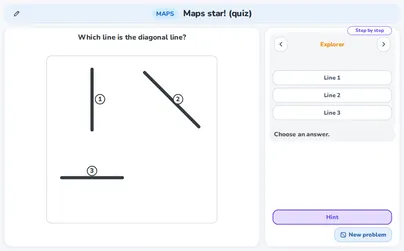
A horizontal line is flat, like the water in a glass. A vertical line goes straight up and down, like a plumb line. A line that is neither horizontal nor vertical is diagonal (slanted).
ADCB
Example
In the square ABCD: AB is horizontal, BC is vertical and AC is diagonal.The water in a glass is horizontal, a plumb line is vertical and a ladder against a wall is diagonal.
Definition

Words for places: above, under, around, straight, slanted, in the middle

Six words say where something is or how it stands: above (higher than something), under (lower than something), around (on every side), straight (not bent and not slanted), slanted (not straight) and middle (the same distance from the edges). In the applications you type these words in English.
Example
The bird is above the tree. The roots are under the ground.The fence is around the garden. The flagpole is straight.The tower of Pisa is slanted. The ball is in the middle of the field.
Rule

The diagonals of a polygon

A diagonal of a polygon joins two corners that are not neighbours. From each corner you can draw a diagonal to every corner except itself and its two neighbours: n − 3 diagonals. Every diagonal is counted from both of its ends, so divide by 2. The word diagonal has two meanings: a slanted line, and a line between two corners of a polygon.
Example
A pentagon has 5 corners. From each corner → diagonals., and every diagonal is counted twice → .Quadrilateral 2, pentagon 5, hexagon 9.
Rule

Perpendicular and parallel lines

Two lines are perpendicular when they make a right angle of 90°. A horizontal line and a vertical line are perpendicular. Two lines are parallel when they always keep the same distance and never meet.
Example
The top and bottom of a rectangle are parallel.A side and the top meet in a corner of 90°: they are perpendicular.

Exercises

A walker starts at A3 and faces east. It goes straight on 2 blocks, turns right and goes straight on 1 block. At which crossing does it stop? Easy
ABCDEF1234A
Show solution
2 blocks east from A3 is C3.
A turn to the right when facing E makes the walker face S: E + 90° → S.
1 block south from C3 is C4.
C4
Check → blocks, and C4 is 2 columns and 1 row away from A3.
B is 5 blocks west and 5 blocks south of A. In which direction is B seen from A? Write the compass letters. Easy
NNEESESSWWNW
Show solution
The numbers of blocks are the same: 5 and 5. So the direction is a diagonal one.
West and south together make southwest.
SW
Check → SW lies between S and W: SW = 225° from the north.
In which cell is the school? Write the letter first. Easy
ABCDEFGH123456
Show solution
The school symbol (a little house with a red roof) is ringed in blue.
The column at the top is F. The row at the side is 2.
The letter first, then the number: F2.
F2
Check → F2 is not 2F: the letter goes first.
Your eyes are 1.5 high. A wall is 1 high, a house 2, a tree 2 and a tower 3. Which blocks are higher than your eyes, so that you can not look over them? Easy
Show solution
You can not look over a block that is higher than your eyes: higher than 1.5.
The wall is 1 → , so you can look over it.
The house (2), the tree (2) and the tower (3) are higher than 1.5.
The house, the tree and the tower
Check → and , but .
A pole is 2 m tall. Its shadow is 1.5 times as long as the pole. How long is the shadow? Easy
34°2 m3 m
Show solution
The shadow is 1.5 times the height of the pole.
.
3 m
Check → .
Which word fits: horizontal, vertical or diagonal? (a) The water in a glass. (b) A plumb line. (c) A ladder against a wall. Easy
Show solution
The water in a glass lies flat: horizontal.
A plumb line hangs straight down: vertical.
A ladder leans: it is neither horizontal nor vertical, so it is diagonal.
(a) horizontal, (b) vertical, (c) diagonal
Check → a horizontal and a vertical line are perpendicular: 90°.
A walker goes 2 blocks, turns right, goes 1 block, turns left and goes 3 blocks. One block is 250 m. How long is the route in metres and in kilometres? Medium
Show solution
blocks.
.
.
Check → blocks.
You face northwest (NW) and turn 135° clockwise. In which direction do you face now? Write the compass letters. Medium
NNEESESSWWNW135°
Show solution
NW = 315° from the north.
.
, and E = 90°.
E
Check → 135° is 3 steps of 45°: NW + 135° → E goes round N, NE, E.
Start in cell B2. Move 2 cells to the right and 3 cells down. Which cell do you reach, and how many blocks did you move? Medium
ABCDEFGH12345623
Show solution
To the right changes the letter: B → C → D, so D2.
Down changes the number: 2 → 3 → 4 → 5, so D5.
Blocks → .
D5, 5 blocks
Check → from D5 back: 3 up and 2 to the left is B2.
You stand at A3 with your eyes 1.5 high. A house of height 2 stands at D3. Is the tower at E3 (height 3) seen? Is the tree at F3 (height 2) seen? Medium
1223221ABCDEFGH1234561223221ABCDEFGH123456
Show solution
At the front edge of the house the line to the tower is about 2.4 high → , so the line passes over the house.
The line to the tree is about 1.8 high there → , so the house hides the tree.
The tower is seen; the tree is hidden.
Check → the tower is 3 high and the tree 2; the further and taller target gets the higher line.
The noon shadow of a pole of 2 m in Delft is 7.7 m on 21 December and 1.1 m on 21 June. About how many times as long is the shadow in December? Medium
Show solution
Divide the long shadow by the short one.
.
About 7 times
Check → . The sun is low in winter, so the shadow is long.
How many diagonals does a hexagon have? Medium
Show solution
A hexagon has 6 corners.
From each corner → diagonals.
, and every diagonal is counted twice → .
9 diagonals
Check → count the dashed lines in the picture: 9.
Two routes lead from A1 to G3. Route S has 10 blocks and 5 turns. Route F has 12 blocks and 2 turns. How many blocks longer is F, how many turns fewer does it have, and which route is the shortest? Hard
ABCDEFG1234512345AB
Show solution
→ F is 2 blocks longer.
→ F has 3 fewer turns.
The shortest route has the fewest blocks → , so S.
F is 2 blocks longer and has 3 fewer turns; S is the shortest.
Check → fewest turns is not the shortest route: F has fewer turns, S has fewer blocks.
A walker starts at B5 and goes E 2, N 2, NW 1. At which crossing does it end? How many blocks east of the start is it? Hard
ABCDEF12345AB
Show solution
E 2: B5 → D5. N 2: D5 → D3.
NW 1: one block west and one block north, so D3 → C2.
East steps: 2. West steps: 1. .
C2, 1 block east of the start
Check → B to C is one column to the right: 1 block east.
A wind comes from the southwest (SW). A kite flies the way the wind blows. Then it turns 45° anticlockwise. In which direction does it fly now? Write the compass letters. Hard
NNEESESSWWNW
Show solution
A wind from SW blows to the opposite direction: SW ↔ NE.
NE = 45°.
Turn 45° anticlockwise → , and N = 0°.
N
Check → NE − 45° → N: one step anticlockwise from NE is N.
On the map 1 block is 100 m. How far is it along the streets from the church (C2) to the library (F6)? Give the blocks and the metres. Hard
ABCDEFGH12345634
Show solution
Across from C to F: 3 cells. Down from 2 to 6: 4 cells.
blocks.
.
7 blocks, 700 m
Check → blocks.
At the same moment a stick of 1 m has a shadow of 1.5 m, and a tree has a shadow of 9 m. How tall is the tree? Hard
34°6 m9 m1 m1.5 m
Show solution
Divide the shadow of the tree by the shadow of the stick → .
The tree is 6 times as tall as the stick.
.
6 m
Check → → the shadows have the same proportion as the heights.
Two people have their eyes 1.5 high. One stands at A3. A house of 2 stands at D3. Can the person at A3 and a person at G3 see each other? And a person at H1? Hard
1223221ABCDEFGH1234561223221ABCDEFGH123456
Show solution
A sight line goes both ways, so it is enough to check one way.
A3 and G3: the house at D3 is on the line and 2 is higher than 1.5, so they do not see each other.
A3 and H1: no block higher than 1.5 is on the line, so they see each other.
A3 and G3: no. A3 and H1: yes.
Check → if I can see you, you can see me: the answer is the same from G3 or H1 to A3.
Are you a teacher?

Start live lessons with these applications for your whole class. Free to try for one month.

Try it free

Fits these school years

IB (MYP, Diploma): PYP, MYP 1, MYP 2, MYP 3

Cambridge International: Primary, stage 4, Primary, stage 5, Primary, stage 6, Lower Secondary, stage 7, Lower Secondary, stage 8

Netherlands: Groep 5, Groep 6, Groep 7, Groep 8, Vmbo bb (years 3-4), Vmbo kb (years 3-4), Vmbo gt (years 3-4), Year 1

Türkiye (MEB): Year 3 (MEB), Year 4 (MEB), Year 5 (MEB), Year 6 (MEB)

England (GCSE, A Level): Year 4, Year 5, Year 6, Year 7, Year 8

USA (Common Core): Grade 3, Grade 4, Grade 5, Grade 6, Grade 7

What the applications of this topic teach 6 applications

Describe the route: left, right, straight on, north, east

  • Describing a route from A to B in parts
  • Following a route and knowing left and right depend on the facing
  • Finding the shortest route by counting blocks
  • Reading a signpost at a crossing

Read the map: the legend and the grid references

  • Reading the legend of a map and counting symbols
  • Naming a grid cell with the letter first, like C2
  • Moving on the grid and counting the blocks between two cells
  • Using the scale: 6 blocks of 100 m is 600 m

The compass rose: N, NE, E, SE, S, SW, W, NW

  • Naming the four and eight directions of the compass rose
  • Finding the direction of B seen from A
  • Knowing a wind is named after where it comes from
  • Following a route in compass words

Where did I stand? Viewpoints, sight lines and perspective

  • Finding where a photo was taken from a plan
  • Telling which cells are visible from a spot and which are hidden
  • Knowing a block hides what is behind it below its top
  • Knowing far things look smaller in perspective

The sun and the shadow: why long in the morning, short at noon

  • Knowing a shadow points away from the sun and is shortest at noon
  • Using the height of the sun to find a shadow length
  • Knowing the sun is lower in winter than in summer
  • Measuring the height of a tree with a stick and two shadows

Horizontal, vertical, diagonal: the words for lines and places

  • Naming lines as horizontal, vertical or diagonal
  • Using the words above, under, around, straight, slanted
  • Counting the diagonals of a polygon
  • Telling parallel and perpendicular lines apart