İnteraktif Dersler
Lecture notes Exercises

Percentage increase and decrease

Lecture notes

Definition

Increase and decrease

An increase makes an amount bigger, a decrease makes it smaller.The old amount is always 100%.
04080120100+−
Example
A concert ticket goes from 50 euro to 45 euro. Increase or decrease?: a decrease of 5 euro, and the old price euro
010203040506050504545
Definition

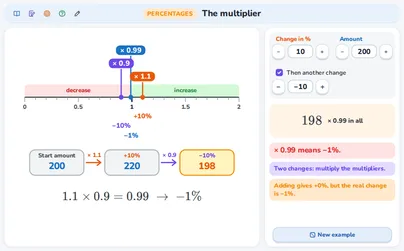
The multiplier

The number you multiply by to make the change in one step.+25% → × 1.25−25% → × 0.75,
100%×1.25125%100%×0.7575%
Example
The water bill goes up by 8%. What is the multiplier? → multiplier
100%×1.08108%
Rule

Increase by p%

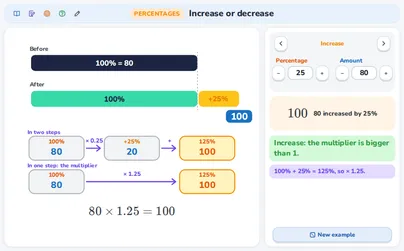
80 + 25% →
0010080125100%×1.25
Example
A bike costs 150 euro. The price goes up by 12%. New price? euro
00100150112168%×1.12
Rule

Decrease by p%

60 − 15% →
00855110060%×0.85
Example
A game of 80 euro gets 30% off. What do you pay? euro
00705610080%×0.7
Rule

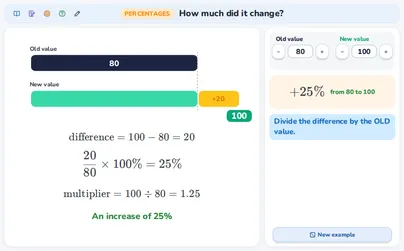
Percentage change

From 80 to 100 →
10080+20
Example
A class grows from 25 to 30 pupils. By what percentage?
3025+5
Rule

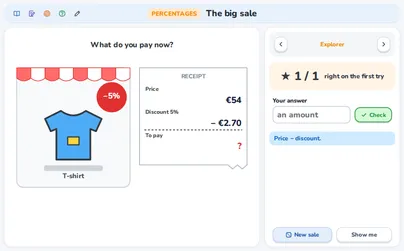
Discount and VAT

Discount → VAT →
Example
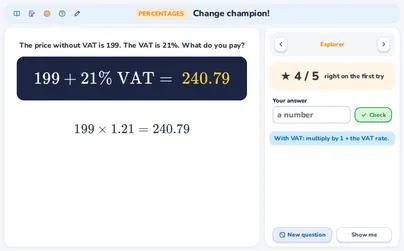
A lamp costs 200 euro without VAT. VAT is 21%. Price with VAT? euro
00100200121242%×1.21
Tip

Two steps or one

Two steps → 25% of 80 = 20, then One step → The same!
80+2010080×1.25100
Example
Add 15% to 40 euro. euro, no extra step needed
40×1.1546
Tip

Read the multiplier

× 1.07 means +7%× 0.93 means −7%,
0.911.1×0.93×1.07
Example
What change is × 0.82? → −18%
0.70.80.911.1×0.82
Watch out!

Divide by the OLD value

80 → 100 is +25%,but 100 → 80 is −20%!
80+25%100✔100−20%80✔
Example
A scooter drops from 50 to 40 euro. By what percentage?✘ ✔
50−20%40✔50−25%40✘
Watch out!

Changes do not add up

+10% then −10% → That is −1%, not 0%!
100×1.1110×0.999
Example
A price rises by 50% and then falls by 50%. Back to the start?✘ ✔ → −25%
100×1.5150×0.575
Special case

A decrease of 100%

−100% leaves 0.A decrease can never be more than 100%.
100%×00%
Example
A 40 euro item gets a discount of 100%. What is the price? euro
40×00
Special case

An increase of 100% or more

+100% = twice as much (× 2)+200% = three times as much (× 3),
100%×2100%+100%×3100%+200%
Example
A plant of 12 cm grows by 150%. How tall is it now? → cm
3012+18
Rule

Percentages of the same total add up

30% of a class and 20% of the same class are together 50% of the class. When the total is the same, the percentages add up.
30%20%10050%
Example
In one school 25% of the pupils cycle and 40% walk: 65% in all.
25%40%10065%
Watch out!

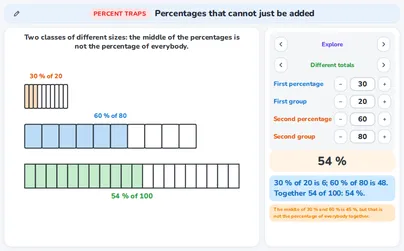
Percentages of different totals do not add up

30% of a class of 20 and 60% of a class of 80 are not 90% together, and not the middle, 45%. 30% of 20 is 6 and 60% of 80 is 48. Together that is 54 pupils out of 100: 54%.
30%2060%8054%100
Example
Class A has 40 pupils and 50% cycle. Class B has 60 pupils and 25% cycle. of the 100 pupils: 35%
50%4025%6035%100
Rule

Combine two percentages: parts over totals

To combine two percentages, work out each part, add the parts, add the totals, and divide.
620488054100
Example
10% of 50 and 30% of 150.
5504515025200
Watch out!

Up and down: plus 10% and then minus 10%

The second percentage is of the new amount, not of the old one. A price of 100 goes up 10% to 110. Then 10% of 110 is 11, so it goes down to 99, not back to 100.
100+10%110−10%99
Example
A price of 200 goes up 25% and then down 25%.
200+25%250−25%187.5
Rule

Two discounts after each other

The second discount is of the sale price. €50 with 20% off is €40; then 10% off €40 is €36. In all €14 less, which is 28% of €50, not 30%.
50−20%40−10%36
Example
A price of 80 with 25% off and then 20% off: 48 is left, which is 32 off, so 40% off in all.
80−25%60−20%48

Exercises

A game costs €40. The price goes up by 10%. What is the new price? Easy
Show solution
10% of 40 = 4
4440+4
Answer: €44
Or in one step →
A jacket of €60 has 15% discount. What do you pay? Medium
Show solution
Multiplier →
00855110060%×0.85
Answer: €51
Check: 10% off gives €54, so a bit less is right.
A plant grew from 80 cm to 100 cm. By what percentage did it grow? Medium
Show solution
Difference →
10080+20
Answer: +25%
Divide by 80 (the old value), not by 100.
A price of €200 goes up by 20% and then down by 20%. What is the price now? Hard
Show solution
200×1.2240×0.8192
Answer: €192
In one go → , that is −4%.
35% of the pupils of a school play football and 25% of the same pupils play hockey (nobody plays both). What percentage plays one of the two sports? Easy
35%25%100
Show solution
The total is the same (all the pupils), so the percentages add up.
35%25%10060%
60%
Check → 35 + 25 = 60 of every 100 pupils.
In class A (20 pupils) 50% have a bike. In class B (30 pupils) 20% have a bike. What percentage of the 50 pupils together has a bike? Medium
50%2020%30?50
Show solution
50% of 20 is 10 pupils.
20% of 30 is 6 pupils.
Together of the 50 pupils.
50%2020%3032%50
32%
Check → not 35% (the middle) and not 70% (the sum): the classes are different totals.
A shirt costs €80. The price goes up 25% and a month later down 25%. What does the shirt cost now? Is it back to €80? Hard
80+25%?−25%?
Show solution
After the increase.
80+25%100−25%?
The decrease is of €100, the new price.
80+25%100−25%75
€75 is not €80: it is €5 less.
€75; no, it is €5 less than €80.
Check → .
Are you a teacher?

Start live lessons with these applications for your whole class. Free to try for one month.

Try it free

Fits these school years

IB (MYP, Diploma): MYP 1, MYP 2, MYP 3

Cambridge International: Lower Secondary, stage 8, Lower Secondary, stage 9, IGCSE, Primary, stage 6, Lower Secondary, stage 7

Netherlands: Groep 8, Year 2, Year 3 (havo, vwo), Havo · Mathematics A, Vwo · Mathematics A, Vwo · Mathematics C

Türkiye (MEB): Year 7 (MEB), Year 9 (MEB), Year 6 (MEB)

England (GCSE, A Level): Year 8, Year 9, Year 10 (GCSE), Year 6, Year 7

USA (Common Core): Grade 7, Grade 6

What the applications of this topic teach 5 applications

Increase or decrease: two steps or one multiplier

  • Increasing or decreasing an amount by a percentage: 80 + 25%
  • Doing it in two steps: find the change, then add or subtract
  • Doing it in one step with a multiplier: × 1.25 or × 0.75
  • Knowing that a multiplier above 1 is an increase and below 1 a decrease

The multiplier: one or two changes

  • Turning a percentage change into a multiplier: +10% → × 1.1
  • Reading a multiplier as a change: × 0.77 → −23%
  • Knowing that two changes after each other are multiplied
  • Explaining why +10% then −10% does not return to the start

How much did it change? The percentage change

  • Finding the percentage change from an old to a new value
  • Knowing the rule: difference ÷ old value × 100%
  • Finding the multiplier as new ÷ old
  • Rounding a percentage change that does not come out exactly

The big sale: discount and VAT

  • Working out a discount and the price after the discount
  • Working out VAT and the price with VAT
  • Doing two changes after each other, such as an extra discount
  • Comparing “4 for the price of 3” with “50% off”

Percentages that cannot just be added

  • Knowing that percentages add up only when they are of the same total
  • Combining two percentages of different totals: parts over totals
  • Showing that +10% then −10% is not back at the start
  • Working out two discounts after each other