İnteraktif Dersler

Reverse percentages, interest and depreciation

Lecture notes

Definition

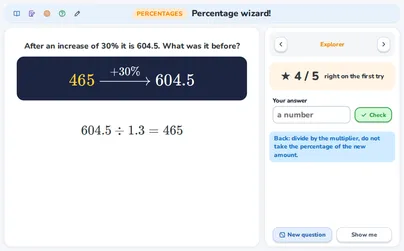
Reverse percentage

You know the amount AFTER a change and look for the amount BEFORE.The old amount is the 100%.
x×myy÷mx
Example
After 25% off a coat costs 60 euro. What was the price before? euro → euro
00756010080%÷0.75
Definition

Simple and compound interest

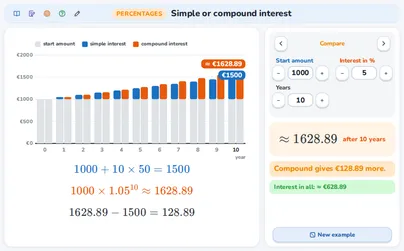
Simple: every year interest on the start amount only.Compound: every year interest on the new amount.,
100010501100012+50+50100010501102.5012×1.05×1.05
Example
2000 euro at 10% for 2 years. Simple or compound?Simple: compound:
200022002400012+200+200200022002420012×1.1×1.1
Rule

Back to the old amount

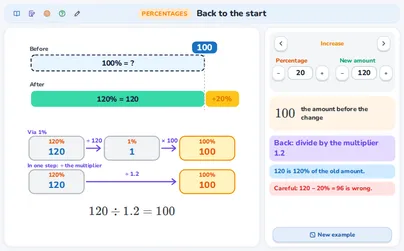
+20% gave 120 →
x×1.2120
Example
A price rose by 25% to 150 euro. What was the old price? euro
00100120125150%×1.25
Rule

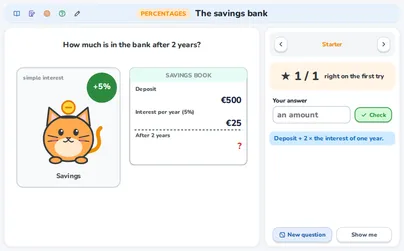
Simple interest

Interest per year → 1000 at 5% for 3 years →
10001050110011500123+50+50+50
Example
300 euro at 4% simple interest for 5 years. How much then? euro
3603005×12
Rule

Compound interest

is the start amount, the number of years.After years → 1000 at 5% for 2 years →
100010501102.5012×1.05×1.05
Example
200 euro at 10% compound interest for 2 years. euro
200220242012×1.1×1.1
Rule

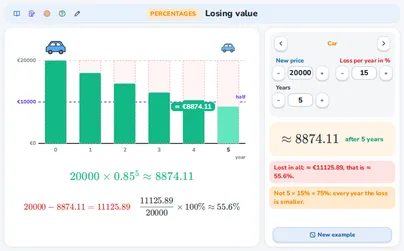
Depreciation

is the new price, the number of years.After years → −20% per year → × 0.8 every year
1008064012×0.8×0.8
Example
A laptop of 1000 euro loses 20% of its value per year. Value after 2 years? euro
1000800640012×0.8×0.8
Tip

Via 1%

120 is 120% of the old amount.So 1% → and 100% →
120÷1201×100100
Example
After +30% a bike costs 260 euro. Old price? → → euro
260÷1302×100200
Tip

Read the power

→ 3 years +5% → 4 years −10%
1001051101160123×1.05×1.05×1.05
Example
What does mean?4 years +6%: × 1.06 four times
10010611211912601234×1.06×1.06×1.06×1.06
Watch out!

Not a percentage of the new amount

After −20% it is 80.80 + 20% = 96 is wrong!Right →
100×0.88080÷0.8100✔80×1.296✘
Example
After a rise of 50% a bag costs 90 euro. Old price?✘ (50% of 90) ✔ euro
60×1.59090÷1.560✔90−50%45✘
Watch out!

Years × percentage is wrong

3 years +10% is not +30%. → +33.1%
100110121133.10123×1.1×1.1×1.1
Example
Money grows 50% per year for 2 years. Total growth?✘ ✔ → +125%
100150225012×1.5×1.5
Special case

After 1 year

Simple and compound interest give the same after 1 year.After that the difference grows every year.
1000102010401060SC
Example
500 euro at 6% for 1 year. Simple or compound? and : the same
500510520530540SC
Special case

Never down to 0

Depreciation always leaves a part.−50% per year → 100 → 50 → 25 → 12.5 → …
100502512.5…×0.5×0.5×0.5
Example
A car of 8000 euro loses 25% per year.8000 → 6000 → 4500 → 3375 → … never 0
8000600045003375…×0.75×0.75×0.75

Exercises

After a price rise of 10% a ticket costs €44. What did it cost before? Easy
Show solution
Multiplier →
44÷1.140
Answer: €40
Check →
You save €500 at 4% simple interest. How much do you have after 3 years? Medium
Show solution
Interest per year → 4% of 500 = 20
5005205405600123+20+20+20
Answer: €560
Every year the same €20.
You save €500 at 4% compound interest. How much do you have after 2 years? Medium
Show solution
500520540.8012×1.04×1.04
Answer: €540.80
In one go → . That is €0.80 more than simple interest.
A scooter of €2000 loses 20% of its value every year. What is it worth after 3 years, and what percentage is lost? Hard
Show solution
20001600128010240123×0.8×0.8×0.8
Lost → , that is 48.8%
Answer: €1024 (48.8% lost)
Not 3 × 20% = 60%!
Are you a teacher?

Start live lessons with these applications for your whole class. Free to try for one month.

Try it free

Fits these school years

IB (MYP, Diploma): MYP 2, MYP 3, MYP 4, MYP 5

Cambridge International: Lower Secondary, stage 9, IGCSE, Lower Secondary, stage 8

Netherlands: Year 2, Year 3 (havo, vwo), Groep 8, Year 1, Havo · Mathematics A, Vmbo gt (years 3-4), Vwo · Mathematics A, Vwo · Mathematics C

Türkiye (MEB): Year 9 (MEB), Year 7 (MEB)

England (GCSE, A Level): Year 9, Year 10 (GCSE), Year 8, Year 11 (GCSE)

USA (Common Core): Grade 7, Grade 8, Algebra 1

What the applications of this topic teach 4 applications

Back to the start: reverse percentages

  • Finding the amount before an increase or decrease: 120 after +20%
  • Knowing that the new amount is 120% (or 80%) of the old
  • Going back via 1%, or in one step ÷ the multiplier
  • Knowing why 120 − 20% is not the old amount

Simple or compound interest

  • Calculating simple interest: the same interest every year
  • Calculating compound interest with a power: 1000 × 1.05^10
  • Explaining why compound interest grows faster

Losing value: depreciation

  • Calculating the value after depreciation: 20000 × 0.85^5
  • Knowing that the loss gets smaller every year
  • Finding the total percentage that is lost

The savings bank: interest and reverse percentages

  • Calculating simple interest and the amount after a few years
  • Calculating compound interest year by year
  • Calculating the value after depreciation
  • Finding the price before VAT or before a discount