İnteraktif Dersler

Positive and negative fractions and decimals

Lecture notes

Definition

Rational number

A number you can write as a fraction of two whole numbers.Examples →
−3−2−10123−3/40.5−2
Example
Is a rational number?Yes:
−3−2−101−3/2
Definition

The opposite

The same distance to 0, on the other side.
−1012/32/3−2/32/3
Example
What is the opposite of ?Same distance to 0 →
−1015/85/8−5/85/8
Rule

Comparing

Farther left on the number line is smaller.
−101−3/4−1/21/4
Example
Which is colder: °C or °C? → °C
−10−2/3−1/3
Rule

Adding and subtracting

Same denominator first.Subtracting → adding the opposite
−101−3/41/4−1/2
Example
Work out .
−0.75−0.5−0.2500.25+1/3−1/2−1/6
Rule

Multiplying and dividing

Same signs → +Different signs → −
Example
Work out .Different signs → −:
Rule

Dividing by a fraction

Multiply by its reciprocal (flip it).
1/2×(−4/3)−2/3
Example
Work out .
−2/5×(−3/4)3/10
Tip

Count the minus signs

An even number of minus signs → +An odd number → −: even , odd
Example
Work out .Four minus signs → +:
Tip

Fraction or decimal

The same number in two ways.
−1−0.75−0.5−0.250−3/4
Example
Write as a decimal. →
−0.5−0.350−7/20
Watch out!

Minus and minus

, not 2.Two minus signs make + only when you multiply or divide.
−9−6−30−5−3−8
Example
It is °C and it gets 6 degrees colder.✘ ✔ °C
−10−8−6−4−20−6−4−10
Watch out!

Comparing negatives

but !
−101−3/4−1/21/23/4
Example
Which is smaller: or ?✘ ✔ , so
−10−5/6−2/3
Special case

Zero

0 is not positive and not negative.Times 0 → 0Dividing by 0 is not possible.,
−330
Example
Work out and .Both are
Special case

Where the minus stands

The same number!
Example
Write with the minus in the numerator., which is
Rule

A signed story: multiply or divide?

Read the story. The same change again and again means multiply: change each time × number of times. A total cut into equal parts means divide. Then use the sign rule: different signs give a negative answer, equal signs a positive one. Work out the size first, then give it the sign, and check with a quick estimate or with the opposite operation.
Example
The temperature changes by °C every hour for 4 hours, so °C. A quick estimate gives , close. A balance of euros is shared equally by 4 friends, so euros each. The opposite operation checks it with .

Exercises

Put in order, smallest first. Easy
Show solution
As decimals →
−0.500.5−1/2−0.30.4
Answer →
Negative numbers come first; −0.5 is farther from 0 than −0.3.
It is −2.5 °C. It gets 4 degrees colder. What is the temperature now? Medium
Show solution
−7−6−5−4−3−2−10−4−2.5−6.5
Answer → −6.5 °C
Colder → subtract. The number gets more negative.
Calculate Medium
Show solution
Same denominator →
−0.75−0.5−0.25+1/4−2/3−5/12
Answer →
Check → is farther from 0 than , so the answer is negative.
Calculate Hard
Show solution
Sign → two minus signs → +
−3/5÷9/10−2/3×(−2)4/3
Answer →
Dividing → multiply by the reciprocal .
Are you a teacher?

Start live lessons with these applications for your whole class. Free to try for one month.

Try it free

Fits these school years

IB (MYP, Diploma): MYP 2, MYP 3

Cambridge International: Lower Secondary, stage 7, Lower Secondary, stage 8, Lower Secondary, stage 9

Netherlands: Year 1, Groep 8, Year 2

Türkiye (MEB): Year 7 (MEB)

England (GCSE, A Level): Year 7, Year 8, Year 9

USA (Common Core): Grade 6, Grade 7
What the applications of this topic teach 5 applications

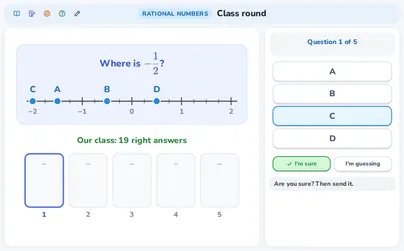
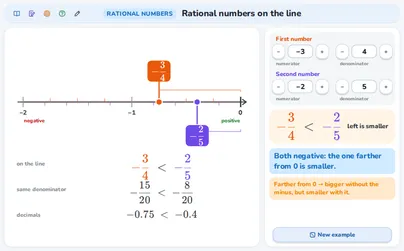
Rational numbers on the line: compare and order

  • Placing positive and negative fractions on the number line
  • Comparing two rational numbers: farther left is smaller
  • Seeing that −3/4 < −1/2 although 3/4 > 1/2

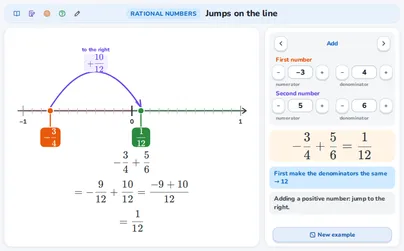
Jumps on the line: add and subtract

  • Adding and subtracting positive and negative fractions
  • Making denominators the same first
  • Showing a sum as a jump on the number line
  • Knowing that subtracting is adding the opposite

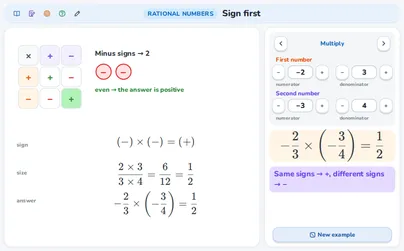
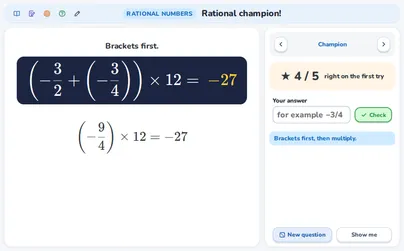
Sign first: multiply and divide

  • Multiplying and dividing positive and negative fractions
  • Finding the sign first: same signs +, different signs −
  • Dividing by a fraction by multiplying by its reciprocal

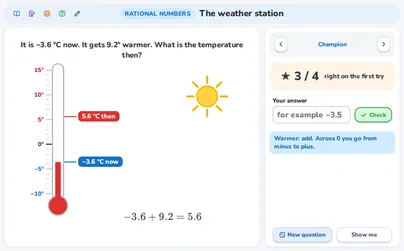
The weather station: temperatures below zero

  • Calculating with temperatures below zero, also with decimals
  • Finding the difference between a high and a low temperature
  • Working out a steady drop over a few hours
  • Finding the average of positive and negative numbers

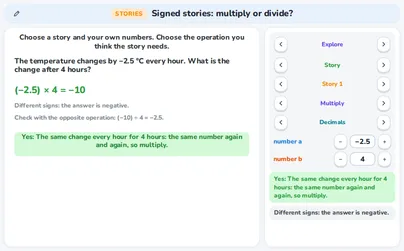
Signed stories: multiply or divide?

  • Deciding from a story whether to multiply or divide
  • Giving the sign of an answer first, then its size
  • Checking an answer with an estimate or the opposite operation