İnteraktif Dersler

Quadratic, cubic and geometric sequences

Lecture notes

Definition

First and second differences

The 1st differences are the jumps between terms next to each other. The 2nd differences are the jumps between the 1st differences.
1491625u3579Δ222Δ²
Example
Differences of :
13610u234Δ11Δ²
Definition

A quadratic sequence

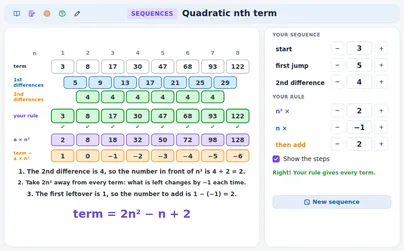
When the 2nd differences are all the same (and not 0), the sequence is quadratic. Its nth term has an n² in it.
12345102030nu
Example
Is quadratic? → the 2nd differences are the same: yes
13713u246Δ22Δ²
Definition

A cubic sequence

When the 3rd differences are all the same, the sequence is cubic: its nth term has an n³ in it.
182764125u7193761Δ121824Δ²66Δ³
Example
The 3rd difference is 6 → cubic
3102966u71937Δ1218Δ²6Δ³
Definition

A geometric sequence

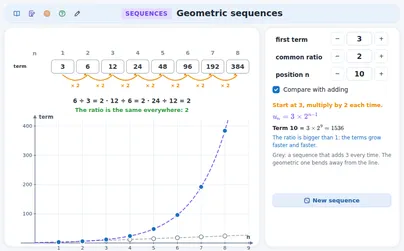
In a geometric sequence every term is the term before times the same number, the common ratio r.
361224×2×2×2
Example
In every term is 3 times the term before.
51545135×315÷5×345÷15×3135÷45
Rule

The number in front of n²

For a quadratic sequence the number in front of n² is the 2nd difference divided by 2.
3122748u91521Δ66Δ²÷2=3
Example
All 2nd differences are 8. →
4163664u122028Δ88Δ²÷2=4
Rule

The nth term of a quadratic sequence

Step 1: a = 2nd difference ÷ 2. Step 2: subtract a × n² from every term. Step 3: what is left is a linear sequence bn + c. For 5, 12, 21, 32 the rest is 4, 8, 12, 16.
u5122132n²14916u−n²481216
Example
has 2nd difference 2, so a = 1. Take away:, so
u271423n²14916u−n²1357
Rule

The number in front of n³

For a cubic sequence the number in front of n³ is the 3rd difference divided by 6.
182764125u7193761Δ121824Δ²66Δ³÷6=1
Example
All 3rd differences are 12. →
21654128250u143874122Δ243648Δ²1212Δ³÷6=2
Rule

The common ratio

Divide any term by the term before it. The answer is the same everywhere.
6122448×212÷6×224÷12×248÷24
Example
In divide a term by the one before: → r = 3
41236×312÷4×336÷12
Rule

The nth term of a geometric sequence

Term n = first term × ratio^(n − 1). The power is one less than the position.
3612244812345n×2×2×2×2×2⁴
Example
Term 6 of (first term 2, ratio 3):
2618…486123…6n×3⁵
Tip

Square and cube numbers

n² gives 1, 4, 9, 16, … (2nd differences 2). n³ gives 1, 8, 27, 64, … (3rd differences 6).
9
Example
The 5th square and the 5th cube:
25
Tip

Check with the first terms

Put n = 1, 2, 3 in your rule: you must get the first terms.
n123u51221✔✔✔
Example
Rule for ✔ ✔ ✔
n123u2714✔✔✔
Tip

Look at the graph

The points of a linear sequence lie on a straight line. A quadratic sequence lies on a parabola. A geometric sequence bends up (or down) faster and faster.
3510nu31020nu348nu
Example
The terms of are .The points lie on a parabola:
123102040nu432
Watch out!

Do not forget to halve

The number in front of n² is half of the 2nd difference, not the 2nd difference itself. A 2nd difference of 2 gives n², not 2n².
14916u357Δ22Δ²÷2=1
Example
The 2nd difference is 6.✘ ✔ →
4132849u91521Δ66Δ²÷2=3
Watch out!

A geometric sequence multiplies

The sequence 2, 6, 18, 54 has ratio 3, not 4: 6 − 2 = 4 is only the 1st difference.
261854×36−2×318−6×354−18
Example
The ratio of :✘ ✔
51545×315−5×345−15
Watch out!

The power is n − 1

Term 4 of 3, 6, 12, 24 is 3 × 2³ = 24, not 3 × 2⁴ = 48.
3612241234n×2×2×2×2³
Example
Term 4 of :✘ ✔
51020401234n×2×2×2×2³
Special case

A 2nd difference of 0

If the 2nd differences are all 0, the sequence is linear, not quadratic.
2222u000Δ00Δ²
Example
The sequence is linear:
491419u555Δ00Δ²
Special case

A negative or small ratio

With ratio −2 the terms switch between plus and minus. With ratio 0.5 the terms get smaller: 16, 8, 4, 2.
3−612−24×−2×−2×−216842×0.5×0.5×0.5
Example
Ratio −3 from 2:
2−618×−3×−3
Special case

Sequences in real life

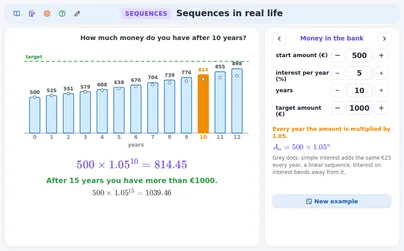
Handshakes at a party of n people are a quadratic sequence. Money with interest on interest is a geometric sequence.
Example
A plant has 3 cells and the cells double every hour. After 5 hours: cells
3612…96012…5h×2⁵

Exercises

Find the 1st and 2nd differences of What kind of sequence is it? Easy
25101726u
Show solution
1st differences:
25101726u3579Δ
2nd differences: : all the same
25101726u3579Δ222Δ²
Answer → the 2nd differences are 2: quadratic
Check: gives .
Find the nth term of Medium
4112237u
Show solution
1st differences: . 2nd differences:
4112237u71115Δ44Δ²÷2=2
, so the rule starts with
Subtract : , , ,
u41122372n²281832u−2n²2345
What is left, , is
Answer →
Check: gives .
The nth term of a sequence is . What is term 10? Medium
103n²−2n+5?
Show solution
Put in the rule:
10n²100×3300
300−20280+5285
Answer →
Check: term 1 is .
Find the common ratio and term 8 of Hard
5102040…1234…n
Show solution
The ratio:
5102040×210÷5×2×2
Term 8 = (the power is )
510…64012…8n×2⁷
Answer → ratio 2; term 8 is
Check: term 4 is .
Is 66 a term of ? If yes, which term? Hard
361118…661234…?n
Show solution
1st differences . 2nd differences , so
361118u357Δ22Δ²
Subtract : , , , : the rule is
u361118n²14916u−n²2222
, so and : a whole number, so yes
66−264√8
Answer → yes, term 8
Check: .
Are you a teacher?

Start live lessons with these applications for your whole class. Free to try for one month.

Try it free

Fits these school years

IB (MYP, Diploma): MYP 4, MYP 5

Cambridge International: IGCSE, AS Level

Netherlands: Vwo · Mathematics A, Vwo · Mathematics C, Vwo · Mathematics D

Türkiye (MEB): Year 9 (MEB), Year 10 (MEB), Year 11 (MEB)

England (GCSE, A Level): Year 10 (GCSE), Year 11 (GCSE)

USA (Common Core): Algebra 1, Algebra 2
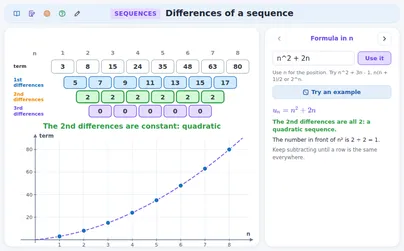
What the applications of this topic teach 4 applications

Differences of a sequence

  • Finding the 1st, 2nd and 3rd differences of a sequence
  • Telling from the differences if a sequence is linear, quadratic or cubic
  • Knowing that the number in front of n² is half the 2nd difference

Find the nth term of a quadratic sequence

  • Finding the number in front of n² from the 2nd difference
  • Subtracting a × n² and finding the remaining linear sequence
  • Writing the nth term a × n² + b × n + c and checking it

Geometric sequences

  • Finding the common ratio of a geometric sequence
  • Finding any term with first term × ratio^(n − 1)
  • Seeing how the graph of a geometric sequence differs from a linear one

Quadratic and geometric sequences in real life

  • Using a quadratic sequence in real life, such as handshakes
  • Using a geometric sequence in real life: bouncing ball, interest
  • Telling when a situation adds the same and when it multiplies