Read, follow and write algorithms
Lecture notes
Input and output
Variable
Flowchart
Step list
The four shapes
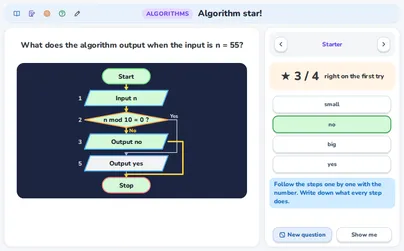
Follow the steps in order
A question (decision)
mod: the remainder
A loop
Trace table
The number of rounds
Write your own algorithm
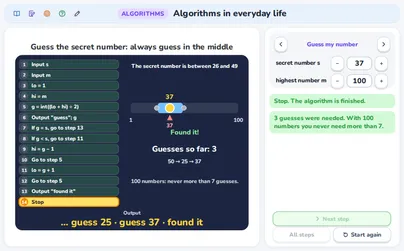
Guess in the middle
The limits of an algorithm
Improve an algorithm
Test with small numbers
Write down the letters
Algorithms are everywhere
The order matters
Count the rounds carefully
Yes and No
A loop that never stops
Dividing by 0
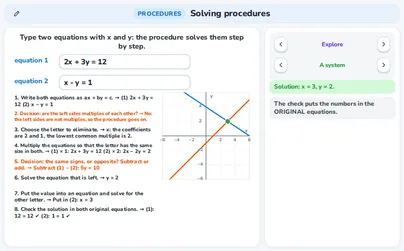
A procedure for a system: elimination
A procedure for a quadratic: factorise and use the zero product rule
Exercises
Show solution
Show solution
Show solution
Show solution
Show solution
Interactive applications for this topic
Free applications open with a free student account. Teachers can use all applications in a live lesson.
Start live lessons with these applications for your whole class. Free to try for one month.
Try it freeFits these school years
IB (MYP, Diploma): PYP, MYP 1, MYP 2, MYP 3, MYP 4, MYP 5
Cambridge International: Primary, stage 5, Primary, stage 6, Lower Secondary, stage 7, Lower Secondary, stage 8, Lower Secondary, stage 9, IGCSE
Netherlands: Groep 7, Groep 8, Year 2, Year 1, Year 3 (havo, vwo), Havo · Mathematics A, Havo · Mathematics B, Vwo · Mathematics A, Vwo · Mathematics B, Vwo · Mathematics C
Türkiye (MEB): Year 5 (MEB), Year 6 (MEB), Year 7 (MEB), Year 8 (MEB), Year 9 (MEB), Year 10 (MEB)
England (GCSE, A Level): Year 5, Year 6, Year 7, Year 8, Year 9, Year 10 (GCSE), Year 11 (GCSE)
USA (Common Core): Grade 5, Grade 6, Grade 7, Grade 8, Algebra 1
What the applications of this topic teach 6 applications
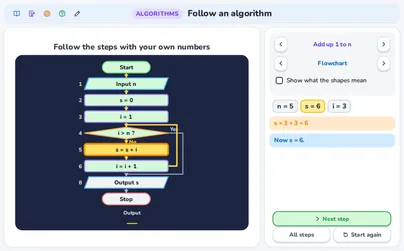
Follow an algorithm
- Following an algorithm step by step
- Reading a flowchart and a step list
- Knowing what a Yes or No question does in an algorithm
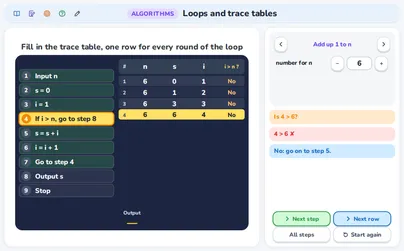
Loops and trace tables
- Following a loop round by round
- Filling in a trace table
- Saying how many times a loop goes round
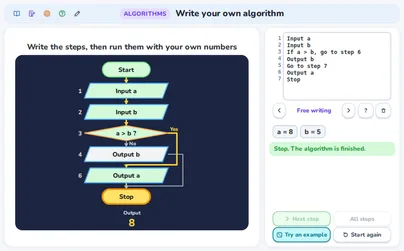
Write your own algorithm
- Writing an algorithm as a list of steps
- Drawing the steps as a flowchart
- Running and testing an own algorithm
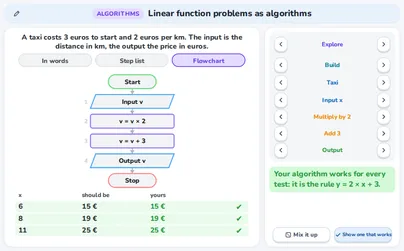
Linear function problems as algorithms
- Explaining the steps of a linear function problem: input x, output y
- Putting the steps in the right order to make one algorithm
- Showing one algorithm as words, step list and flowchart
Algorithms in everyday life
- Seeing algorithms in a cash machine, a game and a shop
- Following an algorithm with a decision and a loop
- Knowing why guessing in the middle is fast
- Improving an algorithm and counting the steps before and after
Solving procedures: a system and a quadratic step by step
- Following a procedure for a system of two equations
- Following the steps for a quadratic equation
- Saying what 0 = 5 and 0 = 0 tell about a system