İnteraktif Dersler

Sequences and sums

Lecture notes

Definition

A sequence and its direct formula

A sequence is a list of numbers in a fixed order. The term with number n is written or . A direct formula gives a term in one calculation from its number, for example . The first number can be or : always say which one you mean. A calculator table shows n, the term, the difference between neighbouring terms and the sum so far. In Direct formula you type the formula and read the table and the graph of the points.
Example
With and n starting at 1 the terms are 5, 8, 11, 14, 17, … and . Starting at the same formula begins with , and a(10) is still 32, but it is now the eleventh term, not the tenth.
na(n)DifferenceSum15·528313311324414338517355620375
Definition

The recursive formula

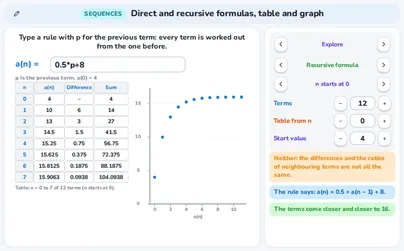
A recursive formula tells you how to get a term from the term before it, and it gives the start value. For example and . You work step by step: a(2) needs a(1), a(3) needs a(2). A rule of the form takes r times the previous term and adds d. With the sequence is arithmetic, with it is geometric. For r between −1 and 1 the terms settle at . In Recursive formula you type the rule with p for the previous term.
Example
With and : , then , and . The rule with gives 4, 10, 13, 14.5, 15.25, … and settles at .
24681004.5913.51816na(n)
Rule

An arithmetic sequence

In an arithmetic sequence you add the same number d every time: the difference d. Recursive: . Direct, with n starting at 1: ; with n starting at 0: . The number of steps from the first term to a(n) is (or n). The points of the graph lie on a straight line. In Both ways you see both formulas side by side.
Example
First term 7 and difference 4: 7, 11, 15, 19, … so and . For which n is ? From 7 to 135 is , and steps, so .
12345678010203040na(n)
Rule

A geometric sequence

In a geometric sequence you multiply by the same number r every time: the ratio r. Recursive: . Direct, with n starting at 1: ; with n starting at 0: . The points of the graph lie on a curve. A ratio between 0 and 1 makes the terms smaller (a percentage decrease), a ratio above 1 makes them grow (a percentage increase) and a negative ratio switches the sign each time.
Example
First term 5 and ratio 3: 5, 15, 45, 135, 405, … and . A decrease of 10 per cent each time is the ratio 0.9: with n from 1 gives 90, 81, 72.9, 65.61, …
123456037575011251500na(n)
Rule

Which kind of sequence?

To decide, work out the differences and the ratios of neighbouring terms. All differences equal: arithmetic. All ratios equal: geometric. Neither: another kind of sequence. If all terms are the same, both are true (difference 0, ratio 1). Check every pair of neighbours, not only the first one. The calculator table of Direct formula says which kind it is.
Example
3, 7, 11, 15: the differences are , and , so it is arithmetic. 2, 6, 18, 54: the ratios are , and , so it is geometric. 1, 4, 9, 16: the differences are , and and the ratios are , and : neither.
Definition

The sum sequence S(n)

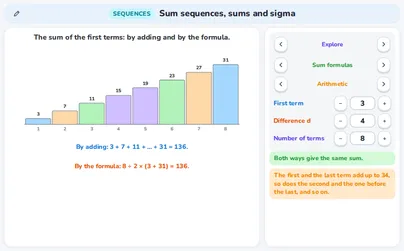
S(n) is the sum of the first n terms: (if n starts at 0, the sum starts at a(0)). The sums S(1), S(2), S(3), … form a sequence of their own: the sum sequence. You get the next sum by adding a term: , so . In Sum sequence you type a(n) and see the terms, the sums and the graph of both.
Example
For a(n) = 2n + 1 the terms are 3, 5, 7, 9, 11, … and the sums are 3, then , , and . Check: .
na(n)DifferenceSum13·325283721549224511235613248
Rule

The sum of an arithmetic sequence

Add the first and the last term, the second and the one before the last, and so on: every pair has the same total. With n terms there are pairs, so . The last term is . With an odd number of terms the middle term stays alone. In Sum formulas you add the terms and use the formula and see that the two agree.
Example
The terms 5, 9, 13, 17, … up to 41 (first term 5, difference 4, 10 terms): , , … there are 5 pairs, so the sum is . By the formula: . With 7 terms 3, 5, …, 15 the first and the last make and , which is (the middle term is 9).
5913172125293337414646464646
Rule

The sum of a geometric sequence

For a geometric sequence with first term a(1) = first and ratio r (not 1): . If every term is equal to the first term and . The formula saves you adding many terms, but you may also add term by term: both give the same sum. In Sum formulas choose the geometric kind.
Example
First term 3, ratio 2, 8 terms: . By the formula: , because . With the ratio 1: six terms of 4 give . With the ratio 0.5: for 5 terms.
Definition

The sigma notation

The sign Σ (sigma) means: add. Under it stands the first value of k, above it the last value, and behind it the expression in k. The number of terms is the upper limit − the lower limit + 1. The same sum can be written with other limits if you change the expression. In Sigma notation you type the expression and the limits and see the terms written out.
Example
: the number of terms is . With k from 0 to 4 the same sum is : , with terms. Another one: with terms.
Σ5k = 1(2k + 1)3 + 5 + 7 + 9 + 11 = 35
Rule

A savings plan as a recursive formula

In a savings plan every period the amount grows by the interest and a deposit is added. With p per cent interest the amount is multiplied by : . Paid in: . The rest of the amount is interest. In Savings plan you choose the start amount, the deposit, the interest and the number of periods and see the table and the graph.
Example
Start €1 000, interest 5 per cent (ratio 1.05) and €200 every year: , then and . After 3 years €1 600 is paid in , so the interest is .
nAmountPaid inInterest01000100001125012005021512.51400112.531788.131600188.1342077.531800277.5352381.412000381.41
Tip

Two plans and the target sum

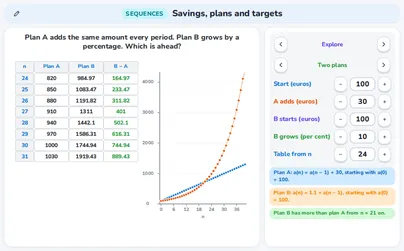
Compare an arithmetic plan A (the same amount every time) with a geometric plan B (a percentage every time) in a table: when is B ahead? That is Two plans. For a target sum find the smallest n with S(n) at least the target: try the sum formula. That is Target sum.
Example
Plan A: 500, plus 100 a week. Plan B: 50, doubled every week. Week 4: A has 900, B has 800. Week 5: A has , B has : B is ahead from week 5. Target: 20 seats in row 1, 2 more in every next row, at least 400. is too small; is enough: rows.
012345045090013501800weekAmount
Watch out!

Common slips

Count the steps, not the terms: from the first term to the term with number n there are steps if n starts at 1, and n steps if n starts at 0. With n from 0, a(3) is the fourth term. In a geometric sequence the power is (or n), not . Do not forget the division by 2 in a sum formula and do not mix up d and r.
Example
First term 7, difference 4. With n starting at 1: (9 steps). With n starting at 0 the first term is , so (10 steps).
Tip

Typing a formula, keys and privacy

Type a direct formula in n, for example 2n+3, 5*2^n or (n-1)^2; use ^ for a power and a point or a comma for a decimal. A sigma expression uses the letter k and a recursive rule uses p for the previous term. If a formula cannot be read, the application says so. The situations and numbers are made up and original. Everything you type is checked in your browser and nothing is stored or sent anywhere. Every stepper, choice and button works by keyboard: Tab moves to the next one, Enter or the space bar presses it.
Example
Typing 3n+2 and choosing n from 1 gives a table with the terms 5, 8, 11, 14, 17, …; the rule p+5 with start 6 gives 6, 11, 16, 21, … (, then add 5 each time).
Rule

A series that settles: partial sums and the common ratio

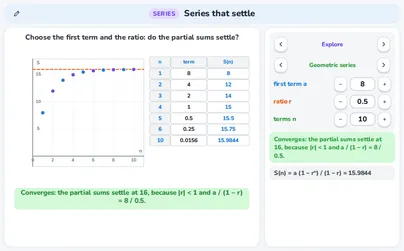
A series is the sum of the terms of a sequence; its partial sums S(n) are the sums of the first n terms. A geometric series with first term a and ratio r settles at the number a ÷ (1 − r) when |r| < 1: the terms get smaller and smaller. When |r| is 1 or more the sums never settle. An arithmetic series settles only when every term is 0. In Geometric series you choose a and r and see the sums and the limit line.
Example
12 + 6 + 3 + … has a = 12 and r = 1/2, so the sums settle at 12 ÷ (1 − 1/2) = 24. After 5 terms S(5) = 23.25 and the gap to 24 is 24 − 23.25 = 0.75. With a = 3 and r = 2 the sums 3, 9, 21, … grow without limit.
1234567806.51319.52624nS(n)

Exercises

A sequence has the direct formula and n starts at 1. What is a(12)? Easy
Show solution
Replace n by 12 in the formula.
.
.
Check the start: and , so the difference is 4.
A sequence starts with and every next term is 5 more: . What is a(8)? Easy
Show solution
Work step by step: 11, 16, 21, … 5 more each time.
From a(1) to a(8) are 7 steps of 5: .
.
The number of steps is , not 8.
Look at the sequence 5, 10, 20, 40, 80, … What kind is it, and what is a(7) (n starts at 1)? Easy
Show solution
The differences are 5, 10, 20, 40: not equal. The ratios are , , , : all equal, so it is geometric with ratio 2.
The direct formula is . The power is .
.
A geometric sequence with ratio 2; .
From the first term to the seventh there are 6 steps, so the power is 6 and not 7.
An arithmetic sequence has first term 12, difference 3 and 15 terms. What is the sum of all the terms? Medium
Show solution
Find the last term: .
The first and the last term make .
.
The sum is 495.
The last term needs steps of 3, not 15 steps.
A geometric sequence has first term 2 and ratio 3. What is the sum of the first 7 terms? Medium
Show solution
Use with first = 2, and .
The power is .
.
The sum is 2 186.
Check by adding: (the last term is ).
Work out . Medium
Show solution
Count the terms: .
The first term () is and the last term () is .
The terms have the difference 2: arithmetic, so .
The sum is 77.
Do not count terms: both limits belong to the sum.
A savings account starts with €2 000. Every year the amount grows by 4 per cent and then €150 is added: and . What is a(3), rounded to two decimals, and how much of it is interest? Hard
Show solution
Work out the years one by one: .
.
.
Paid in: , so the interest is .
euros, of which 267.97 is interest.
Round only at the end: do not round after every year.
Plan A starts with €200 and adds €60 every week. Plan B starts with €10 and doubles every week. In which week (the start is week 0) does B have more than A for the first time? Hard
Show solution
Plan A is arithmetic: . Plan B is geometric: . Make a table of both.
Week 4: A has and B has . Week 5: A has 500 and B has 320.
Week 6: A has and B has : B is ahead for the first time.
In week 6.
From then on B stays ahead: in week 7 A has 620 and B has 1 280, in week 8 A has 680 and B has 2 560.
In year 1 Noor saves €500. Every next year she saves €50 more than the year before. After how many years has she saved at least €10 000 in total? Hard
Show solution
The amounts form an arithmetic sequence (first term 500, difference 50), so .
Try : . That is below 10 000.
Try : . That is at least 10 000.
After 13 years.
In year 13 she saves ; the total jumps from 9 300 to 10 400.
Are you a teacher?

Start live lessons with these applications for your whole class. Free to try for one month.

Try it free

Fits these school years

IB (MYP, Diploma): MYP 4, MYP 5, Diploma, year 1, Diploma, year 2

Cambridge International: AS Level, A Level

Netherlands: Vwo · Mathematics A, Vwo · Mathematics C

Türkiye (MEB): Year 11 (MEB), Year 12 (MEB)

England (GCSE, A Level): Year 12 (A Level), Year 13 (A Level)

USA (Common Core): Algebra 2, Precalculus

What the applications of this topic teach 4 applications

Direct and recursive formulas, table and graph

  • Telling arithmetic, geometric and other sequences from a formula
  • Seeing how starting at 0 or at 1 changes the terms
  • Writing the recursive and the direct formula of a sequence

Sum sequences, sums and sigma

  • Seeing that S(n) − S(n − 1) is the term a(n)
  • Adding an arithmetic or geometric sequence by formula
  • Reading an expression with the sigma sign

Savings, plans and targets

  • Writing a savings plan as a recursive formula with interest and a deposit
  • Comparing adding a fixed amount with growing by a percentage
  • Finding the smallest n for which the sum S(n) reaches a target

Series that settle: partial sums and the common ratio

  • Telling from the common ratio if the partial sums settle
  • Working out the limit a ÷ (1 − r) when |r| < 1
  • Explaining why an arithmetic series never settles