İnteraktif Dersler

Triangle proofs: angles and sides

Lecture notes

Definition

Theorem and proof

A theorem is true for every case of its kind. A proof is a chain of lines: each has a reason and uses only what is given or the lines above it.
Example
One line of a proof and its reason. (alternate angles)
Rule

Angle sum of a triangle

The three angles of a triangle add up to 180°, in every triangle. If two angles are known, subtract their sum from 180°.
abcABC
Example
A triangle has angles 48° and 61°. How large is the third?
48°61°xABC
Rule

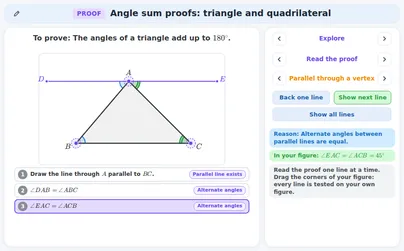
Proof: a parallel line

Draw the line through A parallel to BC. Alternate angles put b and c next to a, and the three fill a straight line.
abcbcABC
Example
A triangle has B = 56° and C = 37°.
a56°37°56°37°ABC
Rule

Proof: a half-turn

Turn the triangle 180° about M, the midpoint of BC: a parallelogram ABA'C. At B the angles b and c lie side by side and, with a, they are co-interior.
abcABCA'M
Example
A triangle has a = 50°. Then b and c together fill the rest.
50°bcABCA'M
Rule

Exterior angle

An exterior angle is made by a side and the extension of the next side. It equals the two remote interior angles together.
abeABC
Example
In triangle ABC, A = 70° and B = 60°. Find the exterior angle at C.
70°60°eABC
Rule

Exterior angles add up to 360°

Take one exterior angle at each corner. Each is 180° minus an interior angle, so together they are 3 × 180° − 180°.
yzxABC
Example
Two exterior angles of a triangle are 130° and 120°. Find the third.
120°130°110°ABC
Rule

Quadrilateral: 360°

A diagonal inside a quadrilateral cuts it into two triangles. Their angles together are the four angles of the quadrilateral.
ABCD
Example
Three angles of a quadrilateral are 85°, 110° and 70°. Find the fourth.
85°110°70°xABCD
Rule

Larger side, larger angle

In a triangle the larger angle is opposite the larger side, and the other way round. Equal sides lie opposite equal angles.
ABC
Example
A = 44°, B = 57°, C = 79°. Which side is the shortest and which the longest?BC is across 44° (shortest), AB across 79° (longest)
44°57°79°ABC
Rule

Proof: the larger side

Let AB > AC. Mark D on AB with AD = AC: triangle ACD is isosceles and ∠ADC is an exterior angle of triangle DBC.
ddABCD
Example
AB = 8 and AC = 5: D lies 5 from A., so
53ABCD
Rule

Triangle inequality

Every side is shorter than the other two together. So the third side lies between the difference and the sum of the other two.
abcABC
Example
Two sides are 4 and 9. Between which numbers lies the third side x?, so
x49ABC
Rule

Proof: extend a side

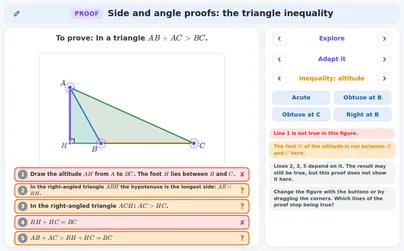
Extend AB beyond B to D with BD = BC. Then ∠BCD = ∠BDC and ∠ACD is larger, so in triangle ACD the side opposite it is larger.
yABCD
Example
AB = 6, BC = 4, AC = 7. Extend AB to D with BD = 4.
6447ABCD
Rule

Proof by contradiction

To show AB > AC when ∠C > ∠B, suppose AB ≤ AC. AB = AC gives ∠C = ∠B and AB < AC gives ∠C < ∠B: both clash with the given.
Example
C = 70° and B = 50°. Suppose AB ≤ AC. or , but , so
Rule

Congruence: the statement and the conditions

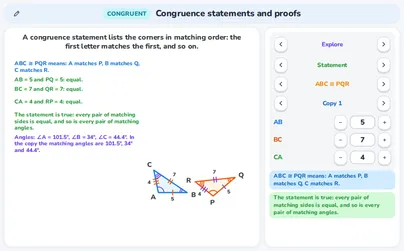
Two triangles are congruent when a slide, a turn or a reflection maps one onto the other. A congruence statement like ABC ≅ PQR lists the corners in matching order: A matches P, B matches Q and C matches R. Three sides (SSS), two sides and the angle between them (SAS), two angles and a side (ASA or AAS) and, in a right triangle, the hypotenuse and a side (RHS) are enough. Three angles (AAA) are not, and two sides with an angle not between them (SSA) can fit two triangles. The application "Congruence statements and proofs" has Statement, Conditions and Build the proof.
Example
Triangles ABC and PQR have a = 5, b = 7 and ∠A = 40°. Compare a with b × sin A: the value of b × sin 40° is about 4.50, and 4.50 < 5 < 7, so 2 different triangles fit (∠B ≈ 64.1° or 115.9°): SSA is not enough. If ∠A = 50° and ∠B = 60°, then ∠C = 180° − 50° − 60° = 70°.
Tip

The order of a proof

The drawing or the supposition comes first. A line uses only lines above it and the last line is the theorem. Two lines that do not use each other can swap.
Example
Parallel line proof: line 1 draws, lines 2, 3 and 4 use line 1, line 5 uses 2, 3 and 4.Good: 1 2 3 4 5 and 1 4 3 2 5; not 2 1 3 4 5
Watch out!

A check is not a proof

Measuring many triangles, or tearing off the corners of one, shows an idea but proves nothing: you cannot measure every triangle and a measurement is never exact.
Example
✘ I measured 50 triangles, every sum is about 180°: proved.✔ A proof with reasons: for every triangle
Special case

A proof can break

In a quadrilateral with a dent the diagonal AC can lie outside. The lines that cut the angles at A and C fail: the sum is still 360°, but this proof does not show it.
ACDB
Example
A dent at B: A = 30°, C = 30°, D = 50°., larger than a straight angle
ACDB30°30°50°
Special case

The foot of the altitude

The altitude proof uses BH + HC = BC, so the foot H must lie between B and C. With an obtuse angle at B it does not and the proof fails. The extension proof has no such condition.
ABCH
Example
Angle B = 120°, AB = 4, BC = 5: the foot is 2 beyond B, so HC = 7.
27ABCH

Exercises

Two angles of a triangle are 47° and 68°. Find the third angle. Easy
47°68°xABC
Show solution
The three angles add up to .
Answer → 65°
Check:
In triangle , and . How large is the exterior angle at ? Easy
64°41°xABC
Show solution
The exterior angle is the sum of the two remote interior angles, and .
Answer → 105°
Check: and
A triangle has the angles , and . Which side is the longest? Easy
40°75°65°ABC
Show solution
The longest side is opposite the largest angle.
The largest angle is .
The side opposite is .
Answer →
The shortest side is opposite : it is .
The exterior angle at of a triangle is 125° and . Find and the interior angle at . Medium
x48°125°yABC
Show solution
The exterior angle is , so .
The interior angle at lies next to the exterior angle on a straight line: .
Answer → ,
Check:
In the parallel line proof the line is written, and later . Give the reason of each line. Medium
Show solution
and lie on the line through parallel to . The angles and lie between the parallel lines on opposite sides of .
The three angles , and lie side by side along the straight line .
Answer → alternate angles; angles on a straight line
Without the parallel line there would be no equal angles and no straight line to use.
Can a triangle have the sides 5 cm, 6 cm and 12 cm? Medium
Show solution
Add the two shorter sides: .
Compare with the longest side: .
The two shorter sides together are too short, so the sticks do not close.
Answer → no
One pair that fails is enough to say no; for a yes you must check all three pairs.
Two sides of a triangle are 7 cm and 10 cm. How many whole numbers of centimetres can the third side be? Medium
Show solution
The third side lies between and .
, so can be 4, 5, ..., 16.
From 4 to 16 there are numbers.
Answer → 13
The ends 3 and 17 are not allowed: the triangle would be flat.
Two exterior angles of a triangle are 110° and 125°. Find the third exterior angle and the three interior angles. Medium
Show solution
The exterior angles add up to : .
Each interior angle is minus its exterior angle: , and .
Answer → exterior 125°; interior 70°, 55°, 55°
Check:
The angles of a quadrilateral are , , and (in degrees). Find and the four angles. Hard
xx+202x2x+10
Show solution
The four angles add up to (two triangles).
, so .
The angles are 55°, 75°, 110° and 120°.
Answer → ; 55°, 75°, 110°, 120°
Check:
In triangle the angle at is 120°, and . The altitude proof of uses . Does this hold here? Hard
27ABCH
Show solution
The angle at is obtuse, so the foot lies on the extension of , beyond .
, so and .
, but .
Answer → no: is outside and , so this proof fails
Use the proof by extension: it works for every triangle.
A triangle has the sides , and . Show that the triangle exists and put the angles , , in order from large to small. Hard
1297ABC
Show solution
Check all three pairs: , and .
The longest side is , opposite .
Then , opposite , and the shortest , opposite .
Answer →
The largest angle is opposite the longest side.

Interactive applications for this topic

Free applications open with a free student account. Teachers can use all applications in a live lesson.

About the free account and Plus

Are you a teacher?

Start live lessons with these applications for your whole class. Free to try for one month.

Try it free

Fits these school years

IB (MYP, Diploma): MYP 4, MYP 5

Cambridge International: Lower Secondary, stage 9, IGCSE

Netherlands: Year 1, Year 2, Vwo · Mathematics C, Year 3 (havo, vwo)

Türkiye (MEB): Year 9 (MEB), Year 10 (MEB)

England (GCSE, A Level): Year 9, Year 10 (GCSE), Year 11 (GCSE)

USA (Common Core): Geometry

What the applications of this topic teach 3 applications

Angle sum proofs: parallel lines, a half-turn, the exterior angle

  • Reading three proofs of the angle sum of a triangle
  • Showing an exterior angle equals the two remote interior angles
  • Putting the lines of a proof in a good order
  • Knowing that measuring is a check, not a proof

Side and angle proofs: the larger side, the triangle inequality

  • Proving the larger side lies opposite the larger angle
  • Reading two proofs of the triangle inequality
  • Following a proof by contradiction

Congruence statements and proofs

  • Writing a congruence statement with corners in matching order
  • Saying which data show congruence, and why SSA and AAA do not
  • Marking equal parts and reading a proof with reasons