İnteraktif Dersler

Antiderivatives

Lecture notes

Definition

An antiderivative undoes the derivative

A function is an antiderivative of if its derivative is : . To find one, ask: which function has as its derivative?
Example
For try : its derivative is ✔.So is : the disappears when you differentiate.
Definition

The family F + C

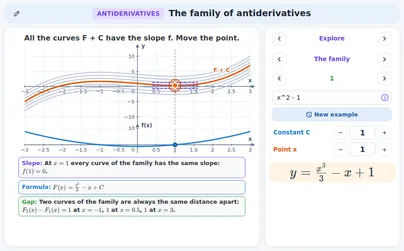
If is an antiderivative of , so is for every constant , because a constant has the derivative . On an interval these are all the antiderivatives: a family of curves, each one the same curve moved up or down. At every they have the same slope , and two of them are always the same distance apart.
xy7
Example
has the antiderivatives , and .At all three have the slope . The outer two are always apart.
Rule

The integral sign

The family of all antiderivatives is written with an integral sign: . Read it as “the integral of with respect to ”. The says which letter is the variable. Finding is called integrating.
Example
.Check by differentiating: , and the disappears.
Rule

The constant from a point

One point on the curve fixes the constant. Four stages: (1) write the family ; (2) put in the point; (3) solve for ; (4) write the curve with its . A point and a slope function give exactly one curve.
xy320
Example
The slope is and the curve passes through .(1) . (2) At the term is , so . (3) . (4) .
Rule

The power rule

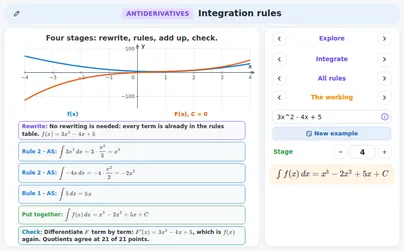
Raise the power by and divide by the new power: for . A constant is a multiple of : . These are rules 1 and 2 of the rules table.
Example
: the power becomes and .So , and .
Rule

Sums and constant multiples

Integrate a sum or a difference term by term, and take a constant factor out: . One constant at the end is enough. This is rule 3 of the rules table.
Example
.With : .
Tip

Roots and reciprocals are powers

Rewrite before you integrate: , , . Then the power rule applies. Do this as the first stage of every problem.
Example
: write it as . and , so the answer is .
Watch out!

Negative and fractional powers

The power rule works for every , also for negative and fractional , but the new power is and you divide by it, sign included. For the new power is (not ) and you divide by . Dividing by a fraction means multiplying by its inverse.
Example
: ✘ (the sign is lost) or (the power went down). ✔ .: the new power is . ✘ (multiplied instead of divided). ✔ .
Rule

Inside ax + b: divide by a

This is the chain rule turned round. If the inner function is , the derivative of has an extra factor , so divide by as well: for . This only works for a linear inner function.
Example
.Why: , so divide by .
Rule

e^(ax+b), sine and cosine

The same factor appears in the rows of the exponential, the sine and the cosine:
Example
(because )..
Watch out!

The sign of sine and cosine

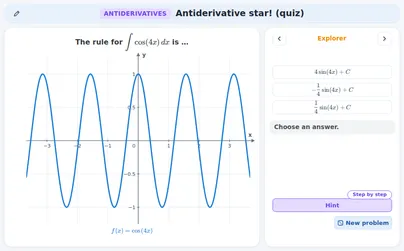
The derivative of is , so an antiderivative of has a minus sign: . For there is no minus: . Differentiate your answer to be sure.
xyπ
Example
: ✘ has the derivative . ✔ . (because ).
Rule

One over x

is the one power that the power rule cannot do (the next card says why). Its antiderivative is the natural logarithm: . With an inner function: .
Example
. (because ).
Watch out!

n = −1 has no power rule

For the power rule would give , which means nothing. The function needs its own antiderivative, . Look at the new power before you divide: if it is , stop and use the logarithm.
Example
: the new power is , so the answer is .: the new power is : no division is possible, use . (The slope of between and is , close to at .)
Watch out!

ln needs the absolute value

exists on both sides of , but only for . The antiderivative has two branches: for and for , and both have the derivative . Without the bars the answer is wrong for negative .
xy
Example
at : . The slope is , the same as .✘ does not exist.
Rule

More rules at A2 / HL

The rules table goes on with rows for A level and IB HL, each with the factor for an inner function : (also in Cambridge AS)Rules 11 to 13 (, , , , ) follow the same pattern.
Example
(because ).The derivative of is : that is why the factor is .
Tip

Expand brackets first

There is no rule for a product of general functions. When a product of polynomials appears, multiply it out and integrate term by term. Only a power of one linear bracket, , has its own rule.
Example
: , so the integral is and for .Two ways for : , or after expanding . They differ by , a constant: both are in the family.
Tip

Split a fraction

A fraction with a single term in the denominator is split into one fraction per term and simplified to powers of : . A sum in the denominator cannot be split like this.
Example
.With : .
Rule

Squares of sine, cosine and tangent

There is no rule for , or . Use an identity first: , , (and ). Then integrate.
Example
..
Watch out!

A product is not integrated factor by factor

The integral of a product is not the product of the integrals: . Multiply out first (card on brackets); later come substitution and integration by parts.
Example
and .✘ has , not .✔ , so and .
Tip

Check by differentiating

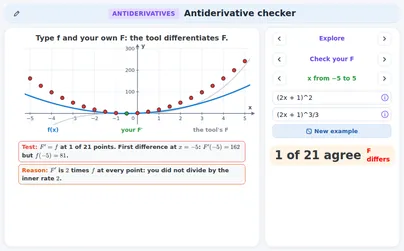
You can always test an answer: differentiate . If you get back, is an antiderivative. The applications do this check for you: they compute at points and compare it with .
Example
and : ✔.At : . A computer check at points between and agrees at of .
Watch out!

One point proves nothing

A wrong can have at one or two points by chance: one agreeing point proves nothing, while one point where they differ proves that is wrong. Test several points spread out, and best of all differentiate completely. For a polynomial is a polynomial: if it is at more points than its degree, it is everywhere.
xy21020
Example
and the wrong answer (the division by forgotten), so .At both are : they agree. At : but : wrong. Right: .
Watch out!

Do not forget + C

Without you give one antiderivative, not the whole family. That costs a mark, and it breaks every problem that uses the constant, such as a curve through a point or a start value.
Example
.If and : gives and . Without you cannot reach .
Watch out!

Do not forget to divide by a

Writing , or , forgets the inner rate. Differentiate to see it: the chain rule multiplies by , so the answer is times too big.
Example
: ✘ has the derivative , nine times .✔ .
Special case

Antiderivatives without a formula

Every continuous function has antiderivatives, but not every one has a formula made of the functions of the rules table. is the famous example: its antiderivative exists and can be computed, but it cannot be written with powers, exponentials, sines and logarithms. The applications then draw it from numbers and say so.
xy1xy1
Example
is an antiderivative of , found numerically: and .The tempting fails: the inner derivative is not a constant, so its derivative has an extra term.
Definition

Rate in, amount out

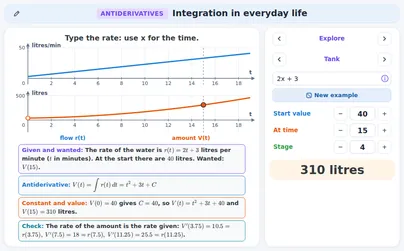
When is an amount and is its rate of change, then : the amount is an antiderivative of the rate, . The unit of the amount is the unit of the rate times the unit of time: litres per minute × minutes = litres.
tr329tV358
Example
A tank gets litres per minute and holds litres at the start. litres, so litres. Check: .
Rule

The constant is the start value

In a story the constant is what was there at the start: , the fixed cost, the start position. Put the start into to find , then read off the value you want and write its unit. A negative rate takes away.
xK150100
Example
A factory has the marginal cost euros per item and a fixed cost of euros. euros: is the fixed cost, and euros.
Tip

Which course needs what

Powers, sums, multiples and the constant from a point are asked in every course (Cambridge AS, UK AS and A level, IB SL, AP Calculus AB, vwo B). , , sine, cosine and with the factor come in Cambridge AS, IB SL and AP Calculus AB; in the UK they wait until A level. and the identities for , and are in Cambridge (AS and A2); the rows with , , and belong to IB HL.
Example
An exam asks: (every course), (Cambridge AS, IB SL, AP AB; UK A level), (Cambridge AS; IB HL).

Exercises

Find . Easy
Show solution
Raise the power by : becomes .
Divide by the new power : the coefficient is .
Do not forget the constant .
Check: the derivative of is .
A student says that is an antiderivative of . Is that right? If not, find an antiderivative. Easy
Show solution
Differentiate : .
is not , so is not an antiderivative of .
Raise the power to and divide by the new power : .
No. . An antiderivative is (plus any constant).
Check: the derivative of is .
Find an antiderivative of with and give . Easy
Show solution
Integrate term by term: gives (), gives () and gives .
So .
Put in : .
and
Check: .
The slope of a curve is and the curve passes through the point . Find the equation of the curve. Easy
Show solution
An antiderivative of is , so .
Put in the point: , so .
So .
Check: at : .
and are both antiderivatives of the same function . What is ? Easy
Show solution
Subtract: .
The cancels and .
The difference does not depend on .
at every : two antiderivatives of one function differ by a constant.
Check: both have the derivative .
A tank holds litres. A tap adds litres per minute. Write the amount after minutes and find . Easy
Show solution
The rate is the derivative of the amount: , so .
At the start , so .
.
litres and litres
Check: litres per minute × minutes = litres: litres are added to the .
Find and give for . Medium
Show solution
The inner function has the derivative : divide by as well as by the new power.
New power : .
.
;
Check: the derivative of is .
The slope of a curve is and the curve passes through . Find the equation of the curve. Medium
xy
Show solution
Integrate term by term: , so .
Put in the point: , where .
.
Check: at : .
Find and give for . Medium
Show solution
Write the root as a power: .
The new power is ; dividing by means multiplying by : .
, so .
;
Check: the derivative of is .
Find and give for . Medium
Show solution
Write the fraction as a power: .
The new power is . Divide by : . The sign changes.
, so .
;
Check: the derivative of is .
Find and give for . Medium
Show solution
An antiderivative of sine has a minus sign: .
The inner function has the derivative : divide by , and .
, so .
;
Check: the derivative of is .
A factory has the marginal cost euros per item and a fixed cost of euros. Find the cost function and the cost of items. Medium
Show solution
The marginal cost is the derivative of the cost: , so .
With no items the cost is the fixed cost: , so .
.
euros and euros
Check: euros, close to the marginal cost euros.
Find and give for . Hard
Show solution
A product is not integrated factor by factor: expand first. .
Integrate every term: .
.
;
Check: the derivative of is , the expanded product.
Find and give for . Hard
Show solution
Divide every term by : .
Integrate: gives ; gives .
.
;
Check: the derivative of is .
Find . Hard
Show solution
There is no rule for : use the identity .
So .
Integrate: gives , and gives .
Check: the derivative is .
A curve has the slope (for ) and passes through . Find its equation. Hard
Show solution
: the inner function has the derivative .
.
At : and , so .
Check: the derivative of is .
A student writes . Differentiate the answer, say what went wrong and give the right answer. Hard
Show solution
Differentiate: .
That is times : the student forgot to divide by the inner rate .
Divide by : .
The derivative is : the factor is missing. Right: .
Check: the derivative of is . At the wrong answer gives , but .
A tank holds litres. The net flow into the tank is litres per minute for ( in minutes). When is the tank fullest, and how much water does it hold then? Hard
tr96
Show solution
The amount is an antiderivative of the flow: , and gives .
The tank is fullest where the flow changes from positive to negative: , so and .
At minutes, with litres
Check: : after minutes the tank is back at its start amount.
Are you a teacher?

Start live lessons with these applications for your whole class. Free to try for one month.

Try it free

Fits these school years

IB (MYP, Diploma): Diploma, year 1, Diploma, year 2

Cambridge International: AS Level, A Level

Netherlands: Vwo · Mathematics B

England (GCSE, A Level): Year 12 (A Level), Year 13 (A Level)

USA (Common Core): Calculus

What the applications of this topic teach 4 applications

The family of antiderivatives

  • Seeing that all antiderivatives have the form F + C
  • Finding the curve of the family through a given point
  • Seeing that e^(−x²) has antiderivatives without a formula

Integration rules: reverse the derivative

  • Integrating a sum of powers, roots, e^(ax + b), sine and cosine
  • Explaining why to divide by a: the chain rule turned round
  • Saying why the power rule stops at n = −1 and what replaces it

Antiderivative checker: differentiate to test

  • Testing a proposed antiderivative by differentiating it
  • Telling a wrong factor, missing term or missing + C
  • Picking the right antiderivative from three candidates

Integration in everyday life

  • Turning a flow, marginal cost or velocity into an amount
  • Finding the constant from the start value
  • Checking that the rate of the amount function is the given rate