İnteraktif Dersler

Binomial distribution

Lecture notes

Definition

The binomial distribution

A binomial variable counts the successes in trials. Each trial succeeds with chance and fails with chance . We write ; takes the values .
012345678910
Example
A player takes 10 free throws and hits each with chance 0.7; is the number of hits., and can be any value from to .
Definition

The four conditions

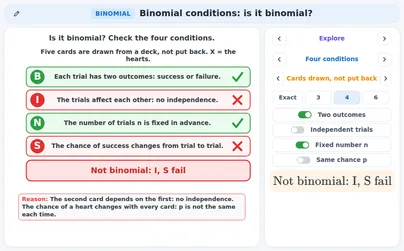
is binomial when four things hold: B each trial has two outcomes, success or failure; I the trials are independent; N the number of trials is fixed in advance; S the chance of success is the same every time. If one fails, is the wrong model.
Example
A 12-question quiz is guessed, 4 choices per question; is the number of right answers.Right or wrong (B) ✔, one answer does not change another (I) ✔, (N) ✔, every time (S) ✔ → .
Watch out!

Without putting back: not independent

Drawing without putting back makes the trials depend on each other: the pack or the bag changes after every draw. Then is not binomial, however many conditions look right.
Example
5 cards are dealt from a deck; is the number of hearts.✘ because of the cards are hearts.✔ After a heart the next card is a heart with chance , not : no independence.
Watch out!

Not binomial: n not fixed, or no count

Two more ways to fail: you stop when something happens (then is not fixed), or is a measurement, not a count of successes. Check B, I, N and S before you write .
Example
✘ A die is thrown until the first six; is the number of throws. Not : you stop at the six, so is not fixed.✘ is the temperature on 10 days. A temperature is a measurement, not a number of successes.
Rule

Without putting back: the second draw

A bag holds counters, of them red; the first draw is red with chance . If it is not put back, the second draw is red with chance after a red one. The chance changes, so the draws are dependent.
Example
A bag has 12 counters, 5 red; 3 are drawn and is the number of red ones. with putting back is .Without putting back it is : not the same.
01230123
Tip

A big bag is almost binomial

When the bag is large and you draw only a few counters ( at most about a tenth of ), one draw hardly changes the bag. Then is a good model even without putting back: a rule of thumb, not a theorem.
Example
, , : is 0.2668 with putting back and 0.2682 without.No bar of the two charts differs by more than 0.0013.
Definition

Binomial or geometric?

Binomial: the number of trials is fixed and you count the successes. Geometric: you keep going until the first success and count the trials, so is not fixed. (Only Cambridge 9709 asks for the geometric law.)
Example
A die. Thrown 10 times, is the number of sixes → .Thrown until the first six, is the number of throws → geometric: .
Definition

The tree of S and F

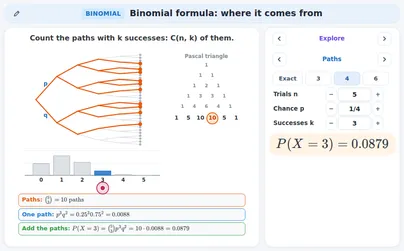
Draw each trial as a branch: S (success, chance ) or F (failure, chance ). trials give paths, each a word of S and F. The chance of a path is its branches multiplied, because the trials are independent.
pqSSSSSFp²qSFSp²qSFFFSSp²qFSFFFSFFF
Example
: the paths are SSS, SSF, SFS, SFF, FSS, FSF, FFS, FFF.Exactly 2 successes: SSF, SFS, FSS → 3 paths, each with chance .
Rule

Counting the paths: C(n, k)

Paths with exactly successes differ only in where the successes sit: choose of the places. There are of them. Pascal’s triangle lists them: every number is the sum of the two above it.
11112113311464115101051
Example
: row 5 of the triangle is 1, 5, 10, 10, 5, 1, so there are 10 paths.Check with Pascal’s rule → (from row 4: 1, 4, 6, 4, 1).
Rule

The formula P(X = k)

Every path with successes has the same chance (multiply the branches), and there are such paths. So.
0.23700.39610.26420.08830.01540.0015
Example
A 5-question quiz is guessed, 4 choices each: , . Exactly 2 right:.
Tip

The bars add up to 1

The probabilities together are , because the paths are all the paths: . Use it as a check on a table. For the table reads the same from both ends.
1/803/813/821/83
Example
: , and the list is the same backwards because .
Definition

One trial at a time: indicators

Write , where if trial is a success and if not. One indicator has and .
0.700.31μ=0.3
Example
One trial with : and .
Rule

E(X) = np and Var(X) = npq

is the sum of independent indicators: the means add, and so do the variances because the trials are independent. So, and .
σ05101520μ=6
Example
: , , .
Special case

np need not be a possible value

is the long-run average, not a value that must take: is often not a whole number. The most likely value, the mode, is ; there are two modes when is a whole number.
1/3205/3215/1625/1635/3241/325μ=2.5
Example
: , a value never takes.The modes are and , both with chance (here is a whole number).
Tip

The spread is largest at p = 1/2

For a fixed , is largest at and falls to when goes to or (the result is then certain). and give the same spread.
0.250.7510.511.522.5py0.52.24
Example
: gives and ; and both give and .
Rule

At most, at least, between

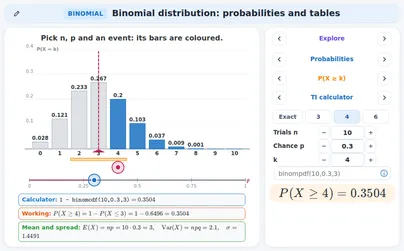
Add the bars of the event: and . Each bar is from the formula.
012345678910
Example
:.
Rule

The complement

When the event has many bars, count the other bars instead: .
012345678910
Example
: , instead of adding the seven bars from 4 to 10.
Watch out!

Look at the end points: ≤ or <

stops before 3, so it equals ; includes the bar at 3. In the same way , but .
012345678910
Example
:✘ ✔
Definition

The cumulative table

The cumulative table lists , as a calculator or a booklet does. It never goes down and ends at . Differences give single bars: and .
kP(X=k)P(X≤k)20.23350.382830.26680.649640.20010.849750.10290.952760.03680.9894
Example
: and , so.
Rule

Find k

To find the smallest with , go down the cumulative column until it first reaches . Check the two neighbours: .
kP(X=k)P(X≤k)00.00100.001010.00980.010720.04390.054730.11720.171940.20510.3770
Example
and : but , so .
Rule

One level, three searches

A test asks for a critical value in three forms: the smallest with ; the largest with (lower tail); the smallest with (upper tail). They are different numbers, so read the sign.
05101520
Example
, : , so the smallest is and the largest with is .Upper tail: → .
Definition

The geometric distribution (9709 only)

If each trial succeeds with chance and is the number of the first success, then , and .
123456789101112μ=6
Example
A die, : and .On average the first six takes throws.
Tip

A simulation estimates

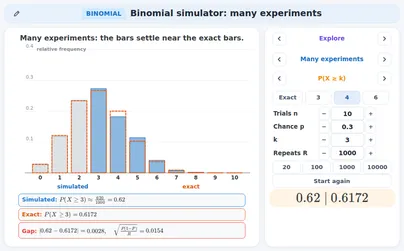
A simulation repeats the whole experiment times; the relative frequency of an event estimates its probability. The exact value from the formula does not depend on ; the estimate does, and it changes with a new run.
Example
: exact .In one run of experiments, 43 had at least 8 hits: estimate , a gap of . Another run gives another estimate.
05100510
Rule

The typical gap of a simulation

The estimate and the exact value typically differ by about . Four times as many repeats halve the gap; 100 times as many make it 10 times smaller.
0.0491000.0244000.01216000.0066400
Example
, so . gives a gap of about ; gives about .
Definition

The shape: symmetric, skewed, mirrored

For the bars are symmetric. For the long tail is on the right (skewed right), for on the left. is the mirror image of : for equals for .
024680246802468
Example
: for the tallest bar is at with height .For the tallest bar is at with the same height.
Definition

Towards the bell curve

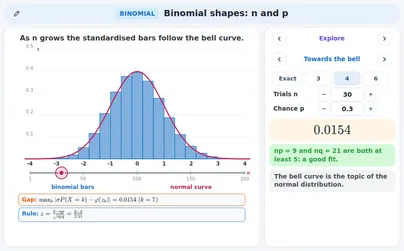
For large the bars of , standardised by (each height multiplied by , so the total area is 1), follow a bell curve. A rule of thumb for a good fit: and .
−4−3−2−101234z
Example
: and , both at least 5, and .The bars and the curve never differ by more than .
Watch out!

A small np is still lopsided

If (or ) is small, the bars are still lopsided and the bell fits badly, however you scale them. Take a larger until both and are at least 5.
−4−3−2−101234z
Example
: , below 5. The largest gap to the curve is .: and . The largest gap is only .
−4−3−2−101234z
Watch out!

Doubling n does not double the spread

grows like : to double the spread you need four times as many trials.
Example
has .✘ has .✔ has ; has .
Tip

The calculator line

A calculator has and under two names. TI: , . Casio: , (other order).
Example
and : type (1 minus cdf at ). The answer is .
Tip

A factory check

A sample of items is checked; the batch is accepted when at most are defective. Each item is defective with chance , independently: acceptance has chance , rejection .
012345678910
Example
, , : is the chance of acceptance, so the chance of rejection is .
Tip

The pass mark of a guess test

A pupil guesses all questions of a test with choices each: . Passing with pass mark has chance . Take the smallest that keeps it at most .
012345678910
Example
questions, choices: is above , is below it.A pass mark of keeps passing by guessing under %.
Tip

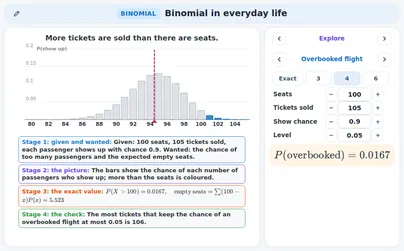
An overbooked flight

An airline sells tickets for seats; each passenger shows up with chance , independently, so show up. The flight is overbooked when : .
0123456789
Example
seats, tickets, : only is too many, so .
Tip

Is a hot streak unusual?

To judge a result, work out how often chance alone gives it. A player with hit rate has hits in throws; says how unusual or more is. Well above a few percent: not unusual.
012345678910μ=7
Example
, : .About % of such sessions have 8 or more hits: not unusual at all.
Tip

Which course asks what

Cambridge 9709: binomial and geometric formulae. UK A level (DfE, Edexcel, AQA): the binomial as a model. IB (AA, AI): the distribution, mean, variance. AP Statistics: justify, compute, simulate. Common Core: guessing a test. Netherlands (wiskunde A, C, D vwo): the situation, E(X), SD. Only 9709 asks for the geometric law.
Example
A typical exam question: ; find and . and .

Exercises

A tray holds 12 seeds. Each germinates with chance , independently of the others. is the number that germinate. Is binomial? Give and and find . Easy
Show solution
Two outcomes (germinates or not), independent seeds, fixed, the same for every seed: all four conditions hold.
.
and
Check → lies between and .
A tree has trials of S and F. How many paths have exactly successes? Use Pascal’s triangle. Easy
111121133114641151010511615201561
Show solution
The number of paths is , the entry of row .
Row 5 is 1, 5, 10, 10, 5, 1, so the entry of row 6 is .
paths
Check → .
. Find . Easy
1/21/2
Show solution
There are paths with exactly 2 successes, and each path has chance .
.
Check → count the orange paths in the tree: there are 6.
. Find , and . Easy
Show solution
.
.
.
, ,
Check → .
A die is thrown 6 times. Find the chance of at least one six. Easy
0123456
Show solution
is the number of sixes, . “At least one” is the complement of “none”.
.
Check → .
For a table gives and . Find and . Easy
kP(X=k)P(X≤k)10.12110.149320.23350.382830.26680.649640.20010.8497
Show solution
A single bar is a difference: .
“At least 3” is the complement of “at most 2”: .
and
Check → the column of the table shows in the row for .
A bag has 12 counters, 5 of them red. Two counters are drawn without putting back. Find the chance that both are red. Is the number of red counters binomial? Medium
Show solution
The first is red with chance . After a red there are 4 red among 11: the second is red with chance .
Both: .
The chance of a red changed from to , so the draws are dependent: not binomial. With putting back both would be red with chance .
Both red: . The number of reds is not binomial.
Check → : after a red there are fewer reds left, so both red is less likely than with putting back.
. Find as an exact fraction. Medium
012345678
Show solution
The numbers of paths are , and ; every path has chance .
.
Check with cumulative values → .
A 5-question quiz is guessed, 4 choices per question. Find the chance of at least 4 right answers. Medium
012345
Show solution
. Exactly 4 right: .
Exactly 5 right: .
Add → .
Check → about 1 guessing pupil in 64 gets 4 or more right: rare.
and . Find the smallest with . Medium
05101520
Show solution
Go down the cumulative column: is still below .
is the first value that is at least .
Check the neighbours → .
(Cambridge 9709) Each trial succeeds with chance . Find the chance that the first success is on trial 4, and the mean number of trials to the first success. Medium
12345678910μ=5
Show solution
A first success on trial 4 means 3 failures and then a success: .
, so .
.
and
Check → the bars for 1, 2 and 3 are , and , each times the one before; .
and . Show that and find the value. Medium
05100510
Show solution
.
, and : the same product.
.
Both are
Check → is the mirror image of : the bar at becomes the bar at .
A plane has 8 seats. 10 tickets are sold and each passenger shows up with chance , independently. Find the chance that the flight is overbooked and the expected number of passengers who show up. Hard
012345678910
Show solution
is the number who show up. Overbooked means , so or .
and .
Add → . And .
and passengers
Check → on average exactly 8 show up, yet more than 8 show up on about % of the flights.
A sample of 12 items is checked and the batch is accepted when at most 2 are defective. Each item is defective with chance , independently. Find the chance that the batch is rejected. Hard
024681012
Show solution
; accepted means .
, , , together .
Rejected is the complement: .
The batch is rejected with chance
Check → the chances of acceptance and rejection add up to .
A player hits % of his free throws. In 10 throws he hits 9 or more. How unusual is that? Give the chance and say what it means. Hard
012345678910
Show solution
, wanted .
and .
Add → .
: about 1 session in 7 is as good or better, so it is not a surprise.
Check → is more than , so the result happens by luck more than 1 time in 10.
A simulation estimates . How many repeats give a typical gap of ? What is the typical gap for ? Hard
0.009725000.0059450
Show solution
The typical gap is with .
gives .
For → .
(about 10 000); for the gap is about
Check → is about a quarter of , so its gap is about twice .
has and . Find and . Hard
Show solution
and . Divide: .
and .
and
Check → and .
For , for which are and ? Is the bell curve a good fit for ? Hard
−4−3−2−101234z
Show solution
gives ; gives .
For : , which is below .
. For the rule is not met, so the fit is not good.
Check → the largest gap between the bars and the curve is about for , more than for .
Are you a teacher?

Start live lessons with these applications for your whole class. Free to try for one month.

Try it free

Fits these school years

IB (MYP, Diploma): Diploma, year 1, Diploma, year 2

Cambridge International: AS Level, A Level

Netherlands: Vwo · Mathematics A, Vwo · Mathematics C, Vwo · Mathematics D

England (GCSE, A Level): Year 12 (A Level), Year 13 (A Level)

USA (Common Core): Algebra 2, Precalculus

What the applications of this topic teach 6 applications

Binomial conditions: is it binomial?

  • Checking the four conditions of a binomial situation
  • Explaining why drawing without replacement is not binomial
  • Telling a fixed number of trials from waiting for the first success

Binomial formula: where it comes from

  • Drawing the tree of S and F for n trials
  • Using P(X = k) = C(n, k) p^k q^(n−k)
  • Explaining E(X) = np and Var(X) = npq with indicators

Binomial distribution: probabilities and tables

  • Finding P(X = k), at most, at least and between for X ∼ B(n, p)
  • Reading the cumulative table
  • Finding k from a level q: a critical value

Binomial simulator: many experiments

  • Estimating a binomial probability by repeating the experiment
  • Comparing the estimate with the exact value
  • Saying how many repeats are needed for a given gap

Binomial shapes: n and p

  • Describing the shape of B(n, p): symmetric or skewed
  • Working out the mean and standard deviation
  • Knowing when the bell curve fits: np and nq at least 5

Binomial in everyday life

  • Turning a story into X ∼ B(n, p) in four stages
  • Working out the chance to accept a batch or pass a guess test
  • Finding a pass mark or the most tickets sold