İnteraktif Dersler

Theoretical probability: equally likely outcomes and P(A)

Lecture notes

Definition

The sample space

The sample space is the list of all possible outcomes of one experiment. Count them: that number is the “possible” in the formula.
2
Example
Die: 1, 2, 3, 4, 5, 66 possible outcomes
6
Definition

Equally likely outcomes

Outcomes are equally likely when none has a better chance than another, as with a fair coin, a fair die or a spinner with equal sectors.
Example
Fair die: every face has the chance
1/6
Definition

P(A) = favourable ÷ possible

For equally likely outcomes the theoretical probability of an event A is . Favourable outcomes make A happen.
kn
Example
3 red among 8 counters
38
Rule

An event with several outcomes

An event can hold several outcomes: even, prime, more than 4, a suit. List the favourable outcomes, count them, then divide by the possible ones.
2/6
Example
Die, even: 2, 4, 6
3/6
Rule

Fraction, decimal, percentage

A probability can be a fraction, a decimal or a percentage. Write the fraction in simplest form, then convert.
610
Example
35=0.6=60%
Rule

Impossible is 0, certain is 1

A probability is never below 0 or above 1: . An impossible event has P = 0, a certain event has P = 1.
01
Example
A 7 on a die: P = 0A number below 7: P = 1
P=0P=1
Rule

The complement: not A

“Not A” holds all the outcomes that are not in A. A and not A together cover everything, so .
1P1−P
Example
13/107/10
Rule

All probabilities add up to 1

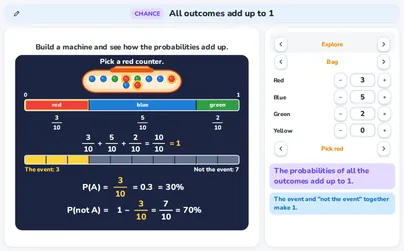
Every trial has exactly one outcome, so the probabilities of all the outcomes add up to 1. This finds a missing probability.
1abc
Example
13/105/102/10
Definition

A pack of cards

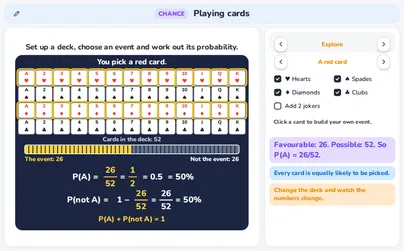
A pack has 52 cards: 4 suits (hearts and diamonds are red, spades and clubs are black) of 13 cards. 12 are picture cards (J, Q, K).
4×13
Example
13/52
Rule

Theory and experiment

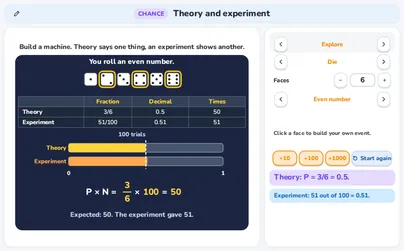
An experiment gives a result near the theory but not exactly equal. A short run can be far away; many trials come closer.
1015202530E
Example
, 120 rollsabout 20 sixes, maybe 23
101520253020
Rule

Expected number

In N trials you expect the event times. The other way round: , and favourable .
NP
Example
red counters
12020410
Tip

Choose the approach

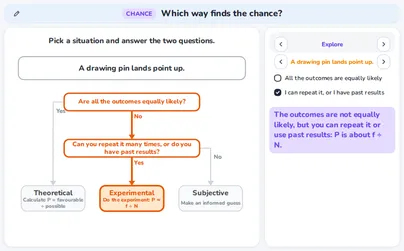
All outcomes equally likely: calculate. Not equal but you can repeat it or have past results: experiment. Neither: an informed guess.
?
Example
Die: calculateDrawing pin: experimentNew shop: guess
1/618/40?≈
Watch out!

Count outcomes, not colours

Count every counter. A bag with 3 red and 5 blue counters has 8 outcomes, not 2 colours, so red is not a 1 in 2 chance.
123456783+5=8
Example
3 red, 5 blue, not
38✔✘
Watch out!

The formula needs equal outcomes

favourable ÷ possible only works when the outcomes are equally likely. A bent coin or a drawing pin needs an experiment.
✔✘
Example
Pin: up or down2 outcomes, but not each
1822≠1/2
Special case

Add counters for an even chance

To make red a 1 in 2 chance, add red counters until there are as many red as blue: add red counters.
b−r
Example
3 red, 7 blue: add 4
310714

Exercises

A bag has 3 red and 5 blue counters. One is picked at random. What is the probability of red, as a fraction, a decimal and a percentage? Easy
Show solution
Possible: counters. Favourable: 3 red
123456783+5=8
012137.5%
Answer → 3/8 = 0.375 = 37.5%
Count ALL the counters (8), not only the blue ones (5).
A spinner has 10 equal sectors and 4 are red. What is P(red) in simplest form? What is P(not red)? Easy
Show solution
12/53/5
Answer → 2/5 and 3/5
Check: .
A card is picked from a pack of 52 cards. What is the probability of a picture card (J, Q, K) in simplest form? And if 2 jokers are added? Medium
12/52
Show solution
Picture cards:
With 2 jokers there are 54 cards:
12/54
Answer → 3/13, and 2/9 with the jokers
The jokers make the pack bigger, so the chance gets smaller.
A spinner has red, blue and green sectors. P(red) = 0.35 and P(blue) = 0.4. What is P(green)? Medium
10.350.4?
Show solution
All the probabilities add up to 1
10.350.40.25
Answer → 0.25
0.25 is 25%: the three add up to 100%.
A bag has 4 red and 12 blue counters. How many red counters must be added so that P(red) = 1/2? Hard
Show solution
Chance 1/2 means as many red as blue
Blue stays 12, so red must be 12
red counters
12−4
Check:
Answer → 8 red counters
Adding red also makes the total bigger: 16 becomes 24.
A fair die is rolled 300 times and a six comes up 54 times. How many sixes does theory expect? How far is the result from it? Hard
1/6
Show solution
Expected:
The result is more than expected
020406050E54f4
Answer → 50 expected; 4 more
4 away from 50 is normal: near the theory, but not exactly equal.
Are you a teacher?

Start live lessons with these applications for your whole class. Free to try for one month.

Try it free

Fits these school years

IB (MYP, Diploma): MYP 1, MYP 2, MYP 3, MYP 4, MYP 5

Cambridge International: Lower Secondary, stage 7, Lower Secondary, stage 8, Lower Secondary, stage 9

Netherlands: Groep 8, Year 1, Year 2, Year 3 (havo, vwo), Vwo · Mathematics D, Vwo · Mathematics A, Vwo · Mathematics C, Groep 7, Vmbo bb (years 3-4), Vmbo kb (years 3-4), Vmbo gt (years 3-4)

Türkiye (MEB): Year 6 (MEB), Year 7 (MEB), Year 8 (MEB)

England (GCSE, A Level): Year 7, Year 8, Year 9

USA (Common Core): Grade 6, Grade 7, Grade 8

What the applications of this topic teach 6 applications

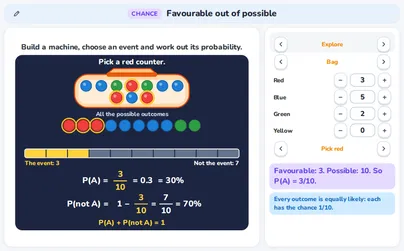
Favourable out of possible

  • Listing the sample space of a coin, die, spinner or bag
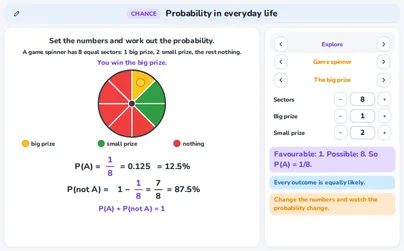
  • Finding P(A) = favourable ÷ possible
  • Finding P(not A) = 1 − P(A)
  • Building a spinner, bag or die event for a chosen probability

Playing cards

  • Knowing a pack of 52 cards: suits, colours, picture cards
  • Finding P(A) for a suit, colour, ace, king or picture card
  • Knowing a heart in a deck without hearts is impossible
  • Taking suits out of a deck to get a given probability

All outcomes add up to 1

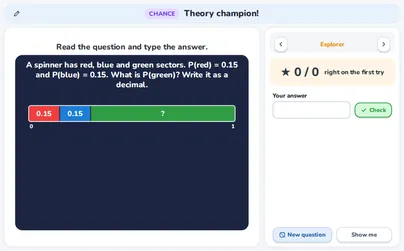
  • Knowing that the probabilities of all outcomes add up to 1
  • Finding a missing probability by subtracting from 1
  • Finding P(not A) = 1 − P(A) from fraction, decimal or percentage
  • Filling a bag for given probabilities

Theory and experiment

  • Working out a theoretical probability and comparing it with an experiment
  • Knowing that more trials come closer to the theory
  • Working out the expected number P × N

Which way finds the chance?

  • Knowing that favourable ÷ possible needs equally likely outcomes
  • Choosing between theoretical, experimental and subjective probability
  • Knowing why a drawing pin or the weather cannot be found by theory

Probability in everyday life

  • Finding the probability in a prize draw, a jar of sweets or a class draw
  • Writing the probability as fraction, decimal and percentage
  • Finding the probability of “not” with 1 − P(A)