İnteraktif Dersler
Lecture notes Exercises

Combined events: grids, Venn diagrams and tree diagrams

Lecture notes

Definition

The sample space of two events

A combined experiment has two steps. List every ordered pair of results: the pair 2,5 is not the pair 5,2. The list is the sample space.
123456122,53455,26
Example
Coin and die: H1, H2 … T612 outcomes
12345612345612345612
Definition

The possibility grid

A grid puts the first step in the rows and the second in the columns. Every cell is one outcome. Count the favourable cells: .
1234563/12
Example
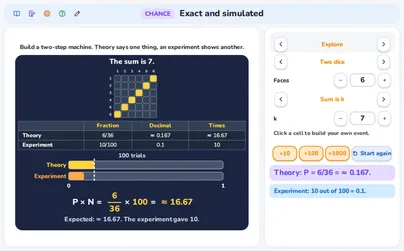
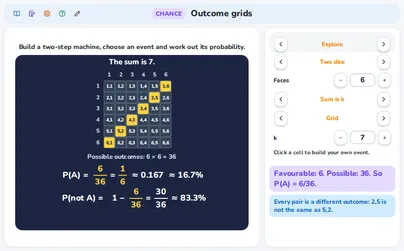
Sum 7 of two dice
123456123456
Rule

The table of sums

Write the sum of the two dice in every cell. Events like “the sum is 7” or “at least 10” are just groups of cells to count.
234567134567824567893567891046789101157891011126123456
Example
Sum at least 10: 6 cells
234567134567824567893567891046789101157891011126123456
Definition

And, or, not, at least

A and B: both happen (the overlap). A or B: at least one happens. Not A: A does not happen. These words pick the cells., ,
ABA∩BABA∪BABA'
Example
Coin and dieheads and even: 3 cellsheads or even: 9 cells
12345631234569
Definition

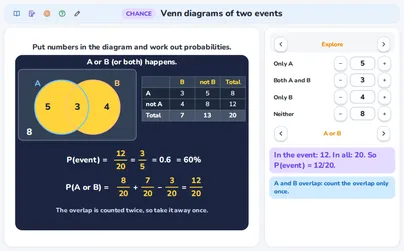
The Venn diagram of two events

Two overlapping circles make four regions: only A, both, only B and neither. Write the counts in the regions; they add up to the whole group.
ABprqsp+q+r+s
Example
30 pupils: 12 only football, 5 both,8 only chess, 5 neither
AB1285530
Definition

The two-way table of counts

The same counts fit a table: rows A and not A, columns B and not B, and the totals. Read P(A), P(B), P(A and B) from it.
BB'A51217A'8513131730
Example
Football: 12 + 5 = 17 of 30
BB'A51217A'851313173017/30
Rule

Mutually exclusive events

Events that cannot happen together do not overlap. Then add: . Exclusive events that cover everything add up to 1.
ABA∩B=∅
Example
A die shows 1 or 2
2/6
Rule

The addition rule with an overlap

When A and B overlap, the overlap is counted twice by P(A) + P(B). Take it away once: .
AB×2A∪B
Example
AB543812/20
Rule

Neither A nor B

“Neither” is the opposite of “A or B”: . In the Venn diagram it is the region outside both circles.
AB(A∪B)'
Example
AB54388/20
Rule

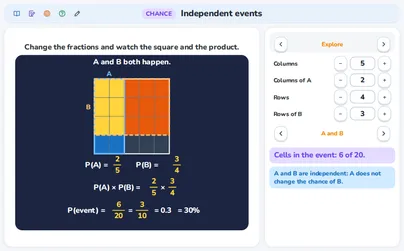
Independent events

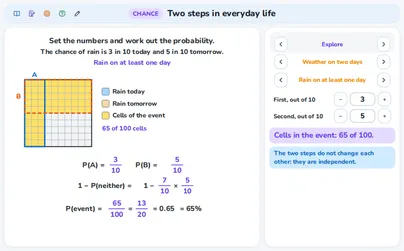
A does not change the chance of B (a coin and a die, two days apart). Then multiply: . In the unit square the overlap is a smaller rectangle.
121316
Example
Heads and a six
1216112
Rule

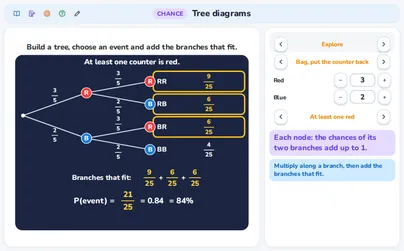
The tree diagram

Draw a branch for every result of each step and write its probability on it. Multiply along a branch. Add the branches that fit the event.
12121212121214141414
Example
3 red, 2 blue, put backone of each:
352535253525925625625425
Rule

The branches of a node add up to 1

Every node splits into all the possible results of the next step, so its branch probabilities add up to 1. All the leaves together also add up to 1.
1213161/2+1/3+1/6=1
Example
3525352535259256256254259+6+6+4=25
Rule

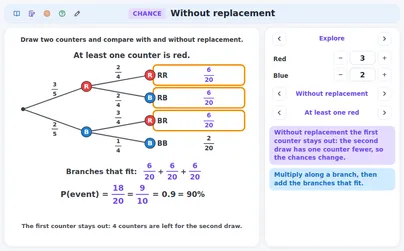
Without replacement

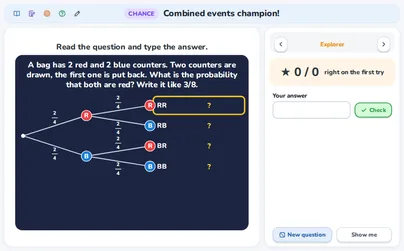
If the first counter is not put back, the bag has one counter fewer for the second draw, so the second branches change: the events are not independent.
3524
Example
3 red, 2 blue, both red
242434143525310310310110
Rule

At least one

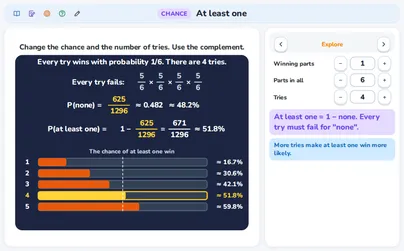
The opposite of “at least one” is “none”, which is easy: every try fails. So .
11−xx
Example
4 rolls, at least one six
1296625671
Tip

Choose the picture

All pairs of outcomes: a grid or a list. Overlapping groups: a Venn diagram. One step after another: a tree diagram.
Example
Two dice: gridFootball and chess: VennTwo draws: tree
36303/5
Watch out!

Exclusive is not independent

Exclusive events cannot happen together; independent events do not change each other's chance. Heads and tails of one coin are exclusive, not independent.
P=0121214
Example
not
P=0121214
Watch out!

Do not count the overlap twice

Adding P(A) + P(B) is only right for exclusive events. With an overlap you get too much: take away P(A and B).
AB×2A+B
Example
is too much of 20
15533412534
Watch out!

Do not forget the missing counter

Without replacement the second branch uses the counters that are left. Using the first fractions again is the mistake of “with replacement”.
35✘24✔
Example
Put back: Not put back:
35×3535×24
Special case

Exact and simulated

A short simulation of a combined event ends near the exact probability, not on it. The expected number is ; more trials come closer.
162024283224
Example
Two dice, 144 throwssum 7:
14424120
Special case

More tries, more chance

The chance of at least one win grows with every extra try, but it never reaches 1. Find the fewest tries that pass a goal.
010.5123456
Example
1 roll: 4 rolls: , more than half
010.50.1710.3120.4230.5240.650.676

Exercises

A coin is tossed and a die is rolled. What is the probability of heads and an even number? Easy
Show solution
Grid: 2 rows (heads, tails) × 6 columns (1 to 6): cells
12345612
Favourable: heads with 2, 4 or 6, that is 3 cells
1234563/12
Answer → 1/4
Both parts must be true, so only the cells of heads and an even number count.
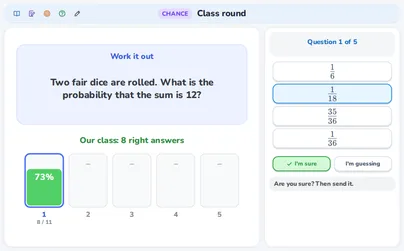
Two fair dice are rolled. What is the probability that the sum is 7? Easy
Show solution
The grid has cells
123456123456
Sum 7: 1+6, 2+5, 3+4, 4+3, 5+2, 6+1, that is 6 cells
123456123456
Answer → 1/6
2,5 and 5,2 are two different cells, so both are counted.
A and B are independent. P(A) = 1/2 and P(B) = 1/3. What is P(A and B)? Easy
Show solution
Independent events: multiply
121316
Answer → 1/6
The answer is smaller than both P(A) and P(B): both have to happen.
In a class of 30, 18 play football, 12 play chess and 7 play both. What is the probability that a pupil picked at random plays football or chess? And neither? Medium
18127
Show solution
Overlap counted once: play at least one
1812115723
Neither: , so
1812115777/30
Answer → 23/30 and 7/30
18 + 12 = 30 would count the 7 who play both twice.
A bag has 3 red and 2 blue counters. Two counters are drawn and the first one is put back. What is the probability of one red and one blue counter? Medium
35
Show solution
Two branches fit: red then blue, blue then red
3/52/53/52/53/52/59/256/256/254/25
for each branch
Answer → 12/25
Multiply along a branch, add the branches that fit.
The chance of rain is 0.3 on Monday and 0.4 on Tuesday, independent of each other. What is the probability of no rain on either day? And of rain on at least one day? Medium
Show solution
No rain: on Monday and on Tuesday
0.40.60.40.60.30.70.120.180.280.42
At least one:
0.58
Answer → 0.42 and 0.58
0.3 + 0.4 = 0.7 would be wrong: the days overlap.
A bag has 4 red and 3 blue counters. Two counters are drawn and the first one is not put back. What is the probability that both are red? That both have the same colour? Hard
47
Show solution
Both red:
3/63/64/62/64/73/72/72/72/71/7
Both blue:
Same colour:
3/63/64/62/64/73/72/72/72/71/7
Answer → 2/7 and 3/7
After a red counter only 3 red of 6 are left; after a blue one only 2 blue of 6.
A die is rolled 3 times. What is the probability of at least one six? Hard
Show solution
None means no six in all 3 rolls
56×56×56125216
21612591
Answer → 91/216
3 × 1/6 = 1/2 would be wrong: that adds chances that overlap.
Two fair dice are thrown 144 times. About how many times do both dice show the same number? Hard
Show solution
Grid: the 6 cells on the diagonal out of 36
123456123456
Expected:
14424120
Answer → about 24 times
A real run gives a number near 24, such as 21 or 27, not always 24.
Are you a teacher?

Start live lessons with these applications for your whole class. Free to try for one month.

Try it free

Fits these school years

IB (MYP, Diploma): MYP 1, MYP 2, MYP 3, MYP 4, MYP 5

Cambridge International: Lower Secondary, stage 8, Lower Secondary, stage 9, IGCSE

Netherlands: Groep 8, Year 1, Year 2, Year 3 (havo, vwo), Havo · Mathematics A, Vwo · Mathematics A, Vwo · Mathematics C, Vwo · Mathematics D

Türkiye (MEB): Year 7 (MEB), Year 8 (MEB), Year 9 (MEB), Year 10 (MEB)

England (GCSE, A Level): Year 8, Year 9, Year 10 (GCSE), Year 11 (GCSE)

USA (Common Core): Grade 7, Grade 8

What the applications of this topic teach 8 applications

Outcome grids

  • Listing the sample space of two dice, two coins or a bag drawn twice
  • Finding P(event) from the cells of a possibility grid
  • Reading the table of sums of two dice
  • Choosing the cells for “and”, “or”, “not” and “at least”

Venn diagrams of two events

  • Filling a Venn diagram of two events with four regions
  • Putting the same counts in a two-way table with totals
  • Using P(A or B) = P(A) + P(B) for mutually exclusive events
  • Using P(A or B) = P(A) + P(B) − P(A and B) for overlapping events

Independent events

  • Telling independent events from mutually exclusive events
  • Using P(A and B) = P(A) × P(B) for independent events
  • Reading the unit square split into columns and rows

Tree diagrams

  • Drawing a two-step tree with the probability on every branch
  • Multiplying along a branch and adding the branches that fit
  • Finding “at least one red” or “not the event” from the branches

Without replacement

  • Seeing that without replacement the second branches change
  • Comparing the tree with and without replacement
  • Finding P(both red) and P(same colour) along the branches

At least one

  • Knowing P(at least one) = 1 − P(none)
  • Finding P(none) by multiplying the chances that every try fails
  • Finding the fewest tries that pass a goal

Exact and simulated

  • Finding the exact probability of a two-step event from a grid
  • Comparing a short simulation with the exact probability
  • Working out the expected number of a combined event

Two steps in everyday life

  • Using two steps in everyday life: weather, traffic lights, penalties
  • Multiplying the chances of two independent steps
  • Finding both, neither, exactly one and at least one