Counting: lists, the product rule and arrangements
Lecture notes
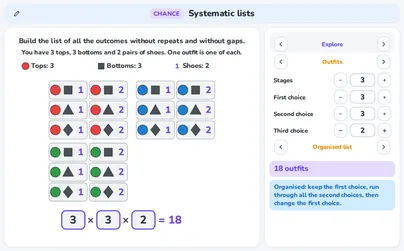
Repeats and gaps
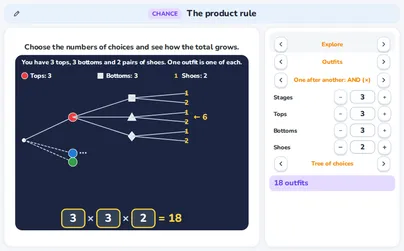
Product rule
Tree of choices
Repeated addition
Add for “or”
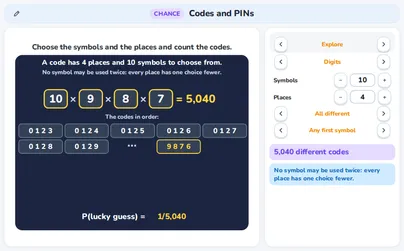
Codes with repeats
All different
First digit not 0
Fixed place
How fast it grows
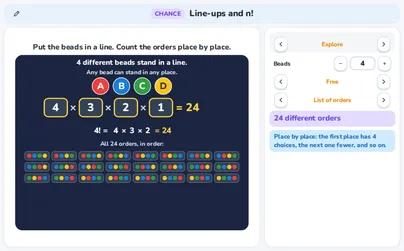
n factorial
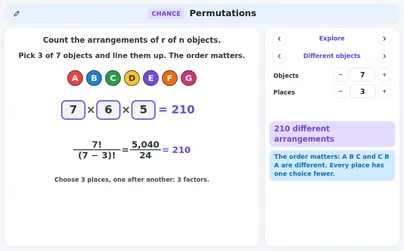
Permutations
Letters of a word
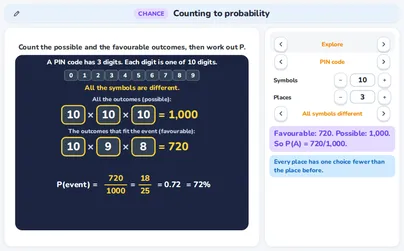
Count to probability
At least once
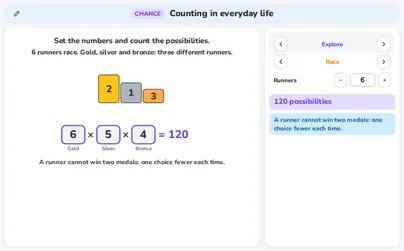
Everyday counting
Exercises
Show solution
Show solution
Show solution
Show solution
Show solution
Show solution
Show solution
Show solution
Show solution
Interactive applications for this topic
Free applications open with a free student account. Teachers can use all applications in a live lesson.
Start live lessons with these applications for your whole class. Free to try for one month.
Try it freeFits these school years
IB (MYP, Diploma): MYP 1, MYP 2, MYP 3, MYP 4, MYP 5
Cambridge International: Primary, stage 5, Primary, stage 6, Lower Secondary, stage 7, Lower Secondary, stage 8, Lower Secondary, stage 9, IGCSE
Netherlands: Groep 6, Groep 7, Groep 8, Year 1, Year 2, Year 3 (havo, vwo), Havo · Mathematics A, Vwo · Mathematics A, Vwo · Mathematics C, Vwo · Mathematics D
Türkiye (MEB): Year 6 (MEB), Year 7 (MEB), Year 8 (MEB), Year 9 (MEB), Year 10 (MEB)
England (GCSE, A Level): Year 5, Year 6, Year 7, Year 8, Year 9, Year 10 (GCSE), Year 11 (GCSE)
USA (Common Core): Grade 6, Grade 7, Grade 8
What the applications of this topic teach 7 applications
Systematic lists
- Writing an organised list of outfits, menus or routes
- Finding repeats and missing outcomes in a mixed-up list
- Multiplying the choices at each stage to count the outcomes
The product rule
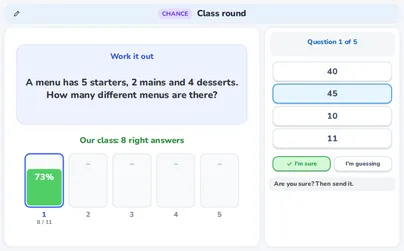
- Using the product rule: m ways then n ways gives m × n
- Drawing a tree of choices and counting its leaves
- Telling AND (multiply) from OR (add)
Codes and PINs
- Counting codes with repeats allowed: n^p
- Counting codes with all different symbols
- Counting numbers whose first digit is not 0
Line-ups and n!
- Counting the orders of n different beads: n!
- Using factorial notation and knowing that 0! = 1
- Counting the orders when the first or last bead is fixed
Permutations
- Counting permutations of r objects chosen from n
- Counting arrangements of the letters of a word with repeats
- Using factorial notation, also for r = n
Counting to probability
- Counting possible and favourable outcomes with the counting rules
- Working out a probability from the counts
- Finding “at least once” as all outcomes minus those that never occur
Counting in everyday life
- Counting choices: an ice cream shop, a bike lock, a race podium
- Telling when a symbol may be used again and when not
- Seeing what one more choice does to the total