İnteraktif Dersler

Energy, work and power

Lecture notes

Definition

Work done by a force

When a constant force moves its point of application a distance , the work done is , where is the angle between the force and the direction of motion. Only the part of the force along the motion, , does any work; the part at right angles to the motion does none.
Definition

Kinetic and gravitational potential energy

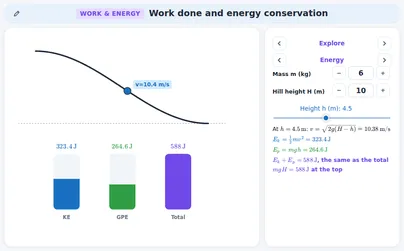
A moving object has kinetic energy . An object at height above some reference level has gravitational potential energy (take unless told otherwise).
Rule

Energy conservation

With no friction or air resistance, mechanical energy is conserved: stays the same throughout the motion. A drop in height turns potential energy into kinetic energy (), and a rise does the reverse. More generally, the work done by a force equals the change in kinetic energy it causes.
Definition

Power

Power is the rate of doing work, . For a force moving at a steady velocity , this becomes : a car's engine driving at force and speed delivers power .
Rule

A vehicle on a hill against resistance

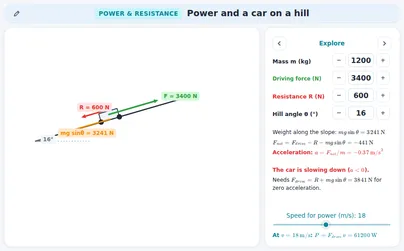
Resolving forces along the slope of a hill inclined at : driving force , resistance (air and rolling resistance, opposing motion) and the weight component along the slope (opposing motion going uphill) give a net force , and an acceleration .
Special case

Maximum, steady speed

A vehicle's acceleration falls to zero exactly when the net force is zero, : at that point the speed is no longer changing, which is the vehicle's maximum, steady speed on that hill.
Watch out!

Common mistakes

Forgetting the when the force is not along the motion (using instead); mixing up (potential energy) with (kinetic energy); and forgetting that the speed reached in a frictionless drop does not depend on the mass, since cancels in .

Exercises

Interactive applications for this topic

Free applications open with a free student account. Teachers can use all applications in a live lesson.

About the free account and Plus

Are you a teacher?

Start live lessons with these applications for your whole class. Free to try for one month.

Try it free

Fits these school years

Cambridge International: AS Level

England (GCSE, A Level): Year 12 (A Level)

What the applications of this topic teach 2 applications

Work, energy and conservation: a car on a hill, a box on a rope

  • Calculate the work done by a force that is not along the direction of motion, W=Fscosθ.
  • Use E_p=mgh and E_k=tfrac12mv² for gravitational potential energy and kinetic energy.
  • Use energy conservation to relate a change in height to a change in speed.

Power and resistance: a car climbing a hill

  • Use power as the rate of doing work, P=Fv.
  • Resolve forces along a slope to find a car's acceleration against resistance, a=(F_drive-R-mgsinθ)/m.
  • Find the condition for zero acceleration (a vehicle's maximum, steady speed on a hill).