İnteraktif Dersler

Constant acceleration: the suvat equations

Lecture notes

Definition

The five quantities

For motion in a straight line with constant acceleration there are five quantities: (initial velocity), (final velocity), (acceleration), (displacement) and (time). Four equations connect them, and each of the four leaves out exactly one of the five.
Rule

The four suvat equations

(no ), (no ), (no ), (no ).
Tip

Choosing the right equation

A problem usually gives three of the five quantities and asks for a fourth; the fifth quantity is simply not part of the problem. That fifth quantity is the one to leave out, and exactly one of the four equations leaves out the same quantity — that is the equation to use.
Watch out!

A common slip: the sign of

These equations need to be constant, and its sign matters once a direction is chosen as positive. If and both point in the positive direction but the object is slowing down, is negative, even though the object is still moving forwards.

Exercises

Interactive applications for this topic

Free applications open with a free student account. Teachers can use all applications in a live lesson.

About the free account and Plus

Are you a teacher?

Start live lessons with these applications for your whole class. Free to try for one month.

Try it free

Fits these school years

Cambridge International: AS Level

England (GCSE, A Level): Year 12 (A Level)

What the applications of this topic teach 1 application

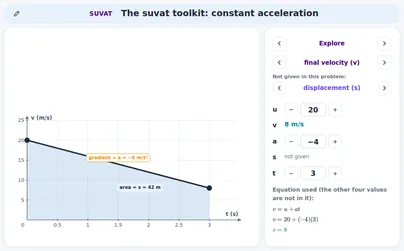
The suvat toolkit: constant acceleration

  • Name the five suvat quantities and the four equations that connect them.
  • Pick the one equation that uses exactly the three given quantities and the one I need to find.
  • Read a velocity-time graph as the same motion: its gradient is the acceleration and the area under it is the displacement.