İnteraktif Dersler

Momentum

Lecture notes

Definition

Momentum:

The momentum of a moving body is its mass times its velocity. In one dimension, velocity is signed: pick a positive direction once, and a negative value just means motion the other way. Momentum has the same sign as the velocity, so it is a vector quantity too, not just a size.
Rule

Conservation of momentum

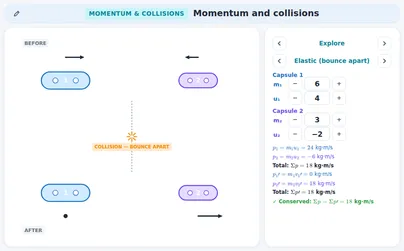
When two bodies collide and nothing else pushes on them, the total momentum right before the collision equals the total momentum right after it: ( = before, = after). This is true for every mass and every velocity, and for every kind of collision.
Definition

Elastic vs. perfectly inelastic

A perfectly elastic collision bounces the two bodies apart: and . A perfectly inelastic collision joins them: they move on with one common velocity, . Most real collisions sit somewhere between the two.
Tip

A given final velocity is often enough

Many exam questions give you one body's final velocity directly and ask for the other's. You do not need to know whether the collision was elastic or inelastic for that: conservation of momentum alone, , has only one unknown left once you substitute the numbers you were given.

Exercises

Interactive applications for this topic

Free applications open with a free student account. Teachers can use all applications in a live lesson.

About the free account and Plus

Are you a teacher?

Start live lessons with these applications for your whole class. Free to try for one month.

Try it free

Fits these school years

Cambridge International: AS Level, A Level

England (GCSE, A Level): Year 13 (A Level)

What the applications of this topic teach 1 application

Momentum and collisions

  • Find the momentum of a moving body, p=mv, and treat it as a signed (vector) quantity in one dimension.
  • Use conservation of momentum, m_1u_1+m_2u_2=m_1v_1'+m_2v_2', in a direct (1D) collision of two bodies.
  • Tell a perfectly elastic collision (they bounce apart) from a perfectly inelastic one (they coalesce and move on together, v'=(m_1u_1+m_2u_2)/(m_1+m_2)).