İnteraktif Dersler

Friction and contact forces

Lecture notes

Definition

Splitting the contact force

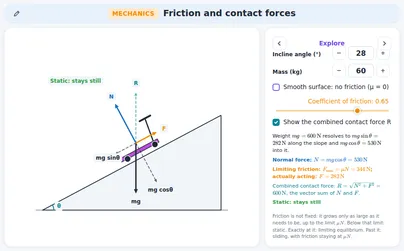
When a body rests on a surface, the surface pushes back with ONE contact force. It is almost always more useful to split that force into two perpendicular parts: the normal force (perpendicular to the surface) and the friction force (along the surface, resisting sliding).
Rule

The normal force on a slope

For a body of weight on a slope at angle to the horizontal, resolving perpendicular to the slope gives . Resolving along the slope, the weight's component pulling the body down the slope is .
Definition

Limiting friction and the coefficient of friction

Friction cannot grow without limit: it stays at whatever value is needed for equilibrium, up to a maximum , where (mu) is the coefficient of friction between the two surfaces. always.
Rule

Static, limiting and sliding

If the force needed for equilibrium is less than , the body stays still (static). If it is exactly , the body is in limiting equilibrium -- on the point of sliding. If it would need to be more than , the body slides, and friction then acts at its limiting value, , opposing the motion.
Definition

The smooth model

A 'smooth' surface is an idealisation that sets friction to exactly zero (). It simplifies problems where friction genuinely does not matter (a well-oiled pulley, a frictionless peg), but it has a sharp limit: a smooth sloped surface cannot hold a body in equilibrium at all, except on completely flat ground.
Watch out!

A common mistake

Friction is NOT always equal to . That is only true once the body is on the point of sliding or actually sliding. In ordinary static equilibrium, friction is whatever smaller value balances the other forces.

Exercises

Interactive applications for this topic

Free applications open with a free student account. Teachers can use all applications in a live lesson.

About the free account and Plus

Are you a teacher?

Start live lessons with these applications for your whole class. Free to try for one month.

Try it free

Fits these school years

Cambridge International: AS Level, A Level

England (GCSE, A Level): Year 12 (A Level), Year 13 (A Level)

What the applications of this topic teach 1 application

Friction and contact forces: a scooter on a ramp

  • Split a contact force into a normal component N and a friction component F.
  • Find the normal force on a slope, N=mgcosθ, and know why friction can never exceed μ N.
  • Tell whether a body is in static equilibrium, in limiting equilibrium, or sliding, and I know the limits of the smooth (frictionless) model.