İnteraktif Dersler
Lecture notes Exercises

Expand a bracket and factorise a common factor

Lecture notes

Definition

Brackets

A bracket groups terms together. In 3(x + 4) the 3 multiplies everything inside the bracket: 3(x + 4) means 3 × (x + 4).
3x4+×
Example
What is when ?
432+×=5=20
Definition

Expand

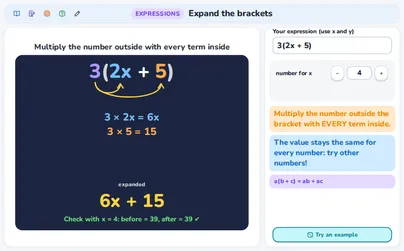
To expand a bracket is to multiply every term inside by the number outside and write the result without brackets.
3(x+4)=3x+12
Example
Expand :
6(a+2)=6a+12
Definition

Factorise

To factorise is the opposite of expanding: write an expression as a common factor times a bracket. 3x + 12 becomes 3(x + 4).
xxx3x43x12
Example
Factorise . Both terms are in the 4 times table:
aaaa4a24a8
Definition

Common factor

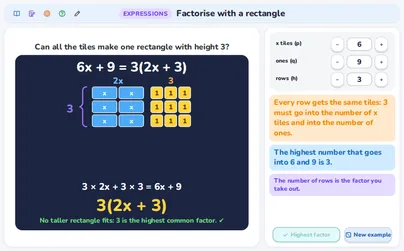
A common factor is a number or letter that goes into every term. The highest common factor is the biggest one: for 6x and 9 it is 3.
xxxxxx
Example
The highest common factor of and is 5:
52x310x15
Rule

The rule

The number outside is shared out over every term inside the bracket: multiply the first term and also the second term.
abcabac
Example
Try the rule with numbers:
51035015
Rule

Area model

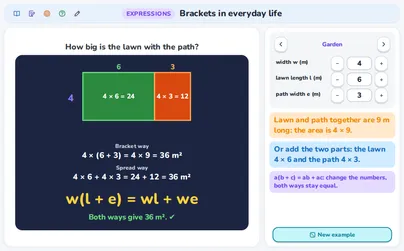
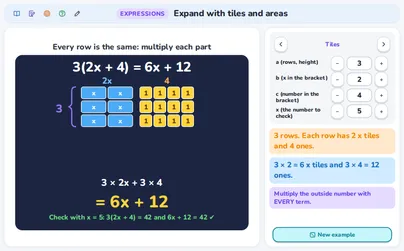
A rectangle that is 3 high and x + 4 wide has the area 3(x + 4). Split it in two parts, 3 × x and 3 × 4, and add them: 3x + 12.
3x43x12
Example
A rectangle is 4 high and wide:
4x64x24
Rule

Algebra tiles

Every row of tiles is the same. 3 rows of one x tile and four small squares make 3 x tiles and 12 small squares.
xxx
Example
2 rows, each with two x tiles and three small squares:
xxxx
Rule

A minus inside

Keep the sign of the term you multiply: 5 × (−2) = −10, so 5(x − 2) = 5x − 10.
5x−22x5x−1010
Example
Expand :
4x−33x4x−1212
Rule

A number in front of x

Multiply the numbers: 2 × 3 = 6, so 2(3x + 1) = 6x + 2.
23x16x2
Example
Expand : and →
34x512x15
Rule

x outside the bracket

x × x = x², so x(x + 5) = x² + 5x.
xx5x²5x
Example
Expand :
xx−44xx²−4x4x
Rule

A minus outside

A minus outside changes every sign inside the bracket: −2(x − 3) = −2x + 6, because a minus times a minus is a plus.
−x−x
Example
Expand : →
−x−x−x
Rule

Expand and simplify

Expand each bracket first, then put the like terms together: 3(x + 2) + 4(x − 1) = 3x + 6 + 4x − 4 = 7x + 2.
xxxxxxxxxxxxxx
Example
Expand and simplify :
xxxxxxxxxx
Rule

Take out the highest factor

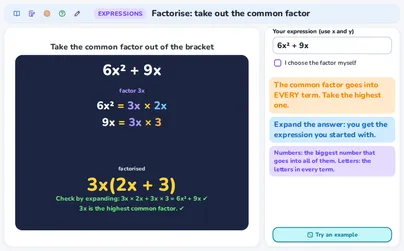
Find the highest number that goes into every number and the letters that are in every term. Divide each term by it and put it in front of the bracket.
3x2x36x²9x
Example
Factorise . The highest factor is :
2x2x54x²10x
Rule

Check by expanding

Expand your answer. You must get the expression you started with: 3(2x + 3) = 6x + 9.
32x36x9
Example
Is ? Expand the answer: ✔
32a56a15
Tip

Mental maths

A bracket makes difficult sums easy: 7 × 19 = 7(20 − 1) = 140 − 7 = 133.
7201191407
Example
Work out in your head:
610029860012
Watch out!

3(x + 4) is not 3x + 4

Multiply EVERY term. The 4 must be multiplied as well: 3 × 4 = 12.
3x43x12
Example
Expand :✘ ✔
5x25x10
Watch out!

Watch the minus

−2(x − 3) = −2x + 6, not −2x − 6: a minus times a minus is a plus.
−x−x✘−x−x✔
Example
Expand :✘ ✔
−x−x−x−x✘−x−x−x−x✔
Watch out!

Not fully factorised

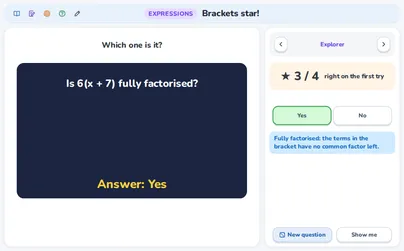
2(3x + 6) is not finished: 3x + 6 still has the common factor 3. Take out the highest factor at once: 6(x + 2).
23x66x126x26x12
Example
Factorise fully:✘ ✔
34x812x2412x212x24
Special case

Terms can cancel

After expanding, like terms can cancel: 2(x + 3) − 2x = 2x + 6 − 2x = 6.
6
Example
Simplify :
12
Special case

Only 1 is a common factor

When no number bigger than 1 goes into every term, as in 4x + 7, there is nothing to take out.
xxxx
Example
Factorise . The 5 does not go into 9.The only common factor is 1 → stays as it is
xxxxx54
Definition

Factors of a product of numbers

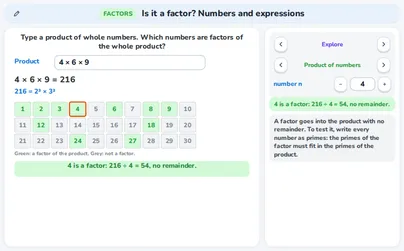
A number is a factor of a product when it goes into the product with no remainder. You do not have to work out the product: write each number as a product of primes. The primes of the factor must fit in the primes of the product, with no prime used more often than in the product.
Example
and . 8 is a factor, because fits and . 16 is not a factor, because needs the prime 2 four times and the product has it only three times; remainder 8. Of the numbers 2, 3, 4, 5, 6, 8, 9, 10 and 12, 7 are factors: 2, 3, 4, 6, 8, 9, 12.
Rule

Is it a factor of the expression? Divide every term

A number or an expression is a factor of an expression with several terms when it goes into every term. To test a candidate, divide every term by it: if every result is whole, it is a factor and the expression is the candidate times the sum of the results. Check by expanding the bracket: you must get the original expression back.
Example
Is 3 a factor of ? and : yes, and . Is 4 a factor? is not whole: no. The largest number that goes into both terms is 6, so ; expanding gives again. The expression is a factor of .

Exercises

Expand . Easy
3x4??
Show solution
Multiply the 3 with the :
3x43x?
Multiply the 3 with the 4:
3x43x12
Together:
Answer →
Check: for both give 18.
Expand . Medium
52x−332x??
Show solution
52x−332x10x?
52x−332x10x−1515
Together:
Answer →
Check: for both give 5.
Factorise . Medium
???6x9
Show solution
The highest number that goes into 6 and 9 is 3
Divide each term by 3: and
xxxxxx
Write 3 in front of a bracket:
32x36x9
Answer →
Check: .
Expand and simplify . Hard
3x2??4x−11x??
Show solution
and
xxxxxxx
The terms: . The numbers:
xxxxxxx
Together:
Answer →
Check: for both give 9.
Factorise fully. Hard
???6x²9x
Show solution
The highest number that goes into 6 and 9 is 3
The letter is in both terms, so take out as well: the factor is
Divide: and , so
3x2x36x²9x
Answer →
Check: and .
Are you a teacher?

Start live lessons with these applications for your whole class. Free to try for one month.

Try it free

Fits these school years

IB (MYP, Diploma): MYP 1, MYP 2, MYP 3, MYP 4

Cambridge International: Lower Secondary, stage 8, Lower Secondary, stage 9, IGCSE, Lower Secondary, stage 7

Netherlands: Groep 8, Year 1, Year 2, Havo · Mathematics A, Havo · Mathematics B, Vwo · Mathematics A, Vwo · Mathematics B, Vwo · Mathematics C, Year 3 (havo, vwo)

Türkiye (MEB): Year 7 (MEB), Year 8 (MEB), Year 9 (MEB), Year 6 (MEB)

England (GCSE, A Level): Year 8, Year 9, Year 10 (GCSE), Year 7

USA (Common Core): Grade 8, Algebra 1, Grade 6, Grade 7
What the applications of this topic teach 6 applications

Expand with tiles and areas

  • Seeing a bracket as a rectangle
  • Expanding a(bx + c) with tiles and areas
  • Knowing the outside number multiplies every term

Expand the brackets

  • Expanding a bracket with a number or x outside
  • Knowing a minus outside changes every sign
  • Expanding two brackets and collecting like terms

Factorise with a rectangle

  • Seeing factorising as making a rectangle
  • Knowing that the rows need the same tiles
  • Finding the highest common factor with tiles

Factorise: take out the common factor

  • Finding the highest common factor of the terms
  • Factorising an expression and checking by expanding
  • Knowing when an expression is fully factorised

Brackets in everyday life

  • Counting a situation in two ways
  • Seeing that a(b + c) and ab + ac give the same answer
  • Using a bracket for a mental sum

Is it a factor? Numbers and expressions

  • Deciding if a number is a factor of a product without multiplying
  • Factorising an expression like 6x + 12 with a bracket
  • Checking a factorised form by expanding