İnteraktif Dersler

Number and shape patterns

Lecture notes

Definition

A number pattern

A number pattern is a list of numbers that follows a rule. Every number is a term. The first number is term 1, the start.
371115…1234…n
Example
The pattern starts at 2.Term 1 is 2, term 4 is 11.
258111234n
Definition

The step

The step is the jump from one term to the next. Subtract two terms next to each other to find it.
371115+4+4+4
Example
In how big is the step? → step 7
5121926+7+7+7
Rule

An add pattern

Every term is the term before it plus the step. The numbers grow by the same amount.
7111519+4+4+4
Example
The pattern has step 5.Next term:
81318?+5+5+5
Rule

A subtract pattern

Every term is the term before it minus the step. The numbers get smaller by the same amount.
46434037−3−3−3
Example
The pattern goes down by 8.Next term:
605244?−8−8−8
Rule

A multiply pattern

Every term is the term before it times the same number. The numbers grow faster and faster.
261854×3×3×3
Example
The pattern doubles every time.Next term:
51020?×2×2×2
Rule

Jump ahead

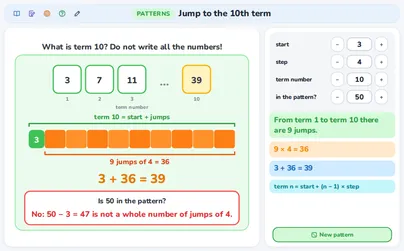
To reach term n you do not need every number: from term 1 there are n − 1 jumps. term n = start + (n − 1) × step.
371115…391234…10n9×4
Example
What is the 8th term of ?
5913…?123…8n7×4
Rule

Shape patterns

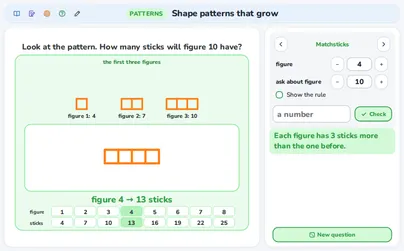
Count the pieces of the first figures, find how many more every figure has, then use the jumps. Matchsticks 4, 7, 10, 13 grow by 3, so figure n has 3 × n + 1.
1234471013+3+3+3
Example
Figures with 5, 8, 11 dots grow by 3, so figure n has .Figure 10: dots
1235811+3+3
Rule

Is a number in the pattern?

Take the start away and divide by the step. If you get a whole number of jumps, the number is in the pattern.
3711…51123…?n12×4
Example
Is 47 in ? jumps → yes, term 10
2712…47123…?n9×5
Tip

Look at the jumps first

Write the jump between every two numbers next to each other. If the jumps are the same, it is an add pattern.
591317+49−5+413−9+417−13
Example
In the jumps are the same: → next:
491419+59−4+514−9+519−14
Tip

Check with the first figures

Put figure 1 in your rule: it must give the number you counted.
1234710✔✔✔
Example
Rule: figure n has for 4, 6, 8. ✔ ✔ ✔
123468✔✔✔
Watch out!

n − 1 jumps, not n

To reach term 10 you make 9 jumps, not 10. (3 + 10 × 4 = 43 is wrong.)
3711151912345n1234
Example
Term 6 of ✘ ✔
4710131619123456n12345
Watch out!

Do not forget the start

The 10th term is the start plus the jumps. The jumps alone are not the term.
33639
Example
Term 5 of ✘ ✔
6814
Watch out!

Add or multiply?

2, 4, 6, 8 adds 2. But 2, 4, 8, 16 multiplies by 2. Look at the third term to see the difference.
2468+2+2+224816×2×2×2
Example
What comes after ?✘ ✔
36912+3+3+3✘361224×2×2×2✔
Special case

Jumps that change

Some patterns do not have the same jump every time. The square numbers 1, 4, 9, 16 have the jumps 3, 5, 7: the jumps grow.
14916+3+5+7
Example
The triangle numbers have growing jumps:
13610+2+3+4
Special case

Patterns in real life

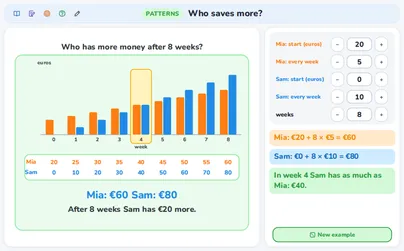
Saving 5 euros every week on top of 20 euros is an add pattern: the start is 20 and the step is 5.
0204060012345678
Example
A taxi costs €3 to start plus €2 per km: start 3, step 2.5 km: → €13
071430517293114135

Exercises

What is the next number in the pattern ? Easy
591317?12345n
Show solution
The jump:
591317?+4+4+4
59131721+4+4+4+4
Answer →
Check: the jumps are the same, so it is an add pattern.
What is the 10th term of ? Medium
371115…?1234…10n
Show solution
From term 1 to term 10 there are 9 jumps of 4:
371115…?1234…10n9×4
33639
Answer →
Check: term 5 is and .
Figure 1 has 4 matchsticks, figure 2 has 7 and figure 3 has 10. How many does figure 20 have? Medium
1234710
Show solution
Every figure has 3 more, so figure has
471013+3+3+3
6061
Answer →
Check figure 1: .
Is 102 a term of ? If yes, which term? Hard
7121722…1021234…?n
Show solution
795102
jumps: a whole number, so yes
71217…102123…?n19×5
The term number is
Answer → yes, term 20
Check: .

Interactive applications for this topic

Free applications open with a free student account. Teachers can use all applications in a live lesson.

About the free account and Plus

Are you a teacher?

Start live lessons with these applications for your whole class. Free to try for one month.

Try it free

Fits these school years

IB (MYP, Diploma): PYP

Cambridge International: Primary, stage 4, Primary, stage 5, Primary, stage 6, Lower Secondary, stage 7

Netherlands: Groep 5, Groep 6, Groep 7, Groep 8, Year 1, Vwo · Mathematics A, Vwo · Mathematics C

Türkiye (MEB): Year 5 (MEB), Year 6 (MEB)

England (GCSE, A Level): Year 4, Year 5, Year 6, Year 7

USA (Common Core): Grade 3, Grade 4, Grade 5

What the applications of this topic teach 4 applications

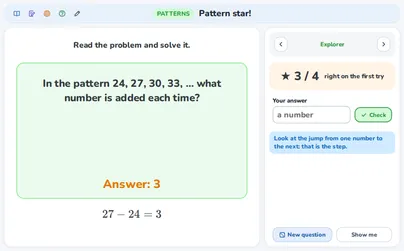
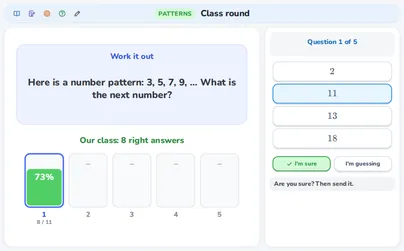
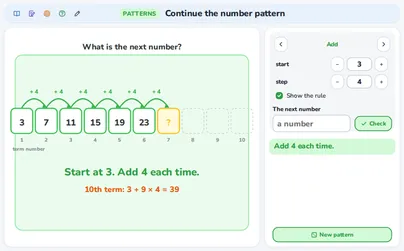
Continue the number pattern

  • Finding the rule of a number pattern
  • Continuing an add, a subtract and a multiply pattern
  • Finding the 10th term
  • Continuing a two-step pattern: 2, 12, 10, 20, 18, 28

Shape patterns that grow

  • Counting the pieces of the first figures of a shape pattern
  • Saying how many more every figure has
  • Finding a far figure with the rule

Jump to the 10th term

  • Finding term n of an add pattern without listing all
  • Knowing that from term 1 to term n there are n − 1 jumps
  • Telling if a number is in the pattern

Who saves more? Two savings patterns

  • Using an add pattern in real life: start + weeks × amount
  • Comparing two patterns
  • Finding when one amount catches up with the other