İnteraktif Dersler

Derivative toolkit and increment diagrams

Lecture notes

Definition

One derivative, three ways to write it

The derivative of is written or or : three notations for the same derivative function. The number is its value at : the slope of the tangent there. It is the limit of the difference quotients as .
Example
gives , so . The quotients at for , , and are , , and : they close in on .
Rule

The standard derivatives

Learn the standard derivatives: , , , , , and ( in radians). The power rule also covers roots and fractions: write and first.
Example
gives , so . A check with a small step: , close to the exact value .
Rule

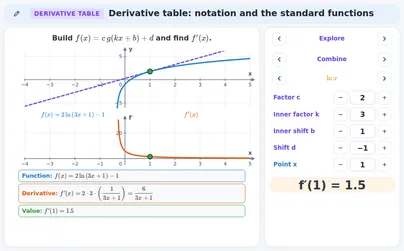
Combine: factor, inner function, shift

For the derivative is . The shift disappears, the factor stays and the factor of the inner function comes in front: take at , not at .
Example
has , and . So and .
Watch out!

Two slips with the table

A variable exponent is not the power rule: is not , the derivative of has the factor . Another slip is the sign: , not .
Example
at : the right value is . The slip gives .
Definition

The equation of the tangent

The tangent at goes through the point with slope : . Work it out to the form .
Example
at : and , so . The tangent is ; at it has the height .
xyA
Rule

A tangent with a given slope

To find the tangents with slope , solve : every solution is a point of tangency. If is a quadratic, there can be two points, so two tangents with the same slope.
Example
and : gives , so or . The points are and , the tangents are and .
xyAB
Definition

The tangent to a path

A point moves along , . Its velocity points along the tangent, so the slope is . If and the tangent is vertical; if both are there is no tangent line.
Example
, at : the point is and the velocity is . The slope is and the tangent is .
xyP
Definition

The second derivative

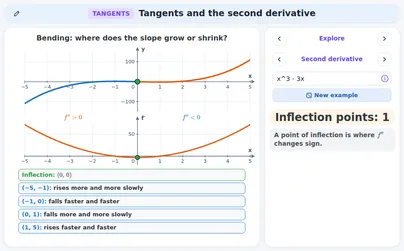
The second derivative is the derivative of , also written . The sign of says rising or falling; the sign of says whether the slope grows () or shrinks (). So and : rising faster and faster; and : rising more and more slowly; and the same for falling.
Example
gives and . At : and , rising faster and faster. At : and , rising more and more slowly.
Rule

The point of inflection

A point of inflection is a point of the graph where changes sign: the graph stops bending one way and bends the other way. Solve and look at the sign of on both sides of the solution.
Example
has at . goes from negative to positive there, so the point of inflection is . In the figure the blue part has and the orange part has .
xyI
Watch out!

is not enough

A point with is a point of inflection only when the sign of changes. A flat tangent () is not a point of inflection either: it is a maximum, a minimum or a flat passage.
Example
has . At it is , but and : no sign change, so no point of inflection. The tangent at is flat and the point is a minimum.
xyO
Definition

The increment diagram

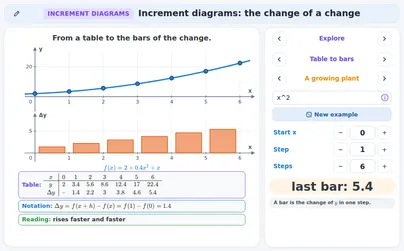
An increment diagram shows the change of in every step as a bar: . A bar above the axis is a rise, a bar below the axis is a fall. You can draw it from a table, from a formula or from a graph.
Example
A table gives , , , , at , , , , . The bars are , , and .
Δy+1+2+3+401234y235812Δy per step
Rule

Reading the bars

Compare neighbouring bars. Above the axis and growing: rises faster and faster; above the axis and shrinking: rises more and more slowly. Below the axis and longer: falls faster and faster; below the axis and shorter: falls more and more slowly. Equal bars: a straight line.
Example
, , , : the bars are , and . They are below the axis and get shorter, so falls more and more slowly.
Δy−3−2−10123y10754Δy per step
Rule

From the bars to the graph

To draw the graph from the bars, start at the start value and add every bar to the value before it: the graph is the running total of the bars. A bar of is a flat piece.
Example
Start value and bars , , , : the values are , , and .
Δy+2+2−1−301234y24652Δy per step
Definition

The average change

The average change on is : the slope of the line through the two points. The bars of the unit steps add up to , so the quotient is their sum divided by the width.
Example
on : . The unit bars are and , and .
Tip

Which kind of function?

Look at the bars of a table with equal steps. Equal bars: linear. Bars that grow by the same step: quadratic. Bars that grow by the same factor: exponential. Compare the bars with a difference and with a quotient.
Example
, , , has the bars , , . The quotients are and : the same factor, so exponential. The next bar is and the next value is .
Δy+2+4+80123y571119Δy per step
Tip

Using the applications

Every control works by keyboard: Tab goes to the next one, Enter (or a click) presses it, and the up and down arrow keys change the number in a box. Decimals can be typed with a point or a comma. Nothing you type or choose is sent anywhere. The items are original, we wrote them for these applications.
Example
For at the exact value is and the answer is asked to 2 decimals: type (a comma works too); an answer that is within of the true value counts.

Exercises

. What is ? Easy
Show solution
The power rule gives .
Put in : .
Answer →
Check → a step of gives the quotient , close to .
A table gives , , , at , , , . Draw the increment diagram and describe how changes. Easy
Δy+2+3+40123y35812Δy per step
Show solution
The bars are , and .
All bars are above the axis, so rises; the bars grow, so it rises faster and faster.
Answer → bars , , : rises faster and faster
Check → : the bars add up to the total change.
. Give the equation of the tangent at . Easy
Show solution
and , so .
The tangent is .
Answer →
Check → at the tangent gives , the value of there.
. What is ? Easy
Show solution
and the factor stays: .
.
Answer →
Check → rises at (the logarithm grows), so a positive slope fits.
. What is ? Round to 2 decimals. Medium
Show solution
, so .
.
Answer →
Check → the slip gives : much too big next to .
( in radians). What is ? Medium
Show solution
The inner function has derivative : .
.
Answer →
Check → near we have , a line of slope .
. A tangent of the graph has slope . Give its equation. Medium
Show solution
Solve : .
, so the tangent is .
Answer →
Check → at the line gives .
. Find the point of inflection. Medium
Show solution
and .
gives . is negative for and positive for : the sign changes.
.
Answer → the point of inflection is
Check → and : different signs on the two sides of .
. What is ? Hard
Show solution
The shift disappears. The inner function has derivative .
.
.
Answer →
Check → the factor of the inner function is easy to forget: without it you would get .
A point moves along , . When is the tangent horizontal, and when is it vertical? Hard
xyABC
Show solution
and .
Horizontal: gives or ; the points are and .
Vertical: gives (, not ); the point is and the tangent is the line .
Answer → horizontal at and , vertical at
Check → in the figure the flat tangents touch the loop at and , the vertical one at .
in steps of from . Find the bars, say by how much each bar is bigger than the one before, and give the next bar. Hard
Δy−1+1+3+501234y0−1038
Show solution
The values are , , , , .
The bars are , , and .
Each bar is bigger than the one before (, , , ), so the next bar is .
Answer → bars , , , ; each is bigger; the next bar is
Check → . The step is .
A savings account holds 200 euros and grows by 5% every year. What is the third yearly increase, in euros? Round to 2 decimals. Hard
Show solution
The first increase is 5% of 200: .
Every next increase is times the one before: and .
Rounded to 2 decimals: euros.
Answer → euros
Check → the balances are , and , and .
Are you a teacher?

Start live lessons with these applications for your whole class. Free to try for one month.

Try it free

Fits these school years

IB (MYP, Diploma): Diploma, year 1, Diploma, year 2, MYP 5

Cambridge International: IGCSE, AS Level, A Level

Netherlands: Havo · Mathematics B, Vwo · Mathematics A, Vwo · Mathematics B, Havo · Mathematics A

Türkiye (MEB): Year 12 (MEB), Year 11 (MEB)

England (GCSE, A Level): Year 12 (A Level), Year 13 (A Level), Year 11 (GCSE)

USA (Common Core): Algebra 2, Precalculus, Calculus, Algebra 1

What the applications of this topic teach 3 applications

Derivative table: notation and the standard functions

  • Writing the derivative of a function in four ways
  • Knowing the derivatives of xⁿ, eˣ, aˣ, ln x, sin x and cos x
  • Differentiating f(x) = c·g(kx + b) + d
  • Checking a derivative with a difference quotient

Tangents and the second derivative

  • Finding the equation of the tangent at a point
  • Finding tangents with a given slope
  • Using the sign of f″ for the bend and points of inflection

Increment diagrams: the change of a change

  • Drawing the increment diagram of a table, formula or graph
  • Building a graph from its bars
  • Working out the average change Δy/Δx on an interval
  • Telling linear, quadratic and exponential tables from the bars