İnteraktif Dersler
Lecture notes Exercises

Factors, multiples and primes

Lecture notes

Definition

Factor

A factor of a number goes into it without a remainder. If a × b = n, then a and b are factors of n.
5210
Example
: 3 and 4 are factors of 12
4312
Definition

Multiple

A multiple of a number is in its times table. A number is a multiple of each of its factors.
04812162024
Example
are multiples of 4: 12 is a multiple of 3 and of 4
0481216+4+4+4
Rule

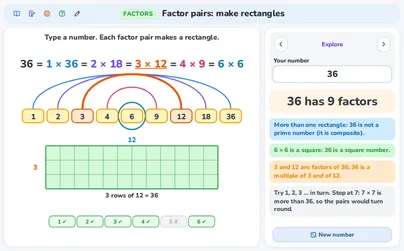
Factor pairs

Find all factors in a system: try 1, 2, 3 … and write the pairs. Stop when the pairs turn round.
136218312496
Example
1239466
Definition

Even and odd

An even number ends in 0, 2, 4, 6 or 8 and can be divided by 2. The others are odd.
1417
Example
: 14 is even17 is odd
Rule

Tests for 2, 5 and 10

Look at the last digit. Even: divisible by 2. 0 or 5: divisible by 5. 0: divisible by 10.
350
Example
350 ends in 0: divisible by 2, 5 and 10
Rule

Tests for 4 and 8

For 4 look at the last two digits, for 8 at the last three. If that number is divisible, so is the whole number.
3816163816816
Example
5724: , so 5724 is divisible by 4
572424
Rule

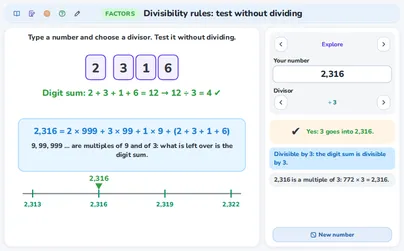
Tests for 3 and 9

Add the digits. If the digit sum is divisible by 3 (or by 9), the number is too.
6129
Example
4257: 18 is divisible by 9 and by 3
425718
Rule

Test for 6

A number is divisible by 6 if it is divisible by 2 AND by 3.
24810391561218×2×3
Example
5742: even,
574057395742×2×3
Tip

Why the tests work

10 is a multiple of 2 and 5, 100 of 4, 1000 of 8, so only the last digits count. 10 = 9 + 1, so a number and its digit sum leave the same remainder by 3 and 9.
3+4
Example
Tip

A missing digit

Add the digits you know, then find the digits that make the digit sum divisible. Every digit that works counts.
691215?=0?=3?=6?=94+?+2
Example
by 3: , so is 0, 3, 6 or 9
Rule

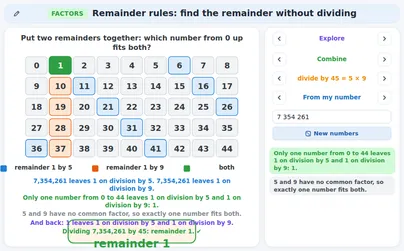
Remainders without dividing

The tests give the remainder too, not only yes or no. For 2, 5, 10, 4 and 8 the last digits leave the same remainder as the whole number. For 3 and 9 the digit sum does. For 6, 12, 30 and 45 combine the remainders by two coprime parts.
Example
4873 by 4: , remainder 14873 by 9: , remainder 4
Definition

Prime and composite

A prime number has exactly two factors: 1 and itself. A composite number has more. 1 is neither. 2 is the only even prime.
516132
Example
: prime: composite
719133
Rule

Sieve of Eratosthenes

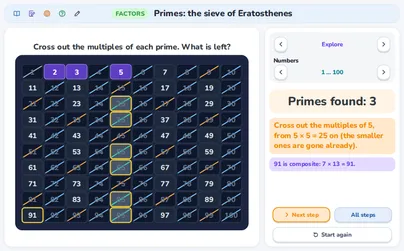
Cross out the multiples of each prime, starting at p × p. Stop when p × p is more than the last number. What is left is prime.
1234567891011121314151617181920212223242526272829303132333435363738394041424344454647484950
Example
Up to 50: cross out the multiples of 2, 3, 5, 7, : stop
1234567891011121314151617181920212223242526272829303132333435363738394041424344454647484950
Tip

Is it prime?

To test a number, try the primes up to its square root only. If none goes in, it is prime.
012345678√37
Example
91: try 2, 3, 5, 7: composite
02357911√9113791
Rule

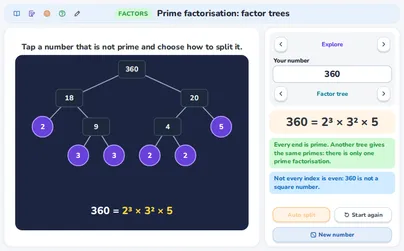
Factor tree

Split a number into a factor pair, and split every composite number again, until every end is prime. The primes are the prime factorisation.
22423624
Example
236251060
Special case

One answer

A different tree ends in the same primes, only in another order. Every number above 1 has exactly one prime factorisation.
236251060224351560
Example
Rule

Index form

Write equal primes as a power: 2 × 2 × 2 is 2³. The index says how many times the prime is there.
22232³3
Example
2223352³3²5
Rule

Use the factorisation

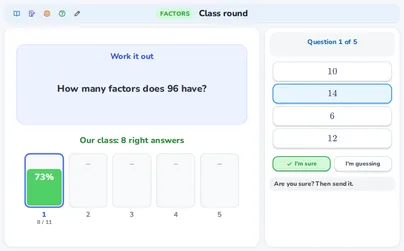
A number is a square if every index is even. Add 1 to every index and multiply: that is the number of factors.
66
Example
: a square, factors
136218312496
Definition

HCF

The highest common factor (HCF) is the biggest number that goes into both numbers.
83612124812
Example
12: 1, 2, 3, 4, 6, 1218: 1, 2, 3, 6, 9, 18HCF = 6
41291812361218
Definition

LCM

The lowest common multiple (LCM) is the smallest number that is a multiple of both numbers.
03569101215
Example
4: 4, 8, 126: 6, 12LCM = 12
046812161820
Rule

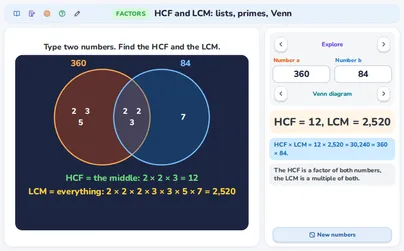
HCF and LCM with primes

Write both numbers as primes. In a Venn diagram the shared primes in the middle make the HCF. All the primes, shared ones once, make the LCM.
23252030
Example
and HCF LCM
23231218
Definition

Coprime

Two numbers are coprime if their HCF is 1. Then the LCM is their product.
3925101910
Example
8 and 15: HCF 1, LCM
24835151815
Rule

HCF × LCM

The HCF times the LCM is the same as the product of the two numbers.
122246424
Example
3662161812216
Tip

HCF or LCM?

Shared into the most equal groups, or the longest equal pieces: the HCF. Meeting again, or coming out even: the LCM.
128
Example
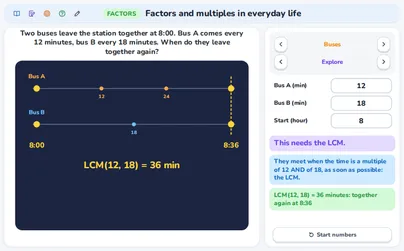
Floor 12 dm by 18 dm: tile 6 dm, tilesBuses every 4 and 6 min: together after 12 min
1812046812
Watch out!

Common mistakes

1 is not a prime. A number ending in 4 is not always divisible by 4. The LCM is not always the product.
Example
✘ 14 ends in 4, but leaves 2✘ , but the LCM of 4 and 6 is 12
3×4+204681216182024

Exercises

Find all the factors of 20. Easy
Show solution
Try 1, 2, 3 …: , ,
3 does not go into 20; after 4 the pairs turn round
12021045
Answer → 1, 2, 4, 5, 10, 20
A factor pair gives two factors at once.
Is 3516 divisible by 3? Easy
3516
Show solution
Digit sum:
351615
15 is divisible by 3
3516✔15
Answer → yes,
The digit sum 15 is not divisible by 9, so 9 does not go in.
Write 180 as a product of primes in index form. Medium
Show solution
2339182510180
Two 2s, two 3s, one 5
223352²3²5
Answer →
Check: .
Find the HCF and the LCM of 12 and 20. Medium
Show solution
and
Shared:
35221220
All:
35221220
Answer → HCF 4, LCM 60
Check: .
Two buses leave the station together at 9:00. One comes every 8 minutes, the other every 12 minutes. When do they leave together again? Hard
Show solution
Meeting again: the LCM
and : LCM
0812162432364048
24 minutes after 9:00
9:009:129:249:369:48
Answer → 9:24
The HCF 4 would be wrong: buses do not meet after 4 minutes.
A floor is 84 dm by 126 dm. It gets square tiles, all the same, without cutting. What is the biggest tile and how many are needed? Hard
126 dm84 dm
Show solution
The side goes into both: the HCF
and : HCF
126 dm84 dm42 dm
and : tiles
32123456
Answer → tile 42 dm, 6 tiles
The LCM would make a tile bigger than the floor.
What remainder does 4873 leave on division by 4 and by 9? Do not divide the whole number. Medium
Show solution
By 4 look at the last two digits: 73.
By 9 add the digits: and
Answer → remainder 1 by 4 and remainder 4 by 9
Check:
Are you a teacher?

Start live lessons with these applications for your whole class. Free to try for one month.

Try it free

Fits these school years

IB (MYP, Diploma): PYP, MYP 1, MYP 2, MYP 3

Cambridge International: Primary, stage 4, Primary, stage 5, Primary, stage 6, Lower Secondary, stage 7, Lower Secondary, stage 8, Lower Secondary, stage 9

Netherlands: Groep 6, Groep 7, Groep 8, Year 1, Year 2, Year 3 (havo, vwo)

Türkiye (MEB): Year 5 (MEB), Year 6 (MEB), Year 8 (MEB), Year 10 (MEB)

England (GCSE, A Level): Year 4, Year 5, Year 6, Year 7, Year 8, Year 9, Year 10 (GCSE)

USA (Common Core): Grade 4, Grade 6, Algebra 1

What the applications of this topic teach 8 applications

Factor pairs: make rectangles

  • Finding all the factors of a number systematically
  • Seeing a factor pair as a rectangle of squares
  • Knowing that a prime number has only one rectangle
  • Telling a factor from a multiple

Divisibility rules: test without dividing
  • Testing divisibility by 2, 5 and 10 with the last digit
  • Testing divisibility by 4 and 8 with the last two or three digits
  • Testing divisibility by 3 and 9 with the digit sum, and by 6
  • Finding a missing digit so that a number is divisible

Primes: the sieve of Eratosthenes

  • Telling prime and composite numbers apart: 1 is neither
  • Using the sieve of Eratosthenes to find the primes up to 100
  • Testing a number with the primes up to its square root

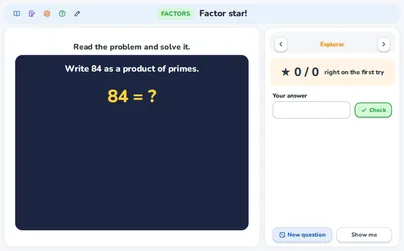
Prime factorisation: factor trees

  • Finding the prime factorisation with a factor tree or a ladder
  • Seeing that every number above 1 has exactly one prime factorisation
  • Writing a factorisation in index form: 360 = 2³ × 3² × 5
  • Using the factorisation to spot squares and count factors

HCF and LCM: lists, primes, Venn

  • Finding the HCF from lists of factors
  • Finding the LCM from lists of multiples
  • Finding the HCF and LCM from prime factorisations and a Venn diagram
  • Knowing that HCF × LCM = a × b for two numbers

Factors and multiples in everyday life

  • Using factor pairs to arrange things in equal rows
  • Using the HCF: biggest square tile, equal groups
  • Using the LCM: buses that meet again, packs that come out even
  • Deciding if a story needs factor pairs, the HCF or the LCM

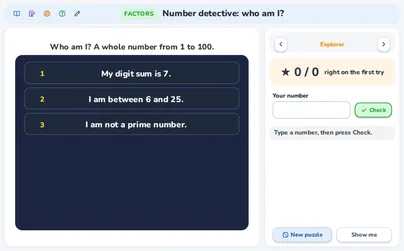
Number detective: who am I? (puzzles)

  • Using clues: even or odd, multiple of, between, factor of
  • Using divisibility tests and the digit sum
  • Using prime, square number and number-of-factors clues
  • Using the HCF or LCM with another number as a clue

Remainder rules: find the remainder without dividing

  • Finding the remainder by 2, 5, 10, 4 and 8 from the last digits
  • Finding the remainder by 3 and 9 from the digit sum
  • Combining remainders to find the remainder by 6, 12, 30 or 45
  • Testing a guess about remainders on many numbers