İnteraktif Dersler
Lecture notes Exercises

Real numbers: rational, irrational and intervals

Lecture notes

Definition

Rational number

A rational number can be written as a fraction of two whole numbers (q ≠ 0). Whole numbers, fractions and decimals that end or repeat are all rational.
01p/q
Example
Three rational numbers:
−4−201−31/33/4
Definition

Irrational number

An irrational number cannot be written as a fraction . Its decimal never ends and never repeats, so no calculator can show it completely.
11√2
Example
Two irrational numbers:
01234√2π
Definition

Real numbers

All rational and irrational numbers together are the real numbers . Each set sits inside the next one.
ℝℚℤℕ
Example
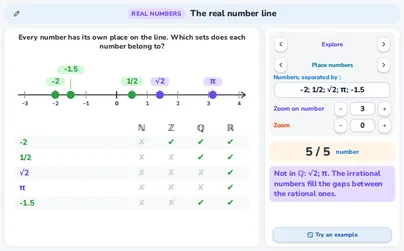
5 is in ℕ, ℤ, ℚ and ℝ. −2 is in ℤ, ℚ and ℝ. 3/4 is in ℚ and ℝ. √2 is in ℝ only.
ℝℚℤℕ5−23/4√2
Rule

Long division with remainders

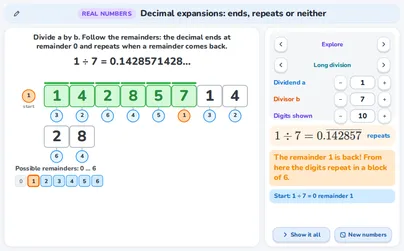
To turn a fraction into a decimal, divide the top by the bottom. After the point, put a 0 after each remainder (remainder × 10) and divide again. Every step gives one digit and a new remainder.
r×1010r÷bd
Example
3 ÷ 8:
3640375
Rule

Remainder 0: the decimal ends

When a remainder is 0, the division is finished and the decimal ends. A fraction in lowest terms ends exactly when its denominator has no prime factor except 2 and 5.
rr0dd
Example
40 = 2·2·2·5, so 3/40 ends:
330200075
Rule

A remainder comes back: the decimal repeats

There are only b possible remainders when you divide by b. So if the remainder never becomes 0, one of them must come back within b steps, and from there the digits repeat in a block.
abcd
Example
1 ÷ 7: the remainders are 3, 2, 6, 4, 5, 1. The remainder 1 is back at the start.
132645
Rule

Writing a repeating decimal

Put a bar over the repeating block, or write it between brackets after the point. The digits before the block are not under the bar.
041666
Example
1/6 and 1/12:
01666008333
Definition

The calculator shows a copy

A calculator shows about 10 digits and rounds the last one. Even √2 is shown as a rounded copy, never in full. To check a decimal you need the exact digits, or a square.
√2≈1.414213562
Example
The display 1.414213562 squared gives 1.99999999894…, not exactly 2.
1.414213562²1.999999999≠2✘
Rule

The decimal is the criterion

Look at the whole decimal expansion. If it ends, the number is rational. If it repeats, the number is rational. If it does neither, the number is irrational.,
Example
Three numbers:
Watch out!

22/7 is not π

3.14 and 22/7 are handy, but they are only close to π. Compare the digits: they differ from the third decimal place. 22/7 repeats, π never does.
3142822/731415π
Example
Compare:
314285722/73141592π
Watch out!

A rounded decimal is not the number

1.414 is a rational number, but √2 is not. Squaring shows it: the square of the rounded decimal is not exactly 2.
Example
Square the copy:
1.414²1.999396✘√2²2✔
Rule

Roots: square or not

The square root of a square number is a whole number, so it is rational. The square root of a whole number that is not a square number is irrational: it lies between two whole numbers and no fraction equals it.
5²n6²
Example
49 is a square, 50 is not:
7²508²
Rule

π is irrational

The circumference of a circle is . The number π is irrational: 3, 3.14 and 22/7 are only approximations, each better than the one before, but never exact.
dCddd
Example
A wheel with d = 10 cm:
1031.41591010101.4159
Rule

Many forms, one number

One number can be written as a fraction, a decimal, a percentage or with a root. A different form does not change whether it is rational.
12240.5
Example
All of these are the same rational number:
3861637.5%
Rule

Another form of the same root

A root can be written in another form. Take out a square factor: because 8 = 4 × 2. It is still the same irrational number, because a rational number times an irrational number is irrational.
√8√2√2
Example
√8 and 2√2:
2√2√2√2
Rule

Rational and rational

Add, subtract, multiply or divide two rational numbers (not dividing by 0) and the result is rational again.
Example
One third plus a half:
131256
Rule

Rational and irrational

A rational number plus an irrational number is irrational. A rational number (not 0) times an irrational number is irrational too.,
Example
Both are irrational:
0123+1√21+√20123×2√22√2
Special case

Irrational and irrational

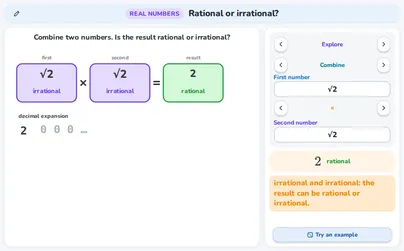
Two irrational numbers can give a rational result or an irrational one. You have to check each case.
Example
Four cases:
Watch out!

Zero is special

Zero times an irrational number is 0, and 0 is rational. That is why the rule needs the words “not 0”.
Example
Wrong → right:
Rule

Squeeze a root between decimals

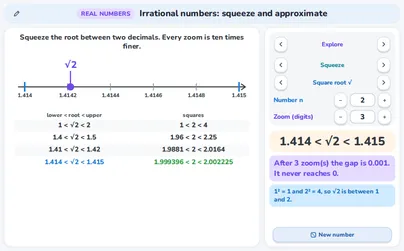
Square decimals until one square is just below and one just above the number. Each zoom is ten times finer and gives one more digit, but it never ends.
121.41.5√2×10
Example
Zoom on √2:
1.4²21.5²
Rule

Best fractions

A fraction can come very close to an irrational root. A bigger denominator gives a closer fraction, but never an equal one.
Example
Fractions near √2 = 1.41421…:
1.31.41.51.67/53/2√21.411.4217/12√2
Watch out!

Close is not equal

If p/q were exactly √2, then p² = 2q². But the difference p² − 2q² is never 0 for whole numbers, so no fraction is exactly √2.
Example
Even a very good fraction misses:
286287288289290289p²2882q²
Rule

The real number line

Every real number has exactly one point on the number line, and every point of the line is exactly one real number. Rational and irrational numbers both have their place.
−304x
Example
Where are −1.5, 3/4, √2 and π?
−2−101234−1.53/4√2π
Rule

Between two numbers

Between two different numbers there is always a rational number: take the middle. So rational numbers are packed together, and you can always go on.
ab(a+b)/2
Example
Between 1 and 2, then between 1 and 1.5:
11.52121.51.25
Rule

Gaps filled by irrational numbers

Rational numbers leave gaps, and the irrational numbers sit in them. Between two different numbers there is also always an irrational number. Take a rational step that is shorter than the distance, divided by √2:
(b−a)/√2abx
Example
Between 1 and 2:
11.521/√2121.7071
Definition

Interval

An interval is a stretch of the number line. It has a left end and a right end. A square bracket includes the end (a filled dot), a round bracket does not (a hollow dot).
ab
Example
The half-open interval [2, 5): 2, 2.5 and √5 are in, 5 is out.
1234562.5√5
Rule

Interval, inequality, line

An interval is the same as an inequality, and as a set. The sign ≤ goes with a square bracket, the sign < with a round one.
07252≤x<5
Example
Three ways to write the same thing:
0725[2,5)
Rule

Rays and infinity

An interval can go on for ever. The symbol ∞ is not a number, so its bracket is always round.
073[3,∞)
Example
Two rays:
−3131(−∞,1)0373[3,∞)
Watch out!

Square or round bracket?

[2, 5) and (2, 5] look alike but they are different. The bracket on the side of the end tells you if that end belongs to the interval.
07ab[a,b)07ab(a,b]
Example
Is 2 in? Is 5 in?
0725[2,5)0725(2,5]
Rule

Whole numbers inside an interval

Count the whole numbers between the ends and look at each end: it counts only if its bracket is square. An interval can also hold no whole number and still hold irrational numbers.
0123456
Example
Whole numbers inside:
012345601234560123√2
Rule

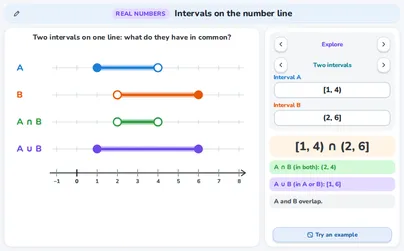
A ∩ B and A ∪ B

The common part A ∩ B holds the numbers that are in A and in B. The union A ∪ B holds the numbers that are in A or in B. Draw both intervals on one line.
ABA∩B048
Example
A = [1, 5] and B = (3, 8):
ABA∩BA∪B1358
Special case

Subset, overlap, gap

B ⊂ A means B lies completely inside A. Two intervals can overlap, touch in one number, touch without a common number, or leave a gap. A union with a gap is not one interval.
ABABABAB
Example
Four pairs:
2345123123123
Tip

Limits in everyday life

Rules with limits are intervals: “at least 120 and less than 195” is [120, 195). Check each end: is it allowed, or only approached? Then test a number by comparing it with both ends.
100200ab
Example
Is 195 allowed? Is 120?
100200120195
Tip

Choose the right test

Ask the questions in this order: does the decimal end? does it repeat? Yes to one of them means rational. For a root: is the number under it a square number? Then check the answer on the number line.
Example
√36, √20, 0.(7), π:

Exercises

Write 5/8 as a decimal. Does it end or repeat? Easy
Show solution
5240625
Answer → 0.625, it ends
The remainder 0 ends the division.
Does 7/20 end or repeat? Check the denominator first. Easy
Show solution
: only the primes 2 and 5
Answer → it ends: 0.35
A denominator with only 2s and 5s always gives a decimal that ends.
Which of √36, √20, 0.(7) and π are rational? Easy
Show solution
: a whole number
: is irrational
4²205²
: repeats
: never repeats
Answer → √36 and 0.(7)
Whole numbers and repeating decimals are rational.
Find the repeating block of 5/11. Medium
Show solution
The remainder 5 is back: the block is 45
56
Answer → 0.(45), a block of 2 digits
The first remainder that comes back closes the block.
Between which two decimals with 2 places does √5 lie? Medium
Show solution
, so √5 is between 2 and 3
2²53²
2.23²52.24²
Answer → 2.23 < √5 < 2.24
Zoom in one decimal place at a time.
Which of 2, 5 and √10 lie in the interval [2, 5)? Medium
Show solution
2: left end, square bracket → in
5: right end, round bracket → out
and → in
01234562√105
Answer → 2 and √10
The brackets decide for the ends.
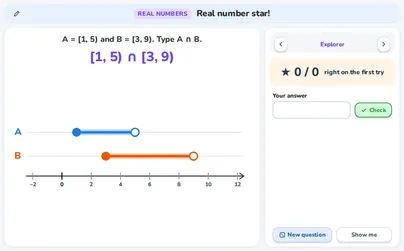
A = [1, 6) and B = (4, 9]. Find A ∩ B and A ∪ B. Medium
Show solution
Draw both on one line
Common part: from 4 (not in B) to 6 (not in A)
ABA∩B1469
Union: from 1 (in A) to 9 (in B)
ABA∪B1469
Answer → A ∩ B = (4, 6) and A ∪ B = [1, 9]
For ∩ both brackets must allow the end; for ∪ one is enough.
Is (1 + √3)(1 − √3) rational? And (1 + √3) + (1 − √3)? Hard
Show solution
Answer → both are rational (−2 and 2), although each part is irrational
Irrational numbers can cancel each other out.
Show with p² − 2q² that 17/12 is close to √2 but not equal to it. How big is the error? Hard
Show solution
, not 0
and
1.411.4217/12√2
error
Answer → p² − 2q² = 1 ≠ 0, error about 0.0025
If the fraction were exact, the difference would be 0.
Find an irrational number between 3 and 4, and a rational number between √2 and √3. Hard
Show solution
, so and is irrational
3²104²
and
1.41.61.8√21.5√3
Answer → √10 and 1.5
Many answers are right: check them against the squares.
How many whole numbers lie in [−2.5, 3)? Which of them lie in (−1, 3]? Hard
Show solution
Whole numbers from −2.5 up to but not including 3: −2, −1, 0, 1, 2
−3−2−101234−2.53
In (−1, 3]: 0, 1, 2 (and 3 is not in the first interval)
Answer → 5 whole numbers; 0, 1 and 2 are in both
List the whole numbers before you count.
Are you a teacher?

Start live lessons with these applications for your whole class. Free to try for one month.

Try it free

Fits these school years

IB (MYP, Diploma): MYP 2, MYP 3, MYP 4, MYP 5

Cambridge International: Lower Secondary, stage 7, Lower Secondary, stage 8, Lower Secondary, stage 9, IGCSE

Netherlands: Groep 8, Year 2, Vmbo bb (years 3-4), Vmbo kb (years 3-4), Vmbo gt (years 3-4), Havo · Mathematics A, Year 1, Year 3 (havo, vwo), Havo · Mathematics B

Türkiye (MEB): Year 7 (MEB), Year 8 (MEB), Year 9 (MEB)

England (GCSE, A Level): Year 7, Year 8, Year 9, Year 10 (GCSE)

USA (Common Core): Grade 7, Grade 8, Algebra 1

What the applications of this topic teach 6 applications

Decimal expansions: ends, repeats or neither

  • Turning a fraction into a decimal by long division
  • Using the remainders to see when a decimal ends or repeats
  • Telling ending, repeating and non-repeating decimals apart

Rational or irrational?

  • Deciding if a number is rational or irrational from its decimal
  • Seeing that ½, 2/4, 0.5 and 50% name the same rational number
  • Telling if a sum or product of two numbers is rational

Irrational numbers: squeeze and approximate

  • Squeezing √n or ∛n between two decimals
  • Zooming in on a root one digit at a time
  • Seeing that the digits of an irrational root never end
  • Finding fractions p/q close to an irrational root

The real number line

  • Placing rational and irrational numbers on the number line
  • Sorting numbers into ℕ, ℤ, ℚ and ℝ
  • Finding a rational and an irrational number between two numbers

Intervals on the number line

  • Writing open, closed and half-open intervals in three ways
  • Checking if a number lies in an interval
  • Finding the intersection and the union of two intervals

Real numbers in everyday life

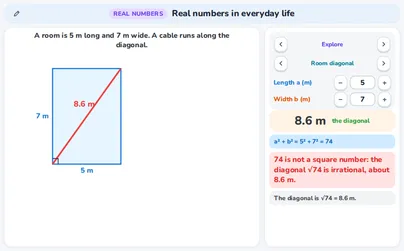
  • Finding √2 in paper sizes and room diagonals, and π in a wheel
  • Seeing why splitting a bill three ways gives a repeating decimal
  • Writing a rule with limits as an interval